Basics — Anatomy & the Core Strokes
Before any beat, you need clean strokes. Spend real time here; everything else is just combinations of these few sounds.
Anatomy of the madal
The madal has a head on each end, so one picture can’t show both clearly. Here they’re split: left (bass) and right (treble). “Bayan/Dayan” are generic drum terms; in Nepali the large left head is the pothi and the small right head is the bhale — the names used throughout this guide.
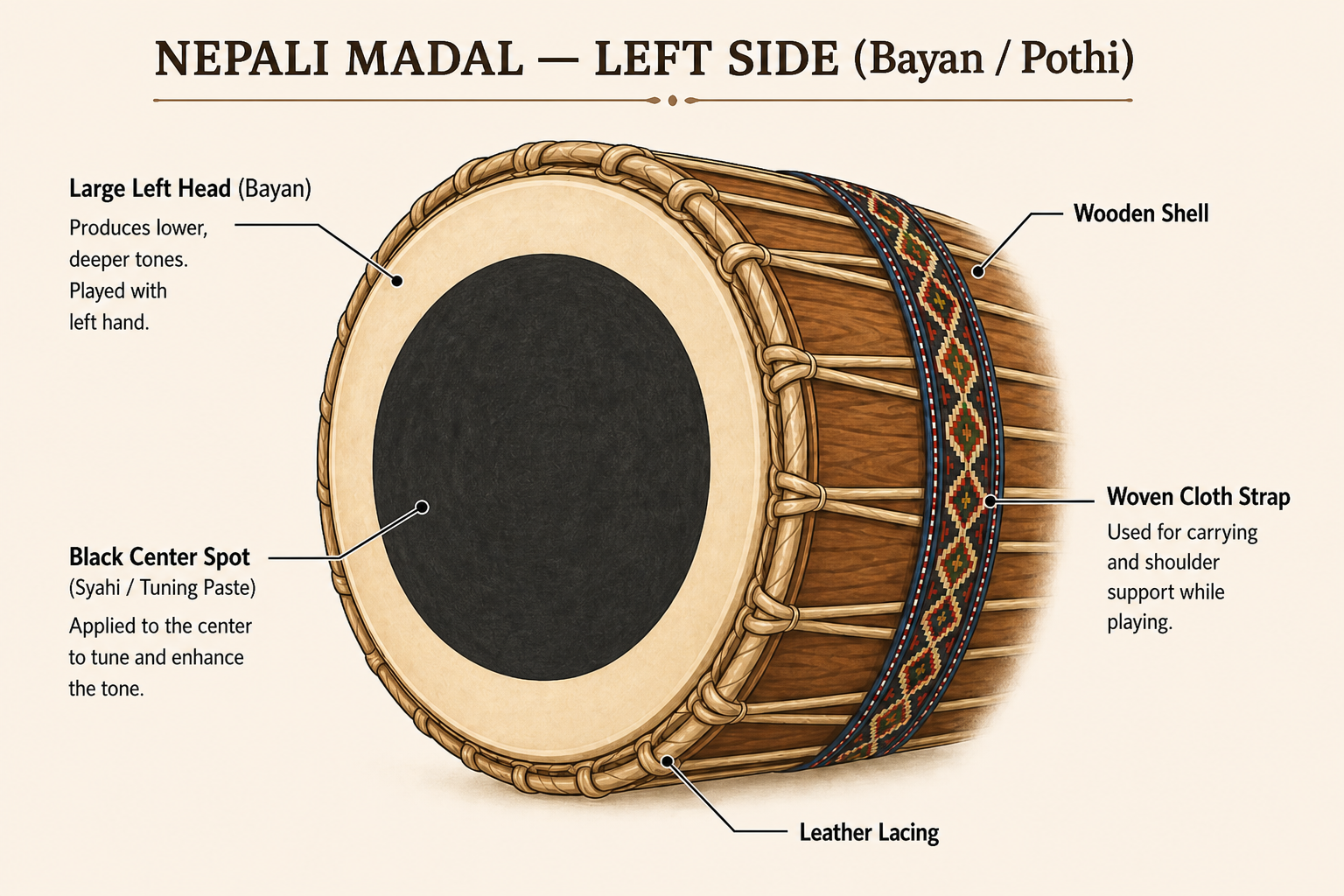
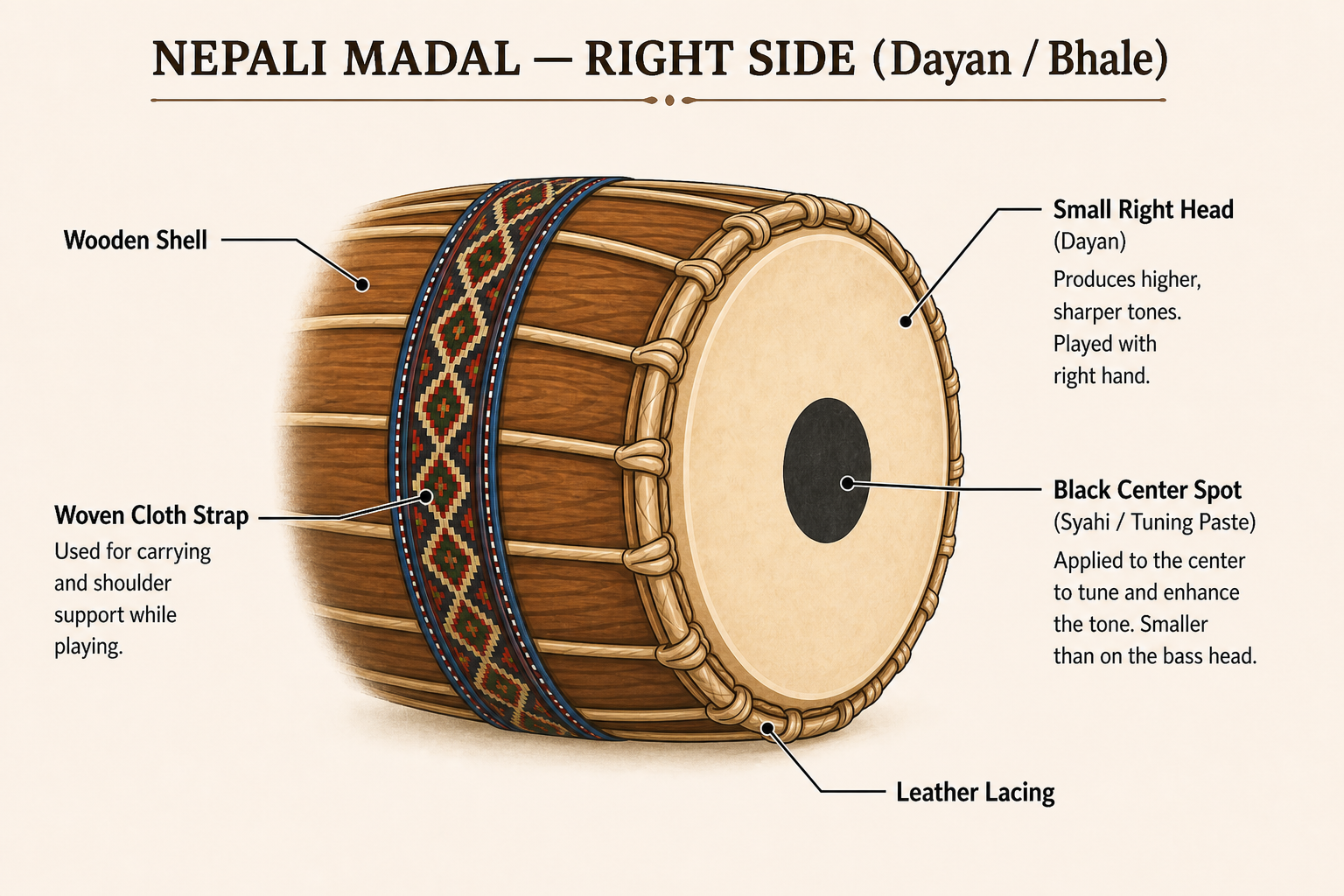
| Part | Nepali | Side | Sound |
|---|---|---|---|
| Higher-pitched (smaller) head | Bhale (भाले, “male”) | Your right | Sharp, high, cutting |
| Lower-pitched (larger) head | Pothi (पोथी, “female”) | Your left | Deep, round, bass |
| Black tuning paste (center spot) | Khari | Both | Where you strike for closed/tuned tones |
Posture
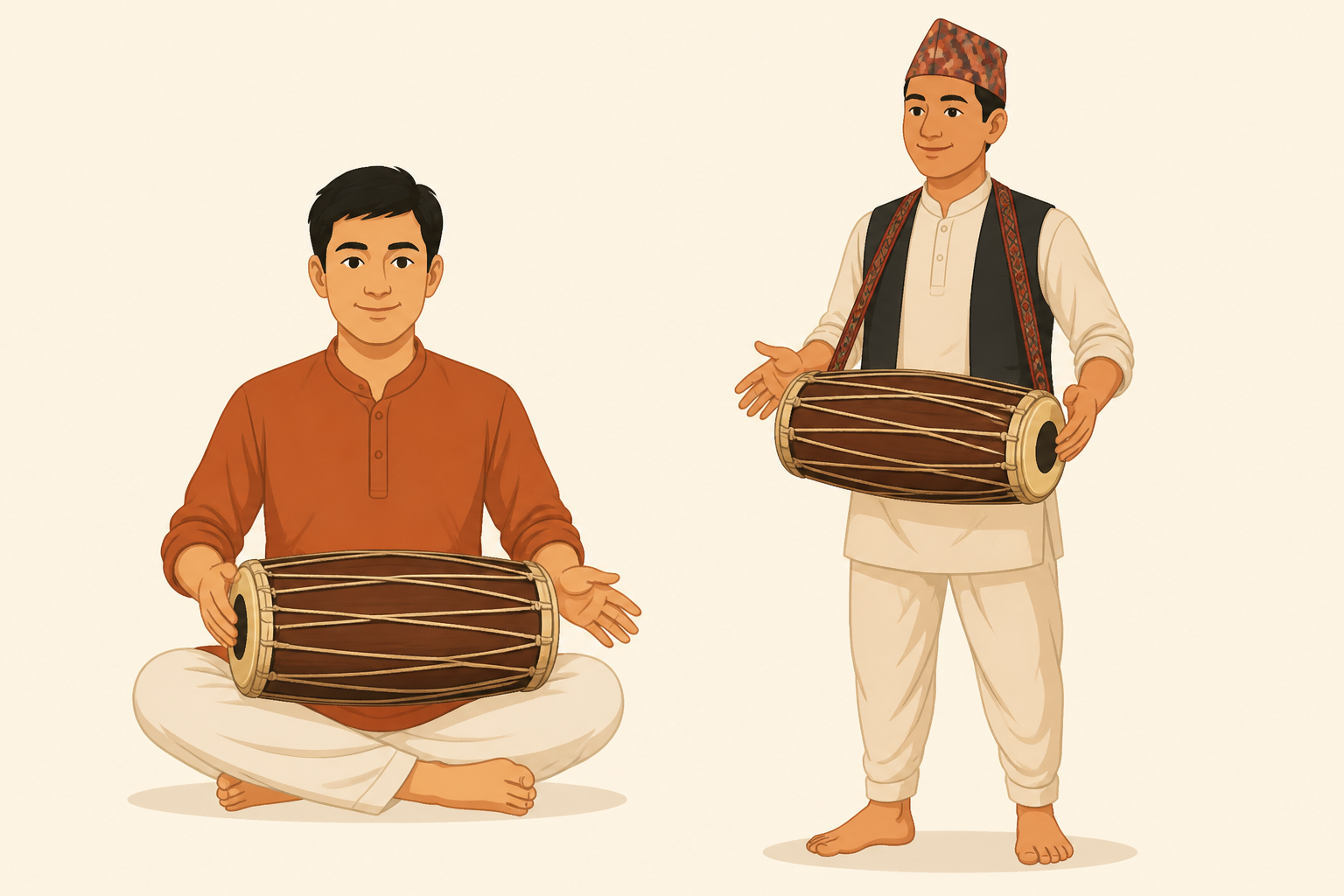
- Sitting: lay the madal horizontally across your lap, bhale (small head) to your right, pothi (big head) to your left.
- Standing: tie the strap around your waist so the drum sits horizontally in front of you, heads facing left/right.
- Shoulders relaxed, wrists loose. Sound comes from relaxed fingers bouncing off the head, not tense forearm hitting. If your hand hurts, you're hitting too hard.
The core strokes (bols)
A bol is a spoken syllable that names a stroke. You say them out loud while playing — this is how the whole tradition is taught and memorized. There are only five fundamentals.
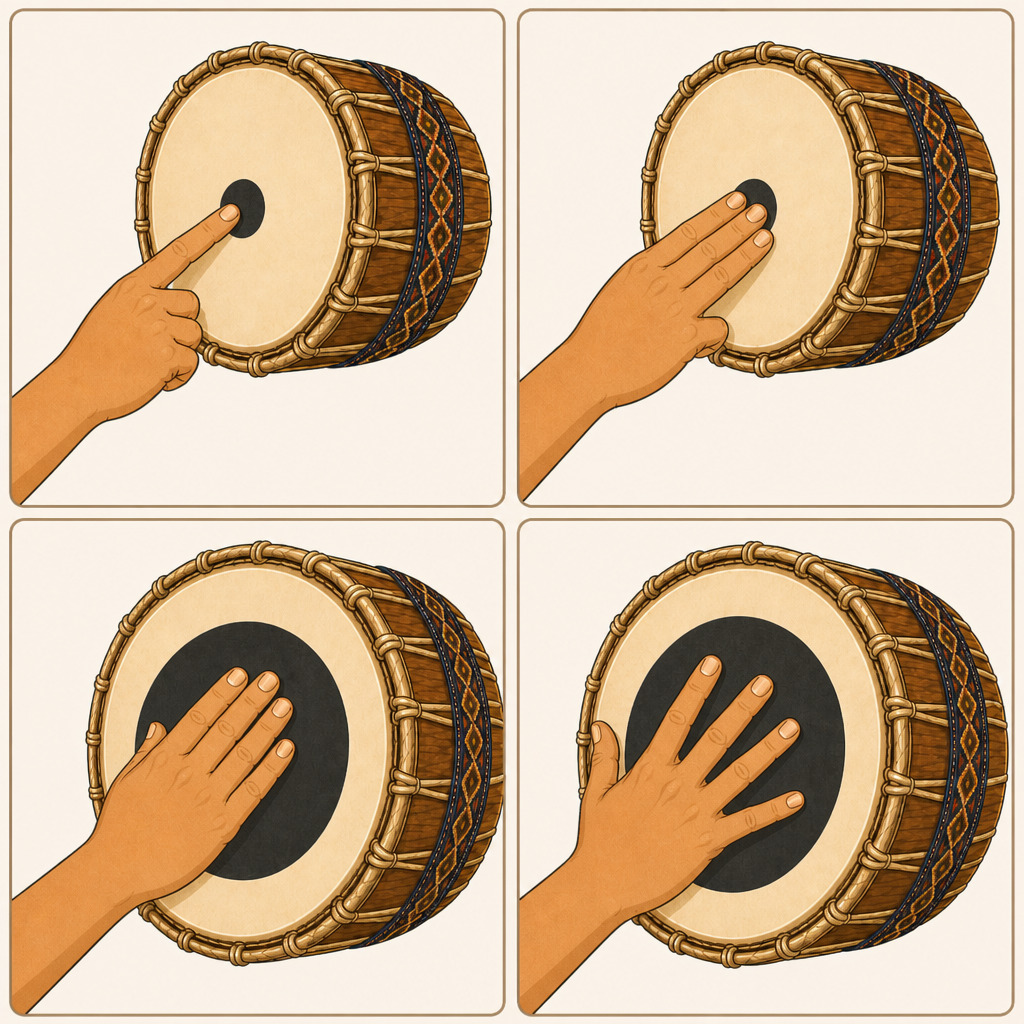
| Bol | Hand / head | How | Sound |
|---|---|---|---|
| Taang | Right · Bhale | Strike with your index finger near the edge, let it bounce — open | High, ringing “ting” |
| Taak | Right · Bhale | Middle + ring + little fingers strike the khari, held down — closed | Sharp, dry “tak” |
| Ghin | Left · Pothi | All fingers (not thumb) strike the head, let it ring — open | Deep, ringing “ghin” |
| Kha | Left · Pothi | Strike the khari with fingers pressed and held — closed | Short, damped “kha” |
| Dha | Both | Play Taang + Ghin at the same time | Full, resonant “home” sound |
Hear the five bols
Press ▶ to loop, or skip ahead to Drills when tone is consistent.
| 1 | 2 | 3 | 4 | 5 |
|---|---|---|---|---|
| Taang | Taak | Ghin | Kha | Dha |
Count it: strong and weak
Before the taals, the counting they all use. Each row is its own loop: press ▶ and play along. Dha (both hands) is the strong beat and Taang the weak one, and Ghin keeps the pulse. The Rhythm room explains each in The beat and the bar and Dividing the beat.
Pulse. One stroke to every beat, all the same. This is the clock the others sit on.
| 1 | 2 | 3 | 4 |
|---|---|---|---|
| Ghin | Ghin | Ghin | Ghin |
March, two to the bar. Strong, weak. The strong beat is Dha, with both hands.
| 1 | 2 |
|---|---|
| Dha | Taang |
Four to the bar. One strong beat, then three weak. Say it: one-two-three-four.
| 1 | 2 | 3 | 4 |
|---|---|---|---|
| Dha | Taang | Taang | Taang |
Eighths. Two strokes to each beat: the beat, then the half-beat between.
| 1 | & | 2 | & |
|---|---|---|---|
| Dha | Taang | Dha | Taang |
Sixteenths. Four strokes to each beat. Keep the three weak ones even and light.
| 1 | e | & | a | 2 | e | & | a |
|---|---|---|---|---|---|---|---|
| Dha | Taang | Taang | Taang | Dha | Taang | Taang | Taang |
Gallop. Long, rest, short, short on every beat: dah, da-da.
| 1 | e | & | a | 1 | e | & | a | 1 | e | & | a | 1 | e | & | a |
|---|---|---|---|---|---|---|---|---|---|---|---|---|---|---|---|
| Dha | – | Taang | Taang | Dha | – | Taang | Taang | Dha | – | Taang | Taang | Dha | – | Taang | Taang |
Quick self-check
Before moving on, you should be able to play each of these with a relaxed hand and consistent tone:
- 10 clean Taang in a row
- 10 clean Taak in a row
- 10 clean Ghin in a row
- 10 clean Kha in a row
- Smooth Ghin–Taang alternation
- A solid Dha with both heads landing exactly together
Notation key
Beats are shown as a grid — read left to right, then loop back to the start. Each cell is one sub-beat.
- – means rest / let the previous sound ring.
- The sam (beat 1, the most important landing point) is marked with a red top-line.
- Different teachers use slightly different syllables (Ta/Taang, Ti/Taak/Na, Ge/Ghin, Ke/Kha, Dha/Dhang). Pick one set and stay consistent — this guide uses Taang / Taak / Ghin / Kha / Dha.