Household stories / Ghosts
Ghosts, Monsters, and the Snow Bear (भूत, प्रेत, राक्षस र हिममानव)
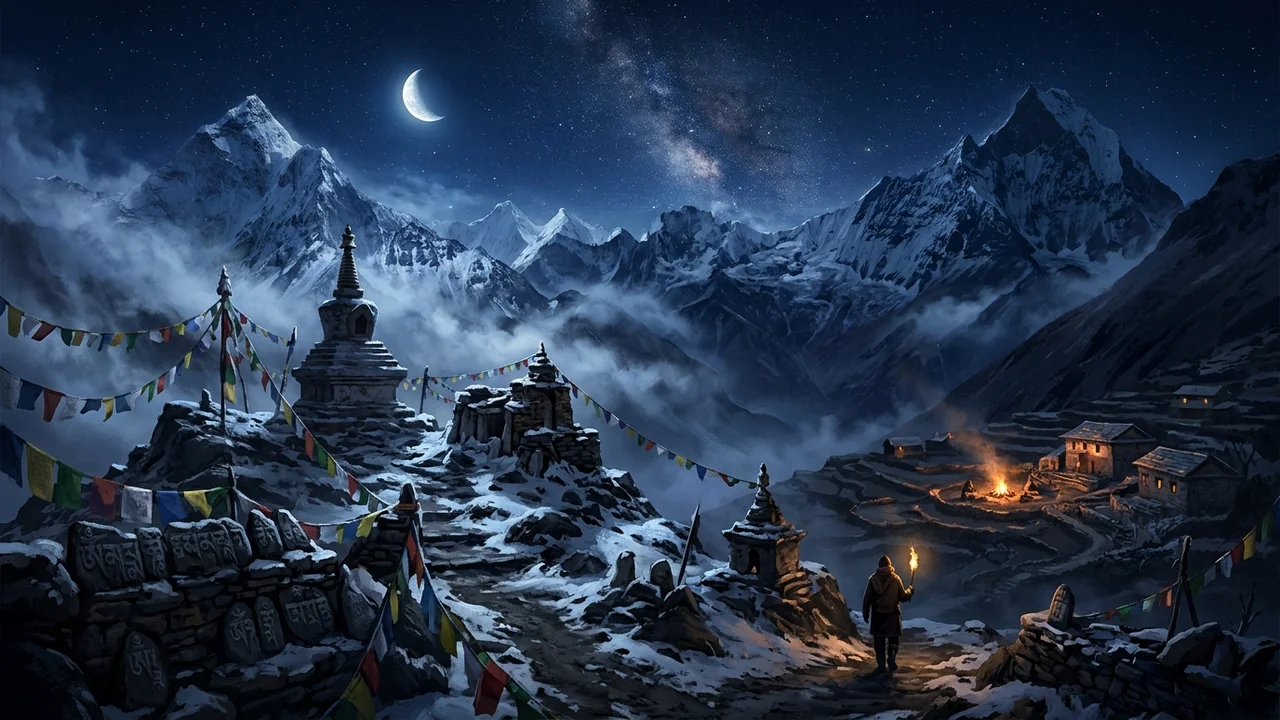
Yeh-Teh (གཡའ་དྲེད) means a bear of the rocks. Yeh means the loose rock and the cliff. Teh means the bear. People in the high mountains use this name for three animals. Each animal lives on a different kind of ground. Later, English posters used the title Abominable Snowman. Those posters put the three animals into one monster. The three kinds come next.
1. The yeti (येती)
The big one is the Dzu-Teh (རྫུ་དྲེད). People also call him the yak-killer. They say he is eight or nine feet tall. His hair is yellowish-black or red-brown. It is long and thick. He usually walks on four legs. He stands up to meet a line of yaks carrying loads. He also stands up at a herder's stone hut.
The Thel-Teh (ཐེལ་དྲེད) is smaller. People say he is four or five feet tall. His hair is red-brown. He jumps among birch and juniper trees near the snow. Birch and juniper are mountain trees. The cry they talk about is a high whistle. It sounds like a bird.
The Mi-Teh (མི་དྲེད) walks on two feet. His skull comes to a point on top. A ridge of bone runs along the top of his head. His hair is dark red and tangled. His face is flat. He leaves one line of huge footprints in the hard snow.
People say the feet point backward. The heels face forward. The toes face back. If you follow the prints, the path leads to a cliff edge. A lost person may notice this too late.
People say a long whistle crosses a mountain pass hours before a bad storm. The storm may be a blizzard or an avalanche. An avalanche is a big slide of snow. Herders tell children another saying. If it chases you, run only downhill. They say the long hair on its chest falls over its eyes on the way down. Then the animal falls in the snow.
Herders tell one story. Followers of Nyingma tell another. Nyingma is a school of Tibetan Buddhism. When Guru Padmasambhava came into these mountains, he bound the fierce spirits with an oath. That oath is called damcan. The spirits had to watch the hidden valleys through a dark age. A dark age here is a long hard time. The hidden valleys are called beyul (बेयुल). In that story, the yeti stands on that border and watches.
The monasteries at Khumjung and Pangboche kept scalps and hands for a long time. People called them yeti scalps and yeti hands for as long as the monasteries held them.
In 2017, Charlotte Lindqvist's study looked at nine samples. A sample is a small piece kept for study. People had offered those samples as yeti. Eight of the nine were bears. They were the Himalayan brown bear or the Asian black bear. Scientists call the brown bear Ursus arctos isabellinus. They call the black bear Ursus thibetanus. The Himalayan brown bear's ancestors split off from other brown bears long ago. That time is called the Pleistocene. It was an old ice age. People still tell the story of the footprints.
2. Kichkandi (किचकन्नी)
The name a house says is kichkandi. People write it किचकन्नी, and also किच्कन्डी. The dictionary's main spelling is किचकन्या. The dictionary entry for किचकन्नी points to that spelling. All three spellings name one spirit.
She is a girl who died before her time. The stories name three causes. They are suicide, murder, or death in childbirth. The funeral rites were left unfinished. Those rites are called kriyā. People meet her late at night. One place is a hanging bridge. One is a burning ground, where dead bodies are burned. One is a resting platform under a banyan tree. That platform is called a cautārī (चौतारी). One is a sharp turn in the road with no house nearby.
To a man walking alone, she looks beautiful. She is dressed in red or in white. She wears glass bangles on her wrists. She smells like flowers. She walks beside him and talks. People say to look at her feet. The feet point backward. She has no shadow.
In the stories, he is at the edge of the trees by morning. He has a fever. His strength is gone. The stories call that strength ojas. This page does not give the steps.
3. Rā̃ke (राँके)
A flame keeps moving from place to place. People see it on a muddy bank, in a bog, or in a sal forest. A bog is soft wet ground. Sal is a tall forest tree. The flame is called Rā̃ke. A rā̃ko (राँको) is a torch. This flame is blue or deep red, and it jumps. It goes out in one clump of bushes. It lights again about fifty steps away.
It spoils a person's sense of direction. It can do that without touching the person. The walker goes in circles. He ends up in a swamp and in thorny bushes. This lasts until a cock crows. By then, fog from the river covers the ground.
A chemistry book calls the light marsh gas. Marsh gas is gas that rises from wet ground. People on the road call it a soul. They say the soul still carries the fire that burned its body. People say both. A person walking home still has to choose one.
4. Murkaṭṭā (मुरकट्टा)
The night walker of the Tarai has no head. The Tarai is the flat land in the south of Nepal. His name is Murkaṭṭā. People say the name means a head that was cut off. Muro means the head. It was cut away. He died by that cut, in a battle or in a crime. He walks at midnight in winter fields of sugarcane and mustard. His eyes and his mouth are on his chest. He is fast. A traveler may hear an ox-cart chain behind him. Or the traveler may hear only breathing.
People say iron bothers him. They say a holy fire bothers him too. This page does not give the steps.
5. Gurumāpā (गुरुमापा)
Gurumāpā took children from the courtyards, and he ate them. In the story this page tells, Kathmandu gave a feast. It also gave him a new place to live.
The man in this story is Keśacandra (केशचन्द्र). He was a merchant who had lost his money by gambling. The story says pigeons brought him gold. At Itum Bāhāḥ, a courtyard in Kathmandu, he offered a bargain. Once a year the city would set out rice and a buffalo. Gurumāpā would leave the lanes for Tuṇḍikhel (टुँडिखेल). Tuṇḍikhel is the big open field. He would leave the children alone. He agreed. This page does not give the steps. It does not say how the man faced him.
The horse page says that other people name a different man. The danger stays the same. The horses stay the same. On the new moon that ends the month of Chaitra, after Rāma Navamī, the horses gallop at Tuṇḍikhel. That day is Ghode Jātrā. The horses run so Gurumāpā stays under the ground.
6. Majipā Lākhe (मजिपा लाखे)
A lākhe has red eyes. He has long teeth like a wild pig's. He has long red and black hair. Majipā's lākhe is that same demon after the city let him stay.
He lived in the forest around the valley. He fell in love with a Newar girl from Majipā. He put on human clothes. He came through the city gate at night. The town found him. They caught him and took him to the king. He had harmed no one. He had come because of love. The king in the story accepted that. The lākhe could stay inside the city walls. He had to keep the children safe from sickness. He had to keep them safe from other spirits.
At Indra Jātrā he comes out. Drums called dhimay (धिमे) go with him. He dances. He chases a boy named Jhyālinchā (झ्याँलिन्चा). The boy is there to tease him and to be chased. Children watch from carved windows. The dancer is frightening to see. Those children are the ones he promised to protect.
7. Bokṣī (बोक्सी)
A bokṣī (बोक्सी) is a living woman the village fears. Often she is the neighbor. The lane puts that name on her. In the morning she is still in the house next door.
The house says she goes out after the doors are shut. One story gives her a black cat. Another story gives her a screech owl, a bird that cries at night. Another story gives her a small light. A child may cry all night. A cow's milk may stop. A person may get sick, and nobody can find an ordinary cause. The house says these things come from her look. That look is called āṅkhā lāgnu (आँखा लाग्नु). The words mean her eyes have fallen on someone.
People talk about her most on the year's dark nights. Those nights are Kuśe Auṃsī, Gathemangal, and a new moon. They name a place where two rivers meet. That place is a dobhān (दोभान). Or they name a crossroads. That place is a cābāṭo (चबाटो).
A child may see a dark mark behind a baby's ear. A child may see a small piece of iron kept on the body. If the fear stays, the house calls a dhāmī or a jhāṅkrī (धामी, झाँक्री). That person is a healer who works with spirits. The lane calls that work ṭūnā-mūnā (टुनामुना). This page does not give the steps. It does not teach the harm or the cure.
Ḍākinī (डाकिनी) is a different word. Tantra is a religious teaching. Tantra and the big monasteries use Ḍākinī for a fierce woman in their own stories. Sometimes a person in the hills puts that name next to bokṣī. This page keeps the two words apart. Kichkandi, in the section above, is already dead. A bokṣī is still alive in the village.
8. Khāyā (खाया)
Newar houses have a name for a weight that sits on the chest during sleep. The name is Khāyā (खाया). This page also writes Bhuñjā (भुञ्जा) next to that name. In Nepali, the pressing is called āi-thān (ऐँठन).
People say it comes through the crack of a locked door. It holds the arms and the legs down. The person cannot describe a face. Breathing is hard. The person cannot cry out. The person is awake the whole time. In the morning the weight is gone.
Some people mention iron, or a pinch of salt, under the pillow. This page does not give the steps.
9. The burning ground (मसान)
A masān (मसान) is a burning ground, usually on a riverbank. Ghāṭ is the other word for that same bank. Shamans talk about a fierce spirit that stays in the fire where the dead are burned. A shaman is a healer who works with spirits. They call that spirit a bīr (वीर). In the story, a master can bind one as a servant. If the spirit is made angry, it goes after farm animals. It also goes after a person's mind. This page does not give the steps.
Kaṅkāla (कङ्काल)
Kaṅkāla is the ordinary word for a skeleton. The word is the same in Sanskrit and in Nepali. In the stories, the skeleton stands up. The skeletons rattle through the hot coals at midnight. They follow Bhairava and Mahākālī. People talk about a bare white skeleton in the bamboo by the river. That bamboo grove is called bā̃sghārī (बाँसघारी). They say the time is about two in the morning. They say it is a sign of a bad illness, or of harmful spells.
Kawañ (कवं)
The valley tells these two spirits as a pair. Khyāḥ (ख्याः) is plump, hairy, and short. He is a goblin of the house. He might bring wealth. Or he might only spoil a night's sleep. Kawañ (कवं) is the other one. He is made of bone. He grins.
Kawañ goes with the eight mother goddesses. They are called the Aṣṭamātṛkā. He also goes with Bhairava. At Indra Jātrā, the dancers go into the street in white that looks like bone. They also dance at Naradevī, where Śvetakālī is kept. The dance is called Kawañ Pyākhan (कवं प्याखं). The clubs are made to look like bone. The city holds the dance to protect people from a spreading sickness and from bad signs. This page does not give the steps.
Citipati (चितिपती)
The pair that the big monasteries dance are the Citipati. They are the lords of the funeral fire. In Sanskrit the name is Cītīpati. In Tibetan the name is Dur-khrod bdag-po.
Two ascetics were meditating in a cemetery. An ascetic is a person who has left ordinary life to meditate. One was a yogi, a man who meditates. The other was a yoginī, a woman who meditates. A thief cut off their heads. The meditation kept going. Later they found out they were bone. The story says that finding was their awakening. Awakening means they finally understood. They saw emptiness. Emptiness here means a body does not last. They stayed as the lords of that ground.
Lamas dance them in Mustang, at Mani Rimdu in Tengboche, and in Ladakh. A lama is a monk in that tradition. The masks are grinning skulls. The dancers carry a bone staff. It is called the kankāla-daṇḍa. They carry a skull bowl. It is called the kapāla. The masks remind people that flesh does not last.
Masāne sukās (मसाने सुकास)
In the hills, people call a wasting illness masāne sukās (मसाने सुकास). A wasting illness makes the body shrink. They also say masān lāgnu. They say an unsettled spirit from the burning ground catches a living person. The flesh falls away. Skin lies on the ribs and the spine. The person is still alive. This page does not give the steps.
10. The pherī (फेरी)
On some dark nights, a horn wakes the house.
The horn belongs to two times of the year. One is the dark half of the month of Kartik, when Tihar is starting. The dark half is the two weeks when the moon is shrinking. The other is the dark half of the month of Chaitra. Chaite Dashain also falls in Chaitra. It falls on the bright eighth of Chaitra. The bright half is the two weeks when the moon is growing. It is the goddess's spring Navarātri. It is the day before Rāma Navamī. Many families also say it remembers Rāma's victory. Autumn Dashain falls in the month of Ashoj. That is a different month. In this story, the horn belongs to the dark nights.
The man outside is a Kāpālī jogī, a wandering holy man. People also call him Darśanadhārī or Kānphaṭā. He follows the tradition of Gorakhnāth. The horn is called the pherī (फेरी), or the śṛṅgī (शृङ्गी). People say it is a human thighbone. Or they say it is the hollow black antler of a male deer. Silver or copper wire is wrapped around it. From midnight until the hours before dawn, the house hears a low wail. The sound is long. It moves along the outside wall. The dogs have gone quiet. People lie under quilts.
The door stays shut. The windows stay shut. People believe something moves through the courtyard with the horn. They believe it will come inside if the door opens. The people in the house listen. They stay back from the door and the windows.
He comes back in the daylight. He wears saffron cloth, which is orange-yellow. He wears large round earrings. He carries a cloth bag. Then the door opens. A gift is carried on a flat bamboo tray used to toss grain. The tray is called a nāṅglo (नाङ्लो). This page does not give the steps. The blessing he speaks is asked in Gorakhnāth's name.
11. Van-Jhāṅkrī (वन-झाँक्री)
Tamang, Rai, Limbu, Gurung, and Magar stories name one teacher of the dhāmī-jhāṅkrī. He is the Van-Jhāṅkrī (वन-झाँक्री), the shaman of the forest. A shaman is a healer who works with spirits. He is about three feet tall. His hair is fine. It is gold or red-brown. It is twisted into thick locks. His feet point backward.
He takes children. The usual story says the children are boys from eight to twelve years old. People say those boys carry a mark. A boy is out with goats, or looking for firewood, near a cliff. The Van-Jhāṅkrī carries him to a cave behind a waterfall.
The food in the cave is roots, yellow earth, and wild worms. If the boy cries, he is left at the edge of the forest. If he asks for salt and cooked grain, he is left there too. That boy is the wrong one. If he stays, he is taught the drum. The drum is called a dhyāṅgro (ढ्याङ्ग्रो). It has deer hide on both sides. He is taught how to set bones. He is taught the plants of these mountains. He is taught the speech of the spirits who live there.
The danger in the cave is the shaman's wife. She is the Van-Jhāṅkrīnī (वन-झाँक्रिनी). She wants human flesh. Her breasts are long enough to throw back over her shoulders. He hides the boy behind his own back. Or he hides the boy in a crack in the rock. He hides him until the teaching is finished.
Weeks later, or months later, the village has already held the funeral. The boy comes back to the line where the trees end. He has a drum and a handful of leaves. For a while he cannot speak ordinary words. Then the village has its jhāṅkrī.
12. The kāṅgliṅ (काङलिङ)
In Dolpo and in Mustang, a practice called Chöd (छोद्) uses a trumpet made from a thighbone. The trumpet is the kāṅgliṅ (काङलिङ, རྐང་གླིང). The old accounts are strict about which bone is used. One bone comes from a person who died in old age. One comes from a virtuous maiden, a good young woman. One comes from a realized yogi, a yogi who has finished the path. Later the bone is bound in leather and silver.
At night, a person who does this practice blows the trumpet. The place is a ground where vultures take the dead. The sound is for fierce gods. It is also for hungry ghosts, ghosts who are always hungry. It is also for the demons of the mountain. In the meditation that goes with the horn, the person offers their own body as food to those beings. This page does not give the steps. The other vessel of that same night is a skull bowl. It is called the kapāla (कपाल). This page only names it.
नेपालीमा
-
ये-ते भनेको चट्टानको भालु हो। ये खुकुलो ढुङ्गा र भीर हो। ते भालु हो। उच्च हिमालका मानिसले यो नाम तीन जनावरलाई दिन्छन्। हरेक जनावरको जमिन फरक छ। पछि अङ्ग्रेजी पोस्टरले अबोमिनेबल स्नोम्यान भने। ती पोस्टरले तीन जनावरलाई एउटै राक्षस बनाए। तीन किसिम अब आउँछन्।
ठूलो जु-ते हो। मानिसले उसलाई याक मार्ने पनि भन्छन्। उचाइ आठ वा नौ फिट भनिन्छ। रौं पहेँलो-कालो वा रातो-खैरो हुन्छ। रौं लामो र बाक्लो हुन्छ। ऊ प्रायः चार खुट्टामा हिँड्छ। भारी बोकेको याकको लाम भेट्दा ऊ उभिन्छ। गोठालोको ढुङ्गे गोठमा पनि उभिन्छ।
थेल-ते सानो हो। चार वा पाँच फिट भनिन्छ। रौं रातो-खैरो हुन्छ। हिउँ नजिकै भोजपत्र र धुपीका रूखमा उफ्रन्छ। भोजपत्र र धुपी पहाडका रूख हुन्। मानिसले भन्ने आवाज तीखो सिठी हो। त्यो आवाज चराको जस्तो हुन्छ।
मी-ते दुई खुट्टामा हिँड्छ। खप्पर माथि तिखो हुन्छ। टाउकोको माथि हड्डीको डाँडो हुन्छ। रौं गाढा रातो र झुत्रो हुन्छ। अनुहार चेप्टो हुन्छ। कडा हिउँमा ठूला पाइलाको छापको एउटै लहर छोड्छ।
खुट्टा उल्टो भनिन्छ। कुर्कुच्चा अगाडि फर्किएका हुन्छन्। औंला पछाडि फर्किएका हुन्छन्। पाइला पछ्याए बाटो भीरको किनारमा पुग्छ। हराएको मानिसले ढिलो थाहा पाउन सक्छ।
नराम्रो आँधी आउनुभन्दा घण्टौँ अघि लामो सिठी भञ्ज्याङ पार गर्छ भनिन्छ। त्यो आँधी हिमआँधी हुन सक्छ। अथवा हिमपहिरो हुन सक्छ। हिमपहिरो भनेको हिउँको ठूलो पहिरो हो। गोठालाले बच्चालाई अर्को भनाइ सुनाउँछन्। लखेट्यो भने ओरालो मात्र दौड। छातीको लामा रौं ओरालोमा आँखामाथि झर्छ भनिन्छ। अनि जनावर हिउँमा लड्छ।
गोठालाको कथा एउटा हो। निङ्माको कथा अर्को हो। निङ्मा तिब्बती बौद्ध धर्मको एउटा सम्प्रदाय हो। गुरु पद्मसम्भव यी हिमालमा आउनुहुँदा उहाँले उग्र आत्मालाई शपथमा बाँध्नुभयो। त्यो शपथको नाम दमकान हो। ती आत्माले लुकेका उपत्यका अँध्यारो युगभरि हेर्नुपर्थ्यो। अँध्यारो युग भनेको लामो कठिन समय हो। लुकेका उपत्यकालाई बेयुल भनिन्छ। त्यो कथामा येती त्यो सिमानामा उभिएर हेर्छ।
खुम्जुङ र पाङबोचेका गुम्बाले खप्पर र हात लामो समय राखे। गुम्बाले राखुन्जेल मानिसले तिनलाई येतीका खप्पर र येतीका हात भने।
सन् २०१७ मा शार्लट लिन्डक्विस्टको अध्ययनले नौ नमूना हेर्यो। नमूना भनेको अध्ययनका लागि राखिएको सानो टुक्रा हो। मानिसले ती नमूना येती भनेर दिएका थिए। नौमध्ये आठ भालु थिए। हिमाली खैरो भालु, अथवा एसियाली कालो भालु। वैज्ञानिकले खैरो भालुलाई उर्सस आर्क्टोस इसाबेलिनस भन्छन्। कालो भालुलाई उर्सस थिबेटानस भन्छन्। हिमाली खैरो भालुका पुर्खा अरू खैरो भालुबाट धेरै अघि छुट्टिए। त्यो समयलाई प्लेइस्टोसिन भनिन्छ। त्यो पुरानो हिमयुग हो। पाइलाको कथा मानिसले अझै भन्छन्।
-
घरले किचकन्नी भन्छ। लेखाइमा किच्कन्डी पनि हुन्छ। शब्दकोशको मुख्य हिज्जे किचकन्या हो। किचकन्नीको प्रविष्टि त्यही हिज्जेतिर देखाउँछ। तीनै हिज्जे एउटै आत्माका हुन्।
उनी बेलाभन्दा पहिले मरेकी केटी हुन्। कथाले तीन कारण भन्छ। ती आत्महत्या, हत्या वा सुत्केरीमा मृत्यु हुन्। अन्त्येष्टि अधुरै रह्यो। त्यो कामलाई क्रिया भनिन्छ। भेट ढिलो रातमा हुन्छ। एउटा ठाउँ झोलुङ्गे पुल हो। एउटा मसान हो, जहाँ मृत शरीर जलाइन्छ। एउटा वरको रूखमुनि बस्ने चौतारी हो। एउटा घर नभएको बाटोको घुम्ती हो।
एक्लै हिँडिरहेको पुरुषलाई उनी सुन्दरी देखिन्छिन्। लुगा रातो वा सेतो हुन्छ। नाडीमा काँचका चुरा हुन्छन्। फूलको बास्ना आउँछ। उनी छेउमा हिँड्छिन् र कुरा गर्छिन्। मानिसले खुट्टा हेर्न भन्छन्। खुट्टा उल्टो हुन्छन्। छाया हुँदैन।
कथामा बिहानसम्म ऊ रूखहरूको छेउमा हुन्छ। ज्वरो आएको हुन्छ। बल गएको हुन्छ। कथाले त्यो बललाई ओज भन्छ। यो पृष्ठले विधि दिँदैन।
-
एउटा ज्वाला ठाउँ छाडेर सर्छ। मानिसले ज्वाला हिलो किनारमा, सिममा, वा सालको जङ्गलमा देख्छन्। सिम नरम भिजेको जमिन हो। साल अग्लो जङ्गली रूख हो। ज्वालाको नाम राँके हो। राँको भनेको मसाल हो। यो ज्वाला नीलो वा गाढा रातो हुन्छ, र उफ्रन्छ। एउटा झाडीमा निभ्छ। करिब पचास कदम पर फेरि बल्छ।
हिँड्ने मानिसको दिशा बिग्रन्छ। ज्वालाले शरीर नछोई पनि यस्तो हुन्छ। ऊ गोलो घुम्छ। हिलो र काँडे झाडीमा पर्छ। भाले नबाजेसम्म यस्तै हुन्छ। त्यसबेलासम्म खोलाको कुहिरोले जमिन छोपेको हुन्छ।
रसायनको किताबले त्यो उज्यालोलाई सिमको ग्यास भन्छ। सिमको ग्यास भिजेको जमिनबाट उठ्ने ग्यास हो। बाटोका मानिसले त्यसलाई आत्मा भन्छन्। आत्माले आफ्नो शरीर जलेको आगो अझै बोकेको छ भन्छन्। दुवै भनाइ चल्छन्। घर फर्कने मानिसले एउटा रोज्नुपर्छ।
-
तराईमा रात हिँड्नेको टाउको हुँदैन। तराई नेपालको दक्षिणको समतल हो। नाम मुरकट्टा हो। मानिसले नामको अर्थ काटिएको टाउको भन्छन्। मुरो टाउको हो। त्यो काटिएको थियो। ऊ युद्धमा वा अपराधमा त्यही काटिएर मरेको हो। जाडोमा ऊ मध्यरात उखु र तोरीको खेतमा हिँड्छ। आँखा र मुख छातीमा छन्। ऊ छिटो छ। यात्रुले पछाडि गोरुगाडाको साङ्लो सुन्न सक्छ। अथवा सास मात्र सुन्न सक्छ।
फलामले उसलाई सताउँछ भनिन्छ। पवित्र आगोले पनि सताउँछ भनिन्छ। यो पृष्ठले विधि दिँदैन।
-
गुरुमापाले चोकबाट बालकहरू लैजान्थ्यो, र खान्थ्यो। यो पृष्ठको कथामा काठमाडौंले भोज दियो। बस्ने नयाँ ठाउँ पनि दियो।
यो कथाको मानिस केशचन्द्र हुन्। उनी व्यापारी थिए। जुवामा पैसा सकिएको थियो। कथा भन्छ, परेवाले उनलाई सुन ल्याइदिए। इटुम्बहाल काठमाडौंको एउटा चोक हो। त्यहाँ उनले मोलमोलाइ गरे: वर्षको एक पटक सहरले भात र भैंसी राखिदिनेछ, गुरुमापा गल्ली छाडेर टुँडिखेल जानेछ, र बालकलाई छुनेछैन। टुँडिखेल ठूलो खुला मैदान हो। उसले मान्यो। यो पृष्ठले विधि दिँदैन। त्यो मानिसले कसरी सामना गरे, यो पृष्ठले भन्दैन।
घोडाको पृष्ठले भन्छ, अरू मानिसले अर्कै मानिसको नाम लिन्छन्। खतरा उही रहन्छ। घोडा पनि उही रहन्छन्। चैत सकिने औँसीमा, राम नवमीपछि, घोडा टुँडिखेलमा दौडिन्छन्। त्यो दिन घोडे जात्रा हो। घोडा दौडिन्छन्, ताकि गुरुमापा जमिनमुनि रहोस्।
-
लाखेको आँखा राता हुन्छन्। जङ्गली बँदेलको जस्तै लामा दाह्रा हुन्छन्। टाउकोको रौं रातो र कालो हुन्छ। रौं लामो हुन्छ। मजिपाको लाखे त्यही राक्षस हो, सहरले बस्न दिएपछि।
ऊ उपत्यका वरिपरिको जङ्गलमा बस्थ्यो। मजिपाकी नेवार केटीको प्रेममा पर्यो। मान्छेको लुगा लगायो। राति सहरको ढोकाबाट भित्र पस्यो। सहरले चिनेर समात्यो। राजासमक्ष लग्यो। उसले कसैलाई चोट पुर्याएको थिएन। ऊ प्रेमले आएको थियो। कथाको राजाले त्यो माने। लाखे सहरको पर्खालभित्र बस्न पायो। उसले बालकलाई रोगबाट जोगाउनुपर्थ्यो। अरू आत्माबाट पनि जोगाउनुपर्थ्यो।
इन्द्रजात्रामा ऊ निस्कन्छ। धिमे भनिने ढोल सँगै जान्छन्। ऊ नाच्छ। झ्याँलिन्चा भनिने केटालाई लखेट्छ। केटा जिस्क्याउन र लखेटिन त्यहीँ हुन्छ। बालकहरू कुँदिएको झ्यालबाट हेर्छन्। नाच्नेलाई हेर्न डर लाग्छ। ती बालक उसले जोगाउने वचन दिएका बालक हुन्।
-
बोक्सी बाँचेकी आइमाई हुन्। गाउँ उनीदेखि डराउँछ। प्रायः उनी छिमेकी हुन्। टोलले त्यो नाम लगाउँछ। बिहान उनी अझै छेउको घरमै हुन्छिन्।
ढोका लागेपछि उनी निस्किन्छिन् भनेर घर भन्छ। एउटा कथाले कालो बिरालो दिन्छ। अर्को कथाले हुच्चिल दिन्छ। हुच्चिल रातमा कराउने चरा हो। अर्को कथाले सानो उज्यालो दिन्छ। बालक रातभर रुन सक्छ। गाईको दुध बन्द हुन सक्छ। मानिस बिरामी पर्न सक्छ। घरले साधारण कारण भेट्टाउँदैन। घरले यी कुरा उनको हेराइले हुन्छन् भन्छ। त्यो हेराइको नाम आँखा लाग्नु हो। अर्थ हो, उनको आँखा कोहीमा परेको।
बोक्सीको कुरा वर्षका अँध्यारा रातमा सबैभन्दा बढी चल्छ। ती रात कुशे औंसी, गठेमङ्गल, र औंसी हुन्। मानिसले दुई खोला मिल्ने ठाउँको नाम लिन्छन्। त्यो ठाउँ दोभान हो। अथवा बाटा काटिने ठाउँको नाम लिन्छन्। त्यो ठाउँ चबाटो हो।
बालकले कानपछाडि कालो टीका देख्न सक्छ। शरीरमा राखिएको सानो फलाम देख्न सक्छ। डर रहिरह्यो भने घरले धामी वा झाँक्री बोलाउँछ। त्यो व्यक्ति आत्मासँग काम गर्ने उपचारक हो। टोलले त्यो कामलाई टुनामुना भन्छ। यो पृष्ठले विधि दिँदैन। हानि वा उपचार यो पृष्ठले सिकाउँदैन।
डाकिनी अर्कै शब्द हो। तन्त्र एउटा धार्मिक शिक्षा हो। तन्त्रले र ठूला गुम्बाले आफ्नै कथाकी उग्र स्त्रीलाई डाकिनी भन्छन्। पहाडको कुनै मानिसले कहिलेकाहीँ त्यो नाम बोक्सीको छेउमा राख्छ। यो पृष्ठले दुई शब्द अलग राख्छ। माथिकी किचकन्नी मरिसकेकी छिन्। बोक्सी गाउँमै बाँचेकी हुन्छिन्।
-
निद्रामा छातीमा बस्ने वजनलाई नेवार घरहरूले खाया भन्छन्। यो पृष्ठले त्यही नामको छेउमा भुञ्जा पनि लेख्छ। थिचाइको नेपाली शब्द ऐँठन हो।
बन्द ढोकाको चिरबाट आउँछ भनिन्छ। हात र खुट्टा थिच्छ। मानिसले अनुहार बताउन सक्दैन। सास फेर्न गाह्रो हुन्छ। मानिसले कराउन सक्दैन। मानिस त्यो बेला होसमा हुन्छ। बिहान वजन गइसकेको हुन्छ।
कति मानिसले सिरानीमुनि फलाम वा एक चिम्टी नुनको कुरा गर्छन्। यो पृष्ठले विधि दिँदैन।
-
मसान दाह गर्ने जमिन हो। प्रायः नदीको किनारमा हुन्छ। घाट त्यही किनारको अर्को शब्द हो। झाँक्रीहरूले मृतकलाई जलाइने आगोमै बस्ने उग्र आत्माको कुरा गर्छन्। झाँक्री आत्मासँग काम गर्ने उपचारक हो। त्यो आत्मालाई वीर भनिन्छ। कथामा गुरुले एउटा वीरलाई सेवक बनाउन सक्छ। आत्मा रिसायो भने घरपालुवा जनावरमा लाग्छ। मानिसको होसमा पनि लाग्छ। यो पृष्ठले विधि दिँदैन।
कङ्काल हड्डीको ढाँचाका लागि प्रयोग हुने सादा शब्द हो। संस्कृतमा पनि यही हो। नेपालीमा पनि यही हो। कथामा हड्डी उठ्छ। मध्यरातको तातो खरानीमा खटखटाउँछन्। भैरव र महाकालीका पछि लाग्छन्। नदीछेउको बाँसघारीमा सेतो कङ्कालको कुरा चल्छ। बाँसघारी बाँसको झाडी हो। समय रातको झन्डै दुई बजे भनिन्छ। मानिसले यसलाई कडा बिरामीको संकेत मान्छन्। अथवा हानिकारक टुनाको संकेत मान्छन्।
उपत्यकाले यी दुई आत्मालाई जोडीमा राख्छ। ख्याः मोटो, रौं भएको, होचो हुन्छ। ऊ घरको भूत हो। धन ल्याउन सक्छ। अथवा रातको निद्रा मात्र बिगार्न सक्छ। कवं अर्को हो। ऊ हड्डीले बनेको हुन्छ। हाँस्छ।
कवं आठ आमा देवीका साथमा हुन्छ। उहाँहरूलाई अष्टमातृका भनिन्छ। कवं भैरवको साथमा पनि हुन्छ। इन्द्रजात्रामा नाच्नेहरू हड्डीको सेतो रङमा सडकमा निस्कन्छन्। नरदेवीमा पनि नाच्छन्। त्यहाँ श्वेतकाली बस्नुहुन्छ। नाचको नाम कवं प्याखं हो। लट्ठीहरू हड्डीजस्तै देखिने गरी बनाइएका हुन्छन्। सहरले मानिसलाई फैलिने रोगबाट जोगाउन यो नाच गर्छ। नराम्रो संकेतबाट जोगाउन पनि गर्छ। यो पृष्ठले विधि दिँदैन।
ठूला गुम्बाले नाच्ने जोडी चितिपती हुन्। उहाँहरू मसानका मालिक हुनुहुन्छ। संस्कृतमा नाम चितीपति हो। तिब्बतीमा नाम दुर्ख्रोद दगपो हो।
दुई तपस्वी चिहानमा ध्यान गर्नुहुन्थ्यो। तपस्वी भनेको सामान्य जीवन छाडेर ध्यान गर्ने व्यक्ति हो। एक जना योगी हुनुहुन्थ्यो। योगी ध्यान गर्ने पुरुष हो। अर्की योगिनी हुनुहुन्थ्यो। योगिनी ध्यान गर्ने स्त्री हो। चोरले टाउको काट्यो। ध्यान चलिरह्यो। पछि उहाँहरूले थाहा पाउनुभयो। उहाँहरूको शरीर हड्डी मात्र भइसकेको थियो। कथाले त्यो थाहालाई बोध भन्छ। बोध भनेको बल्ल बुझ्नु हो। उहाँहरूले शून्यता देख्नुभयो। यहाँ शून्यताको अर्थ हो, शरीर टिक्दैन। उहाँहरू त्यही जमिनका मालिक भएर बस्नुभयो।
मुस्ताङमा, तेङ्बोचेको मणि रिम्दुमा, र लद्दाखमा लामाहरू उहाँहरूको नाच नाच्छन्। लामा त्यो परम्पराका भिक्षु हुन्। मुकुण्डो हाँस्ने खप्परका हुन्छन्। नाच्नेहरूले हड्डीको लट्ठी बोक्छन्। त्यो लट्ठीको नाम कङ्काल-दण्ड हो। खप्परको कचौरा पनि बोक्छन्। त्यो कचौराको नाम कपाल हो। मुकुण्डोले मासु रहँदैन भनेर सम्झाउँछ।
पहाडमा सुकाउने रोगलाई मसाने सुकास भनिन्छ। सुकाउने रोगले शरीर खुम्चिन्छ। मसान लाग्नु पनि भनिन्छ। मसानको अशान्त आत्माले बाँचेको मानिसलाई समात्छ भनिन्छ। मासु झर्छ। छाला करङ र मेरुदण्डमा टाँसिन्छ। मानिस अझै बाँचेको हुन्छ। यो पृष्ठले विधि दिँदैन।
-
कति अँध्यारा रात सिङले घर ब्युँझाउँछ।
सिङ वर्षका दुई समयमा पर्छ। एउटा कात्तिकको कृष्ण पक्ष हो, तिहार सुरु हुने बेला। कृष्ण पक्ष भनेको चन्द्र घट्दै जाने दुई हप्ता हो। अर्को चैतको कृष्ण पक्ष हो। चैते दशैं पनि चैतमा पर्छ। त्यो चैत शुक्ल अष्टमी हो। शुक्ल पक्ष भनेको चन्द्र बढ्दै जाने दुई हप्ता हो। देवीको वसन्त नवरात्र हो। राम नवमीभन्दा एक दिन अघि हो। धेरै परिवारले यो दिन रामको विजय पनि सम्झन्छ भन्छन्। असोजको दशैं अर्कै महिनामा पर्छ। यो कथामा सिङ अँध्यारा रातको हो।
बाहिरको मानिस कापाली जोगी हो। ऊ घुम्ने साधु हो। दर्शनधारी वा कानफाटा पनि भनिन्छ। ऊ गोरखनाथको परम्परामा पर्छ। सिङको नाम फेरी हो, अथवा शृङ्गी। यो मानिसको तिघ्राको हाड हो भनिन्छ। अथवा भाले मृगको खोक्रो कालो सिङ हो भनिन्छ। चाँदी वा तामाको तारले बाँधिएको हुन्छ। मध्यरातदेखि बिहान अघिका घडीसम्म घरले गहिरो रुवाइ सुन्छ। आवाज लामो हुन्छ। बाहिरी भित्तासँगै सर्छ। कुकुर चुप भइसकेका हुन्छन्। मानिस ओढ्नामुनि पर्खन्छन्।
ढोका बन्द रहन्छ। झ्याल पनि बन्द रहन्छन्। सिङसँगै चोकमा केही हिँड्छ भन्ने विश्वास छ। ढोका खुल्यो भने त्यो भित्र पस्छ भनिन्छ। घरका मानिस सुन्छन्। ढोका र झ्यालबाट टाढै बस्छन्।
उज्यालोमा ऊ फर्किन्छ। गेरु लुगा लगाएको हुन्छ। गेरु सुन्तले-पहेँलो कपडा हो। ठूला गोला मुन्द्रा लगाएको हुन्छ। कपडाको झोला बोकेको हुन्छ। त्यसबेला ढोका खुल्छ। दान नाङ्लोमा आउँछ। नाङ्लो अन्न निफन्ने च्याप्टो बाँसको साधन हो। यो पृष्ठले विधि दिँदैन। उसले दिने आशीर्वाद गोरखनाथको नाममा मागिन्छ।
-
तामाङ, राई, लिम्बू, गुरुङ र मगरका कथामा धामी-झाँक्रीको गुरु वन-झाँक्री हो। ऊ जङ्गलको झाँक्री हो। झाँक्री आत्मासँग काम गर्ने उपचारक हो। करिब तीन फिट अग्लो हुन्छ। रौं मसिनो हुन्छ। सुनौलो वा रातो-खैरो हुन्छ। जटा बाटिएका हुन्छन्। खुट्टा उल्टो हुन्छन्।
ऊ बालक लैजान्छ। सामान्य कथामा केटा आठदेखि बाह्र वर्षका हुन्छन्। ती केटामा चिह्न छ भनिन्छ। केटा बाख्रा लिएर, वा दाउरा खोजेर, भीरनजिक हुन्छ। वन-झाँक्रीले झरनापछाडिको गुफामा पुर्याउँछ।
गुफाको खाना जरा, पहेँलो माटो र जङ्गली कीरा हो। केटा रोयो भने जङ्गलको किनारमा छोडिन्छ। नुन र पकाएको अन्न माग्यो भने पनि त्यहीँ छोडिन्छ। त्यो केटा गलत केटा हो। बस्यो भने ढोल सिकाइन्छ। ढोलको नाम ढ्याङ्ग्रो हो। दुईतिर मृगको छाला हुन्छ। हाड मिलाउने काम सिकाइन्छ। पहाडका बिरुवाबारे सिकाइन्छ। त्यहाँ बस्ने आत्माको बोली सिकाइन्छ।
गुफाको खतरा झाँक्रीकी पत्नी हो। उनी वन-झाँक्रिनी हुन्। उनलाई मानिसको मासु चाहिन्छ। स्तन यति लामा छन् कि काँधमाथि फर्काएर फाल्न सकिन्छ। वन-झाँक्री केटालाई आफ्नो पीठपछाडि लुकाउँछ। अथवा चट्टानको चिरामा लुकाउँछ। सिकाइ नसकिएसम्म लुकाउँछ।
हप्तापछि, वा महिनापछि, गाउँले क्रिया गरिसकेका हुन्छन्। केटा रूख सकिने रेखमा आउँछ। ढ्याङ्ग्रो र एक मुठ्ठी पात लिएको हुन्छ। केही बेर उसले साधारण बोली बोल्न सक्दैन। अनि गाउँको झाँक्री बन्छ।
-
डोल्पा र मुस्ताङमा छोद् भनिने अभ्यासले तिघ्राको हाडको तुरही प्रयोग गर्छ। तुरही काङलिङ हो। पुराना कथा कुन हाड हो भनेर किटान गर्छन्। एउटा हाड बुढेसकालमा मरेको व्यक्तिको हो। एउटा हाड सद्गुणी युवतीको हो। सद्गुणी युवती भनेको असल तरुनी हो। एउटा हाड बाटो सिद्ध्याएको योगीको हो। पछि हाड छाला र चाँदीले बाँधिन्छ।
रातमा अभ्यास गर्नेले तुरही फुक्छ। ठाउँ त्यो जमिन हो, जहाँ गिद्धले मृतकलाई लैजान्छन्। आवाज उग्र देवताका लागि हो। सधैँ भोका प्रेतका लागि पनि हो। पहाडका राक्षसका लागि पनि हो। त्यही सिङसँग गरिने ध्यानमा त्यो व्यक्तिले आफ्नै शरीर भोजन बनाएर ती जीवलाई दिन्छ भनिन्छ। यो पृष्ठले विधि दिँदैन। त्यही रातको अर्को भाँडो खप्परको कचौरा हो। नाम कपाल हो। यो पृष्ठले नाम मात्र लेख्छ।
यीमध्ये तीनको आफ्नै दिन छ। गुरुमापालाई जमिनमुनि राख्ने घोडा घोडे जात्रामा दौडिन्छन्। मजिपाको लाखेलाई ढोल दिने सडक इन्द्रजात्रा हो। हड्डीको सेतो नाचलाई भीड दिने पनि त्यही सडक हो। गाईजात्रामा त्यस वर्ष मरेकाका परिवार गाईको पछि हिँड्छन्। परिवार आफ्ना मरेकाका लागि त्यो लाइनमा हिँड्छ। त्यो चाडको आफ्नै पृष्ठ छ।
Where it sits
Three of these have a day of their own. The horses that keep Gurumāpā under the ground run at Ghode Jātrā. Indra Jātrā is the street festival that gives Majipā's lākhe a drum. It also gives a crowd to the dancers in white that looks like bone. At Gai Jātrā, people walk the year's dead behind a cow. A family walks in that line for its own dead. That festival has its own page.