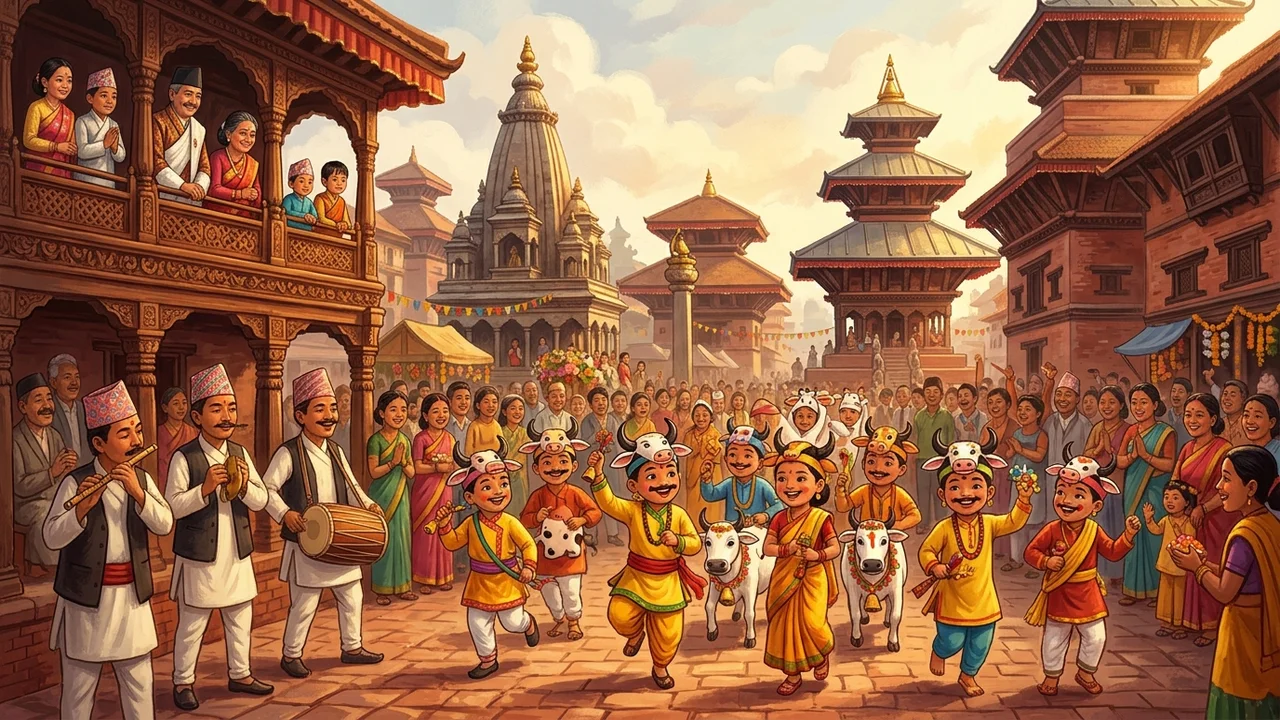
Gai Jātrā (गाईजात्रा) is the same kind of local day, because each town brings its own satire and its own street theatre.गाईजात्रा पनि त्यस्तै स्थानीय दिन हो, किनभने हरेक सहरले आफ्नै व्यङ्ग्य र सडक नाटक ल्याउँछ।
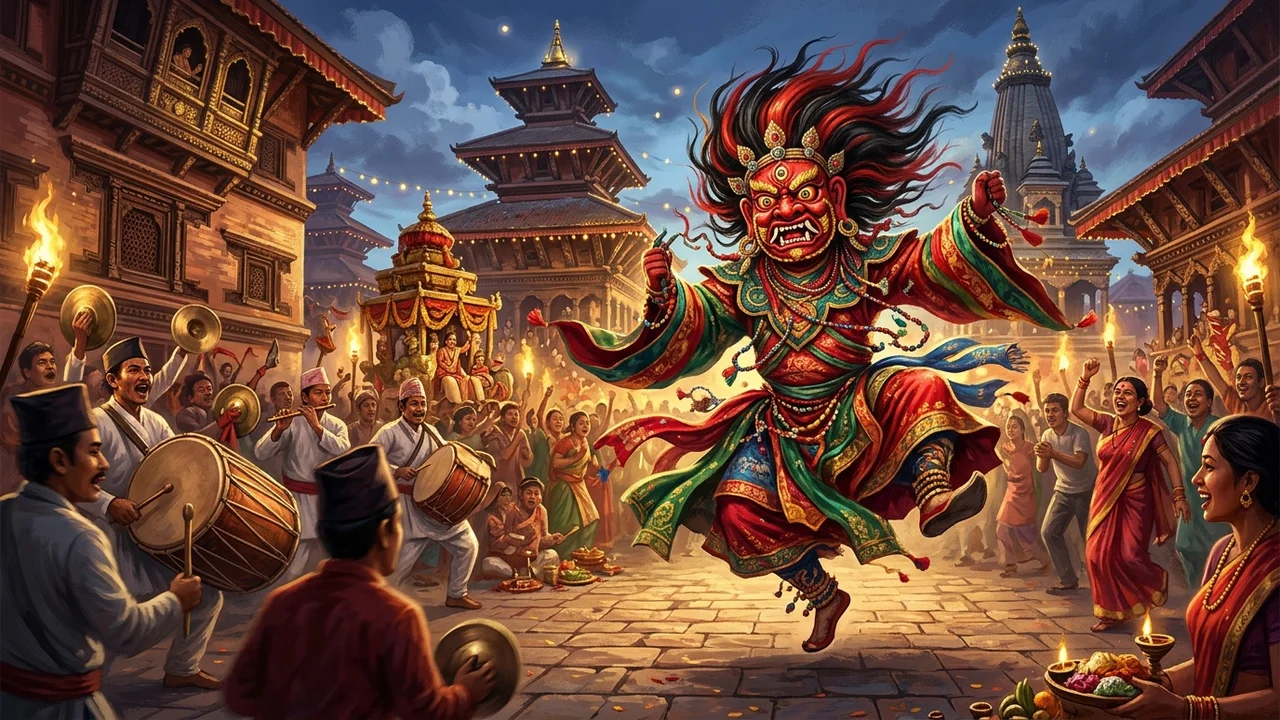
During Indra Jātrā the music leads the dancers. Drums include the dhimay (धिमय्), the khĩ (खिं), and the naykhĩ (नयखिं), whereas the wind instruments include the kāhā (काहा) and the taha (ताहा). That beat moves the masked dancers of the lākhe (लाखे), of Bhairava (भैरव), and of the neighborhood goddesses, and year after year the street tells its own story, keeps the town's sacred boundary, and teaches the next group of carriers.इन्द्रजात्रामा सङ्गीतले नाच्नेलाई डोर्याउँछ। बाजामा धिमय्, खिं, र नयखिं पर्छन्, जबकि फुकेर बजाइनेमा काहा र ताहा पर्छन्। त्यो तालले लाखे, भैरव, र टोलका देवीका मुखुण्डो नाच चल्छ, र वर्षैपिच्छे सडकले आफ्नै कथा भन्छ, सहरको पवित्र सीमाना राख्छ, र बोक्ने अर्को पुस्तालाई सिकाउँछ।
1. Gai Jatra
१. गाईजात्रा
A boy in a cow mask leads the family through the street.गाईको मुखुण्डो लगाएको बालकले परिवारलाई सडकमा डोर्याउँछ।
Dimension
Details
Eschatological & Civic Significance
Calendar Tithi
Bhadra Krishna Pratipada (भदौ कृष्ण प्रतिपदा)
Opens the memorial season directly following the Janai Purnima full moon.
Historical Inception
King Pratāpa Malla (17th c. Kathmandu)
Communal consolation for the grieving queen following Prince Cakravartendra's demise.
Eschatological Guide
Sacred Cow crossing Vaitaraṇī
Bovine intercession aiding the departed spirit through the river of death into Pitṛloka.
Theatrical Masquerade
Youths disguised with horns, whiskers, and straw
Playful carnivalesque inversion transforming domestic sorrow into shared humor.
Civic Satire
Khyālī & political lampooning
Centuries-old immunity permitting unrestrained parody of rulers and public abuses.
The story
Celebrated on the first day of the dark lunar fortnight of Bhadra (Bhādra Krishna Pratipadā), the beloved festival of Gai Jatra—known across the Newar tongue as Sā Pāru—transforms existential bereavement into a communal pageant of laughter, spiritual catharsis, and public political satire. The historical origin of the pageant dates to the seventeenth-century Malla era, when King Pratāpa Malla of Kathmandu lost his youthful son, Prince Cakravartendra Malla, plunging his queen into an abyss of inconsolable grief. Desperate to demonstrate to his distraught consort that death is the universal inheritance of every mortal household rather than an isolated royal curse, the king commanded every family who had lost a kinsperson in the preceding year to join a grand procession through the city streets, masquerading in whimsical, satirical garb behind a consecrated cow or a boy dressed in bovine robes.
भदौ महिनाको कृष्ण पक्षको प्रतिपदा तिथिमा मनाइने गाईजात्रा अर्थात् सा पारु पर्व मृत्युको गहिरो शोकलाई सामूहिक हाँसो, आध्यात्मिक सान्त्वना, र सामाजिक व्यङ्ग्यमा बदल्ने नेपालको एक अत्यन्त मौलिक एवम् अद्वितीय चाड हो। यसको ऐतिहासिक जरा सत्रौँ शताब्दीका मल्लराजा प्रताप मल्लको शासनकालसँग जोडिन्छ। आफ्ना प्यारा छोरा चक्रवर्तेन्द्र मल्लको अल्पायुमै मृत्यु भएपछि रानी पुत्रशोकमा डुबेर दिनरात विलाप गर्न थालिन्। रानीको मन बुझाउन र मृत्यु कसैको वशमा नभएको शाश्वत सत्य देखाउन, राजाले वर्षभरिमा परिवारका सदस्य गुमाएका सहरका सबै नागरिकलाई गाईसहित वा गाईको भेषमा बालबालिकालाई सिँगारेर दरबार अगाडिबाट रमाइलो झाँकीसहितको यात्रा निकाल्न आदेश दिए।
In Hindu and Newar eschatology, the sacred cow (Gau Mātā) serves as the supreme psychopomp, guiding the newly departed soul through the subterranean darkness and helping it cross the terrifying mythological river Vaitaraṇī into the ancestral realm (Pitṛloka) by grasping her holy tail. Simultaneously, the procession became the valley's premier forum for uncensored civic satire (khyālī or prahasana). For this single day of royal immunity, ordinary citizens, comedic actors, and contemporary cartoonists took to the public squares disguised as ascetics, demons, and corrupt officials, lampooning state injustice, judicial venality, and aristocratic hypocrisy with biting wit, liberating the collective psyche from both grief and tyranny in a single sweep.
धार्मिक मान्यताअनुसार मृत आत्माहरूले परलोक जाँदा तर्नुपर्ने अत्यन्त कष्टकर वैतरणी नदी पार गर्न गाईको पुच्छर समातेर सजिलै पार हुन सकिन्छ भन्ने जनविश्वास छ। त्यसैले दिवङ्गत आफन्तको मुक्तिका लागि गाई वा बालबालिकालाई गाईको मुखुण्डो, पहेंलो वस्त्र, र सिङ बनाएर नगर परिक्रमा गराइन्छ। यसका साथै, गाईजात्रा समाज र राज्यसत्ताका विकृति, भ्रष्टाचार, र विसङ्गतिहरूमाथि निर्भीक भएर प्रहार गर्ने व्यङ्ग्यको खुला मञ्च पनि हो। यस दिन नाटक, प्रहसन, र हास्यव्यङ्ग्यमार्फत राजनीतिक एवम् सामाजिक पाखण्डहरूको खिल्ली उडाउँदै मानिसहरूले वर्षभरिको पीडा बिर्सेर उन्मुक्त हाँसो साट्ने गर्दछन्।
Midnight advent of the eighth incarnation of Lord Vishnu.
Puranic Narrative
Mathurā dungeon birth & Yamuna crossing to Gokula
Triumph of divine grace over tyrannical autocracy and deliverance of Devakī.
Architectural Center
Krishna Mandir, Patan (1637 CE)
Monolithic stone Shikhara temple commissioned by King Siddhi Narasimha Malla.
Devotional Praxis
Strict day-long fast & midnight Āratī
Scriptural reading of the Bhagavad Gītā and antiphonal choral bhajans.
Cosmic Mission
Dharma-saṃsthāpanārtha
Re-establishment of moral balance through wisdom, playful love, and righteous action.
The story
Falling on the eighth day of the waning lunar fortnight of Bhadra (Bhādra Krishna Ashtami) under the auspicious conjunction of the Rohiṇī Nakṣatra, Krishna Janmashtami commemorates the midnight advent of Lord Krishna, the eighth avatāra of Vishnu, who incarnated to dismantle demonic tyranny and re-establish cosmic righteousness (dharma-saṃsthāpana). Born inside the fortified dungeon of Mathurā to Devakī and Vasudeva while the cruel despot Kaṃsa slumbered, the infant lord was miraculously ferried across the flooded Yamuna river to the pastoral village of Gokula, initiating a divine life that reconciled profound philosophical revelation with exuberant pastoral play.
भाद्रपद महिनाको कृष्ण पक्षको अष्टमी तिथि तथा रोहिणी नक्षत्रको शुभ संयोगमा भगवान् श्रीकृष्णको शुभ जन्मोत्सव अर्थात् कृष्ण जन्माष्टमी धुमधामका साथ मनाइन्छ। द्वापरयुगमा मथुराको कारागारभित्र क्रूर र पापी राजा कंशको बन्दी जीवन बिताइरहेका माता देवकी र पिता वसुदेवको आठौँ सन्तानका रूपमा मध्यरातमा भगवान् विष्णुले श्रीकृष्णको अवतार लिनुभएको थियो। उहाँ जन्मिनासाथ कारागारका ढोकाहरू आफैँ खुलेका, पहरेदारहरू निदाएका, र वसुदेवले उहाँलाई टोकरीमा राखेर उर्लँदो यमुना नदी पार गराई गोकुलका नन्द र यशोदाको घरमा सकुशल पुर्याएको रोमाञ्चक आख्यान पुराणहरूमा वर्णित छ।
Across Nepal, the focal epicenter of veneration is the seventeenth-century stone masterpiece of Krishna Mandir in Patan Durbar Square, erected in 1637 CE by King Siddhi Narasimha Malla. Carved entirely of fine gray stone in the multi-tiered śikhara architectural style, its intricate friezes depict the entire narrative sequences of the Mahābhārata and Rāmāyaṇa. Tens of thousands of devotees observe a strict day-long fast, queuing patiently for hours beneath monsoon showers to reach the first-floor sanctum, while devotional ensembles chant the Bhagavad Gītā and melodious bhajans throughout the night until the midnight hour, when conch shells sound and lamps flare to greet the divine birth.
नेपालमा कृष्ण जन्माष्टमीको मुख्य आकर्षण ललितपुरको पाटन दरबार स्क्वायरमा रहेको प्रसिद्ध कृष्ण मन्दिर हो। राजा सिद्धिनरसिंह मल्लद्वारा सन् १६३७ मा शिखर शैलीमा निर्मित यो तीनतले मन्दिर पूर्ण रूपमा ढुङ्गाबाट बनेको छ, जसको भित्तामा महाभारत र रामायणका सम्पूर्ण प्रमुख घटनाहरू जीवन्त रूपमा कुँदिएका छन्। यस दिन हजारौँ भक्तजनहरू निराहार व्रत बसेर कृष्ण मन्दिरमा पूजा गर्न लामबद्ध हुन्छन्। रातभर भजनकीर्तन, श्रीमद्भगवद्गीताको पाठ, र कृष्णलीलाका झाँकीहरू प्रदर्शन गरिन्छन्, र ठीक मध्यरात १२ बजे शङ्खध्वनि र आरतीसहित भगवान् श्रीकृष्णको जन्मको जयजयकार गरिन्छ।
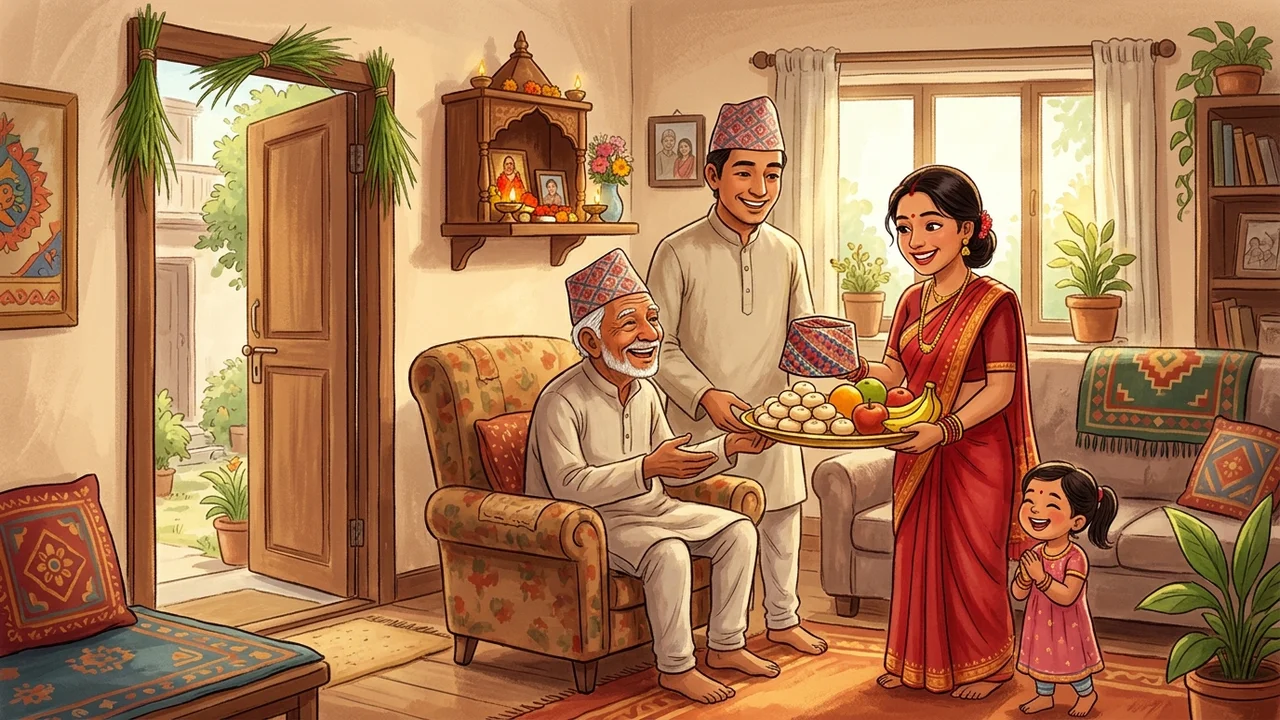
At Gokarna a son offers water for his father.गोकर्णमा छोरा बाबुका लागि पानी चढाउँछ।
Dimension
Details
Ritual & Filial Significance
Calendar Tithi
Bhadra Krishna Amavasya (भाद्र कृष्ण औंसी)
Dark moon threshold dedicated to botanical consecration and paternal devotion.
Sacred Botanical
Kuśa grass (Desmostachya bipinnata)
Imperishable purificatory grass harvested by priests for domestic altars.
Living Filial Rite
Buwā ko mukh herne (पिताको मुख हेर्ने)
Bowing at the father's feet, gifting delicacies, and seeking paternal benedictions.
Ancestral Tirtha
Gokarṇeśvara Mahādeva on the Bagmati
Memorial ablutions, piṇḍadāna, and liberation of deceased paternal lineages.
Cosmological Duty
Discharge of Pitru-ṛṇa (पितृ-ऋण)
Sacred fulfillment of ancestral debts sustaining continuity between generations.
The story
Occurring on the new moon of Bhadra (Bhādra Krishna Amāvāsyā), Kushe Aunsi unites the sanctification of the sacred kuśa grass with filial veneration of living fathers and memorial offerings for ancestral forebears. In Vedic ritualism, kuśa grass (Desmostachya bipinnata) is revered as an incorruptible celestial botanical, infused with divine vibrations capable of purifying sacrificial altars, repelling negative astral entities, and sanctifying water oblations. On this morning, family priests journey to wild riverbanks to ceremonially harvest the sharp, fragrant blades with a consecrated sickle, delivering bundles to household thresholds where it is consecrated and preserved for all sacred domestic rites throughout the turning year.
भाद्रपद महिनाको कृष्ण पक्षको औंसी तिथिलाई कुशे औंसी, गोकर्ण औंसी, वा बुवाको मुख हेर्ने दिन भनिन्छ। यस दिन वैदिक कर्मकाण्डमा अपरिहार्य मानिने पवित्र कुश (एक प्रकारको पवित्र घाँस) घरघरमा भित्र्याइने हुनाले यसलाई कुशे औंसी भनिएको हो। कुशलाई भगवान् विष्णुको प्रतीक मानिन्छ, जसले मण्डल, हवन, तर्पण, र श्राद्धलाई पवित्र बनाउँछ। यस दिन पुरोहितहरूले नदी किनार वा डाँडाबाट विधिपूर्वक कुश उखेलेर जजमानका घरघरमा पुर्याउने गर्दछन्, जसलाई वर्षभरिका धार्मिक अनुष्ठानहरूमा प्रयोगका लागि सुरक्षित राखिन्छ।
Simultaneously, the day honors living fathers in an intimate domestic rite known as Buwā ko mukh herne (beholding the father's face). Adult children return to their paternal homes bearing platters of sweets, fresh fruits, garments, and nourishing foods, bowing low to touch their foreheads to their father's feet and receiving his heartfelt blessings. For those whose fathers have passed into the ancestral realm, the day requires pilgrimage to the ancient sanctuary of Gokarneshwar Mahadev along the upper Bagmati river or to Betrawati in Nuwakot. There, mourners perform piṇḍadāna and śrāddha, offering barley, black sesame, and holy river water to nourish the deceased father's soul, releasing their filial debts (pitṛ-ṛṇa) through sacred remembrance.
यस पावन दिनमा छोराछोरीहरूले आफ्ना जीवित पितालाई अत्यन्त आदरका साथ 'बुवाको मुख हेर्ने' संस्कार सम्पन्न गर्दछन्। बिहानै स्नान गरी बुवालाई मिठामिठा परिकार, फलफूल, र नयाँ वस्त्र उपहार दिई गोडामा ढोगेर आशीर्वाद लिने गरिन्छ। जसका बुवा परलोक भइसक्नुभएको छ, उनीहरूले काठमाडौँको उत्तर-पूर्वी भेगमा रहेको गोकर्णेश्वर महादेव मन्दिरको बागमती नदी किनार, उत्तरगया, वा बेत्रावतीमा गएर पितृहरूको नाममा श्राद्ध, पिण्डदान, र तर्पण गर्दछन्। गोकर्णमा श्राद्ध गर्नाले पितृहरू तृप्त भई मोक्ष प्राप्त गर्दछन् र सन्तानलाई सुखशान्ति मिल्छ भन्ने दृढ विश्वास रहिआएको छ।
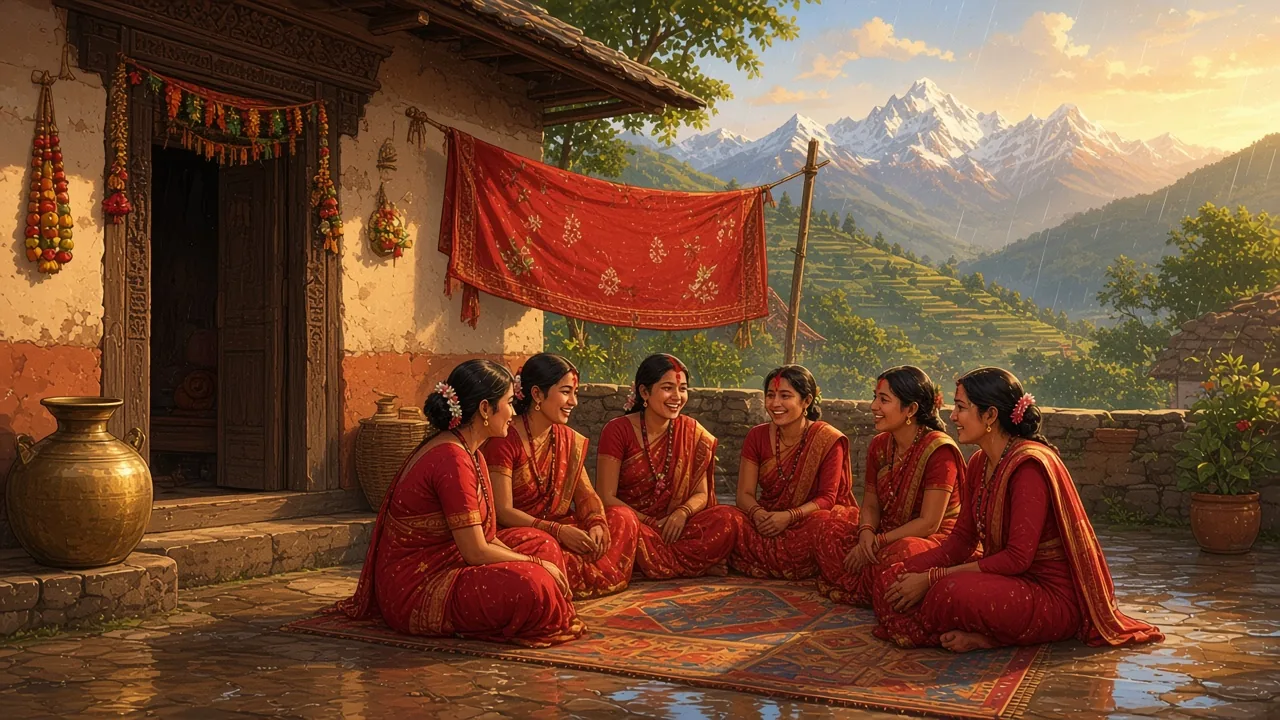
Women in red keep the fast, and the swing moves.रातो लुगाका महिला व्रत बस्छन्, र पिङ चलिरहन्छ।
Dimension
Details
Theological & Sociological Significance
Calendar Tithi
Bhadra Shukla Tritiya (भाद्र शुक्ल तृतीया)
Auspicious third waxing lunar day dedicated to Pārvatī and Shiva.
Etymology & Myth
Haritā (spirited away) + Ālikā (friends)
Female solidarity assisting Pārvatī's sovereign choice of Shiva over Vishnu.
Pre-Fast Feast
Dar Khāne on the preceding midnight
Nutrient-dense culinary reunion hosted at the maternal home (Māiti).
Ascetic Discipline
24-hour Nirjalā Vrata (waterless fast)
Rigorous devotion invoking spiritual resilience and marital longevity.
Socio-Cultural Expression
Red bridal attire & antiphonal folk songs
Cathartic sisterhood expressing marital realities, resilience, and female autonomy.
The story
Celebrated on the third lunar day of the waxing moon of Bhadra (Bhādra Śukla Tṛtīyā), Haritalika Teej stands as the most vibrant, emotionally resonant festival of Hindu women in Nepal. The sacred etymology traces back to two Sanskrit roots: haritā (abducted or secretly taken away) and ālikā (female companions). According to the Bhaviṣya Purāṇa, when King Himālaya arranged to wed his devoted daughter Pārvatī to Lord Vishnu against her deepest spiritual longing, Pārvatī's loyal companions secretly whisked her away into the secluded Himalayan wilderness. Concealed along the banks of a mountain river, Pārvatī fashioned an earthen lingam from river sand, undertaking an arduous twenty-four-hour waterless fast (nirjalā vrata) until Lord Shiva, captivated by her unyielding penance, appeared before her and pledged to accept her as his divine consort.
भाद्रपद महिनाको शुक्ल पक्षको तृतीया तिथिमा सनातन हिन्दु नारीहरूको महान् सांस्कृतिक एवम् धार्मिक उत्सव हरितालिका तीज मनाइन्छ। 'हरितालिका' शब्द संस्कृतका दुई शब्द 'हरित' (हरण गरिएकी) र 'आलिका' (सखी वा साथीहरू) मिलेर बनेको हो। भविष्य पुराणअनुसार, हिमालय पर्वतले आफ्नी सुपुत्री पार्वतीको विवाह उनकी इच्छाविपरीत भगवान् विष्णुसँग गरिदिन खोजेपछि, पार्वतीका साथीहरूले उनलाई लुकाएर घोर जङ्गलमा पुर्याएका थिए। त्यहाँ पार्वतीले बालुवाको शिवलिङ्ग बनाई अन्न-जल नखाई कठोर 'निराहार' तपस्या गरिन्। उनको अनन्य भक्तिबाट प्रसन्न भएर अन्ततः भगवान् शिवले उनलाई अर्धाङ्गिनीका रूपमा स्वीकार गर्नुभएको पावन आख्यान यस पर्वको मूल आधार हो।
The festival commences on the eve of the fast with the lavish midnight feast of dar, where mothers, daughters, and sisters reunite at their maternal home (māiti) to feast on rich, butter-laden curries, sweets, and fruits before the fast begins. On the central day of Teej, women don brilliant crimson red bridal saris, sparkling emerald necklaces (potē), and fragrant flower garlands, assembling at Pashupatinath and local Shiva sanctuaries to offer prayers for conjugal longevity, domestic peace, and spiritual purity. As they dance together in expansive outdoor courtyards, their haunting folk songs span the full gamut of female life—alternating between joyful celebration, humorous social commentary, and poignant outpourings of matrimonial hardships—transforming the sacred fast into an empowering celebration of female solidarity and agency.
तीजको अघिल्लो रात (द्वितीया तिथि) माइतीमा जम्मा भएका दिदीबहिनीहरूले मध्यरातमा मिठामिठा परिकारका साथ 'दर' खाने गर्दछन्, जसले भोलिपल्टको कठोर व्रतका लागि ऊर्जा प्रदान गर्दछ। तृतीयाका दिन रातो साडी, हरियो पोते, सिन्दूर, र गहनामा सजिएका महिलाहरूले पशुपतिनाथलगायत देशभरका शिवालयहरूमा पुगेर अखण्ड सौभाग्य, पारिवारिक सुख, र सुस्वास्थ्यको कामना गर्दै भगवान् शिव-पार्वतीको विधिपूर्वक पूजा गर्दछन्। दिनभर पानीको एक थोपा पनि नपिई व्रत बस्ने नारीहरूले आँगन र चौतारीहरूमा भेला भएर आफ्ना सुखदुःख, माइतीको सम्झना, र सासू-ससुराका व्यवहारलाई भाकामार्फत पोख्दै रातभर नाचगान गरी उल्लास मनाउँछन्।
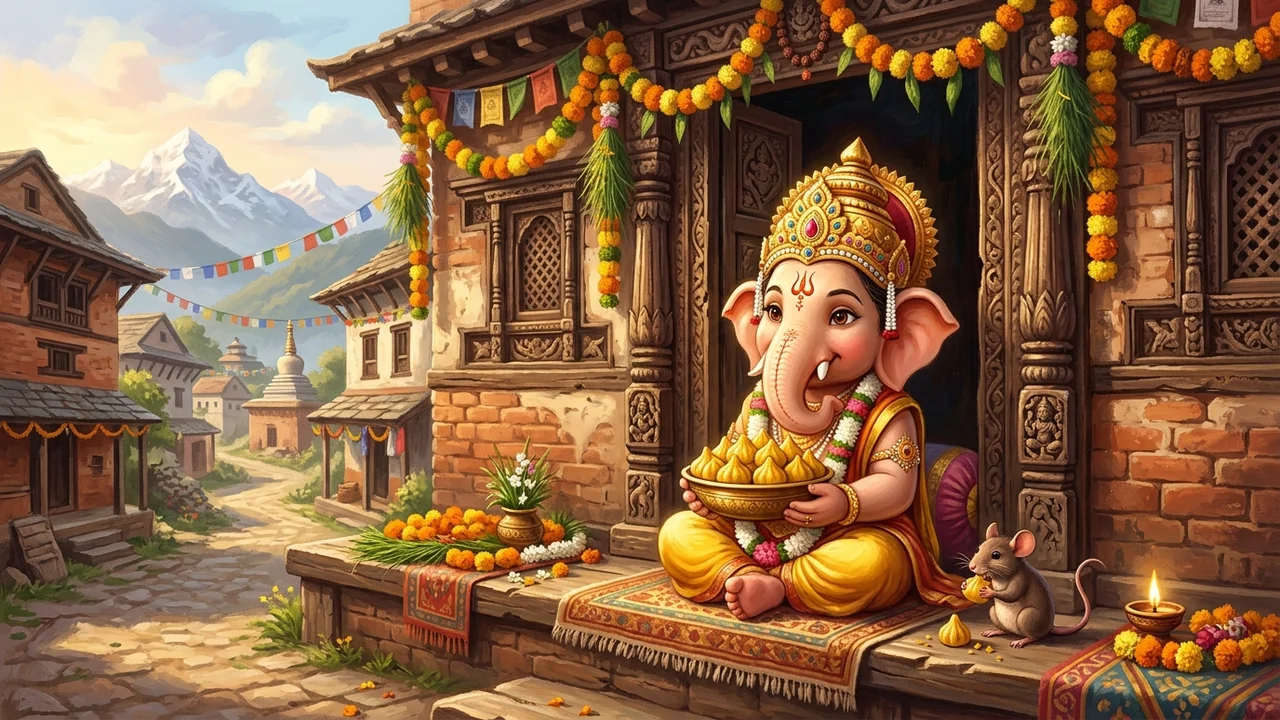
Falling on the fourth day of the waxing moon of Bhadra (Bhādra Śukla Chaturthi), Ganesha Chaturthi commemorates the divine manifestation of Lord Ganesh, the elephant-headed god of wisdom, intellect, and auspicious beginnings. Revered as Vighnahartā (the remover of obstacles) and Prathama Pūjya (the deity who must be invoked before any Vedic sacrifice, pilgrimage, or commercial enterprise), Ganesh embodies the harmonic synthesis of earthly pragmatism and cosmic transcendence. According to the Shiva Purāṇa, Goddess Pārvatī molded the boy from the saffron unguent of her own body, infusing him with life to guard her inner sanctum; when Lord Shiva severed the youth's head in a celestial confrontation, the goddess's grief compelled him to restore the child by affixing the head of a noble elephant, conferring upon him absolute leadership (Gaṇādhipati) over all celestial forces.
भाद्रपद महिनाको शुक्ल पक्षको चतुर्थी तिथिका दिन विघ्नहर्ता, मङ्गलकर्ता, तथा विद्या र बुद्धिका दाता भगवान् श्रीगणेशको जन्मोत्सव अर्थात् गणेश चतुर्थी श्रद्धा र भक्तिपूर्वक मनाइन्छ। कुनै पनि शुभ कार्य, यज्ञ, यात्रा, वा व्यापार सुरु गर्नुअघि प्रथम पूज्यका रूपमा भगवान् गणेशको आराधना गरिन्छ। शिव पुराणअनुसार माता पार्वतीले आफ्नो शरीरको चन्दन र उबटनबाट एक बालकको स्वरूप बनाई प्राणप्रतिष्ठा गर्नुभएको थियो। पछि भगवान् शिव र ती बालकबीच भएको युद्धमा बालकको शीर काटिएपछि, पार्वतीको शोकलाई शान्त पार्न उत्तर दिशामा फेला परेको हात्तीको शीर जोडेर पुनर्जीवन दिइयो र उहाँलाई सम्पूर्ण गणहरूको स्वामी अर्थात् 'गणपति' पदवी प्रदान गरियो।
Across the ancient towns of the Kathmandu Valley, devotees celebrate the day by undertaking sacred pilgrimages to the four cardinal Vināyaka temples that protect the valley perimeter: Surya Vināyaka in Bhaktapur (the dispeller of illness), Jala Vināyaka in Chobhar (guardian of waters and fertility), Aśoka Vināyaka in Maru beside Kathmandu Durbar Square (the spireless guarantor of business ventures), and Kārya Vināyaka in Bungamati (the blesser of ongoing construction). Shrines are heaped with offerings of sweet steamed modaka dumplings, crunchy sesame laddus, fresh red hibiscus flowers, and blades of holy dūrvā grass, while astrophiles observe the ancient cautionary prohibition against gazing upon the autumn moon on this evening, lest they incur false accusations of theft, as did Lord Krishna in the Syamantaka jewel legend.
काठमाडौँ उपत्यकामा यस दिन चार प्रमुख गणेश मन्दिरहरू—भक्तपुरको सूर्यविनायक, चोभारको जलविनायक, काठमाडौँको मरु गणेश (अशोकविनायक), र बुङ्गमतीको कार्यविनायकमा बिहानैदेखि भक्तजनहरूको ठूलो घुइँचो लाग्दछ। यी चार विनायकले उपत्यकाको चारै दिशाबाट रक्षा गरिरहेको जनविश्वास छ। गणेशजीलाई मनपर्ने लड्डु, मोदक, रातो फूल, र हरियो दुबो चढाएर पूजा-अर्चना गरिन्छ। यस दिन साँझ चन्द्रमा हेर्दा 'मिथ्या कलङ्क' लाग्छ भन्ने पौराणिक मान्यता छ, जसको सम्बन्ध भगवान् श्रीकृष्णमाथि लागेको स्यमन्तक मणिको कलङ्क कथासँग जोडिन्छ।
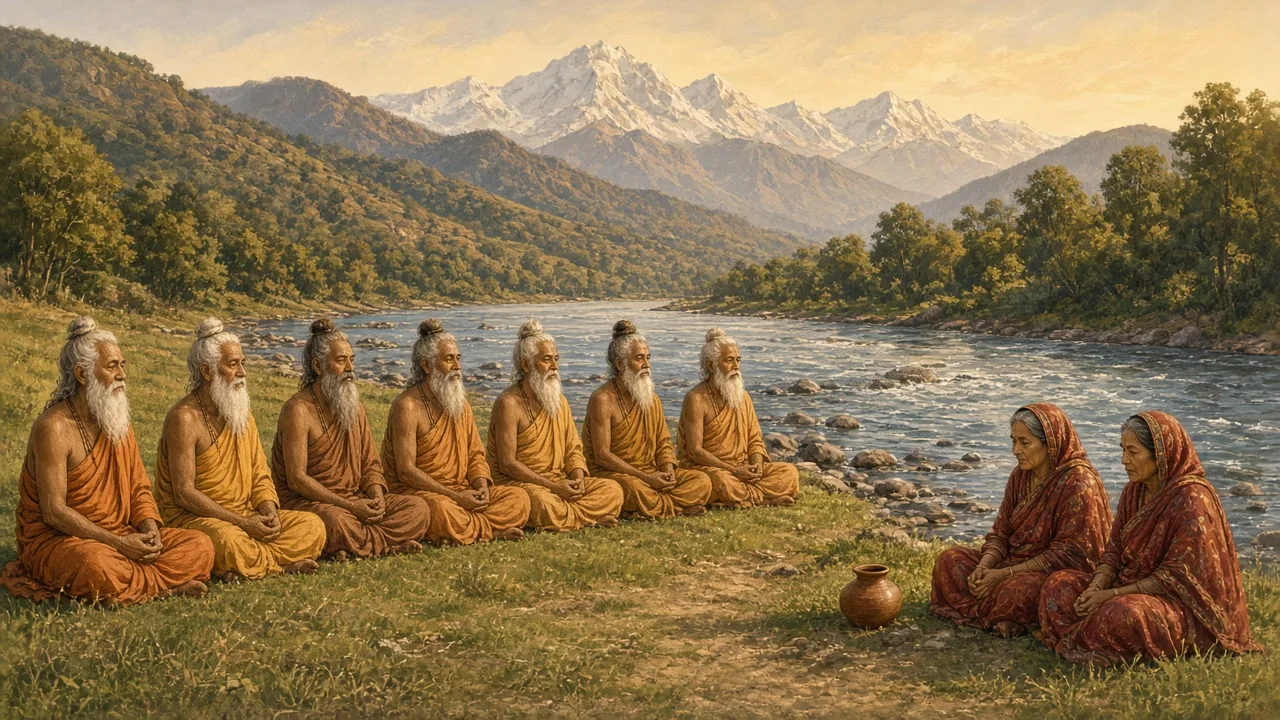
The seven sages sit by the river, and the fast is kept.सात ऋषि नदी किनारमा बस्छन्, र व्रत बस्छ।
Dimension
Details
Purificatory & Scriptural Significance
Calendar Tithi
Bhadra Shukla Panchami (भाद्र शुक्ल पञ्चमी)
Fifth waxing lunar day devoted to bodily purification and ancestral rishis.
Venerated Seers
Saptarṣis and Devi Arundhati
Seven primordial conduits of Vedic wisdom and ethical righteousness.
Botanical Implement
365 stems of Apāmārga (दतिवन)
Medicinal astringent herb cleansing dental enamel and discharging ritual lapses.
Purifying Earths
Red earth, cow dung, sesame, and river clay
Cosmetic and antiseptic scrub grounding the human body in pristine nature.
Sacred Sustenance
Wild roots, uncultivated Sāma rice, and Karkalo
Non-agrarian forest diet cultivating simplicity, mindfulness, and bodily lightness.
The story
Celebrated on the fifth day of the waxing moon of Bhadra (Bhādra Śukla Panchami), directly following Ganesha Chaturthi, Rishi Panchami serves as a sacred day of moral atonement, bodily purification, and veneration of the seven primordial Vedic seers (Saptarṣis). According to classical Smṛti literature, the festival allows women to expiate any unintentional ritual infractions associated with the natural cycle of menstruation (rajasvalā doṣa) accumulated throughout the preceding year. Consecrating the wisdom of the seers who preserved the Vedic revelation, the rite honors Kaśyapa, Atri, Bharadvaja, Vishvamitra, Gautama, Jamadagni, and Vashistha, alongside the embodiment of marital fidelity and truth, Arundhati.
भाद्रपद महिनाको शुक्ल पक्षको पञ्चमी तिथिमा पर्ने ऋषि पञ्चमी सनातन परम्परामा महिलाहरूद्वारा गरिने आत्मशुद्धि, प्रायश्चित्त, र सप्तऋषिहरूको विशेष आराधनाको पर्व हो। शास्त्रीय मान्यताअनुसार वर्षभरि रजस्वला (महिनावारी) हुँदा जान-अन्जानमा भएका धार्मिक तथा शारीरिक त्रुटि वा छोइछिटोका दोषहरूको निवारणका लागि यो व्रत बस्ने गरिन्छ। यस दिन वैदिक ज्ञानका संरक्षक मानिने सात महान् ऋषिहरू—कश्यप, अत्रि, भारद्वाज, विश्वामित्र, गौतम, जमदग्नि, र वशिष्ठका साथै माता अरुन्धतीको निष्ठापूर्वक पूजा-आराधना गरिन्छ।
At daybreak, women walk in groups to sacred river confluences, stone spouts, or natural springs to undergo an ancient, rigorous bodily ablution. Central to this purification is the ritual brushing of teeth with three hundred and sixty-five herbal twigs of the prick-chaff plant (Apāmārga or Dativan), accompanied by cleansing the skin with consecrated red mud, cow dung, sesame paste, and holy river water. After completing these comprehensive ablutions, devotees return home in pure vestments to draw sacred lotuses on brass platters, offering worship to the Saptarṣis with forest roots, uncultivated leafy vegetables (karkalo and sama rice), and unbroken fruits, reaffirming physical purity, environmental intimacy, and ancestral reverence.
यस दिन बिहानै महिलाहरू नजिकैका पवित्र नदी, खोला, वा ढुङ्गेधारामा गएर परम्परागत विधिअनुसार स्नान गर्दछन्। ३६५ वटा दतिवनका डाँठले दाँत माझ्ने, माटो, गाईको गोबर, र तिल प्रयोग गरेर शरीरलाई ३६५ पटक पखाल्ने अनौठो धार्मिक नियम यस दिन पूरा गरिन्छ। यसले शरीर र मन दुवैलाई पूर्ण रूपमा शुद्ध बनाउँछ भन्ने विश्वास छ। त्यसपछि नयाँ वा चोखो वस्त्र पहिरिएर घरमा वा मन्दिरमा सप्तऋषिको मण्डल बनाई पूजा गरिन्छ। यस दिन नजोतिएको खेतमा फलेको अन्न, सामा चामल, कर्कलो, र कन्दमूल मात्र पकाएर एक छाक सात्त्विक भोजन ग्रहण गर्ने परम्परा छ।
Women carry the basket for Gaura through the far-west village.महिलाहरू गौराको डालो लिएर सुदूरपश्चिमको गाउँमा हिँड्छन्।
Dimension
Details
Regional & Folk Significance
Calendar Tithi
Bhadra Krishna Panchami to Ashtami (बिरुडा पञ्चमीदेखि अष्टमी)
Mid-Bhadra autumnal festival celebrating marital fidelity and fertility.
Sacred Grain Mixture
Biruḍā (five steeped grains)
Wheat, gram, pea, black lentil, and horse gram sprouted as divine grace.
Effigy of Gaura
Wild meadow grasses (Kuśa & Sau) clothed in finery
Botanical manifestation of Pārvatī reflecting organic Himalayan spirituality.
Sacred Woolen Thread
Dubudhāgo worn around the neck
Conjugal talisman protecting the family lineage and marital longevity.
Communal Folk Dance
Deudā circular chain dance
Rhythmic synchronized poetry dance preserving the archaic Khas language and memory.
The story
Predominant across the Far-Western (Sudurpashchim) and Karnali provinces of Nepal and the contiguous Kumaoni hills, Gaura Parva is a majestic regional celebration of matrimonial devotion, maternal fertility, and shared communal identity. Dedicated to Goddess Gaura (the local manifestation of Goddess Gauri/Pārvatī) and her consort Maheśvara (Shiva), the festival reenacts their celestial romance and divine union through archaic dialects, intricate grain rituals, and resonant circular folk dances. Commencing on the fifth day of the waning moon of Bhadra (Biruḍā Panchami), women steep a sacred mixture of five legumes known as biruḍā—comprising wheat, gram, field pea, black lentil, and soybean—in shining bronze pots, chanting ancient epic narrative ballads known as Phāg.
नेपालको सुदूरपश्चिम र कर्णाली प्रदेश तथा उत्तराखण्डको कुमाउ क्षेत्रमा अत्यन्त उल्लास र मौलिकताका साथ मनाइने महान् सांस्कृतिक पर्व गौरा हो। यो चाड माता पार्वतीको स्थानीय स्वरूप 'गौरा' र भगवान् शिव 'महेश्वर' को पवित्र वैवाहिक सम्बन्ध तथा पारिवारिक सुखसमृद्धिका लागि समर्पित छ। भाद्र कृष्ण पञ्चमी अर्थात् 'बिरुडा पञ्चमी' का दिनदेखि यो पर्व विधिवत् सुरु हुन्छ। यस दिन तामा वा काँसको भाँडोमा गहुँ, केराउ, गहत, मास, र गुराँस गरी पाँच प्रकारका अन्नलाई मिसाएर भिझाइन्छ, जसलाई 'बिरुडा' भनिन्छ। महिलाहरूले पवित्र मनले माङ्गलिक फाग गीतहरू गाउँदै बिरुडा भिजाउने र धुने गर्दछन्।
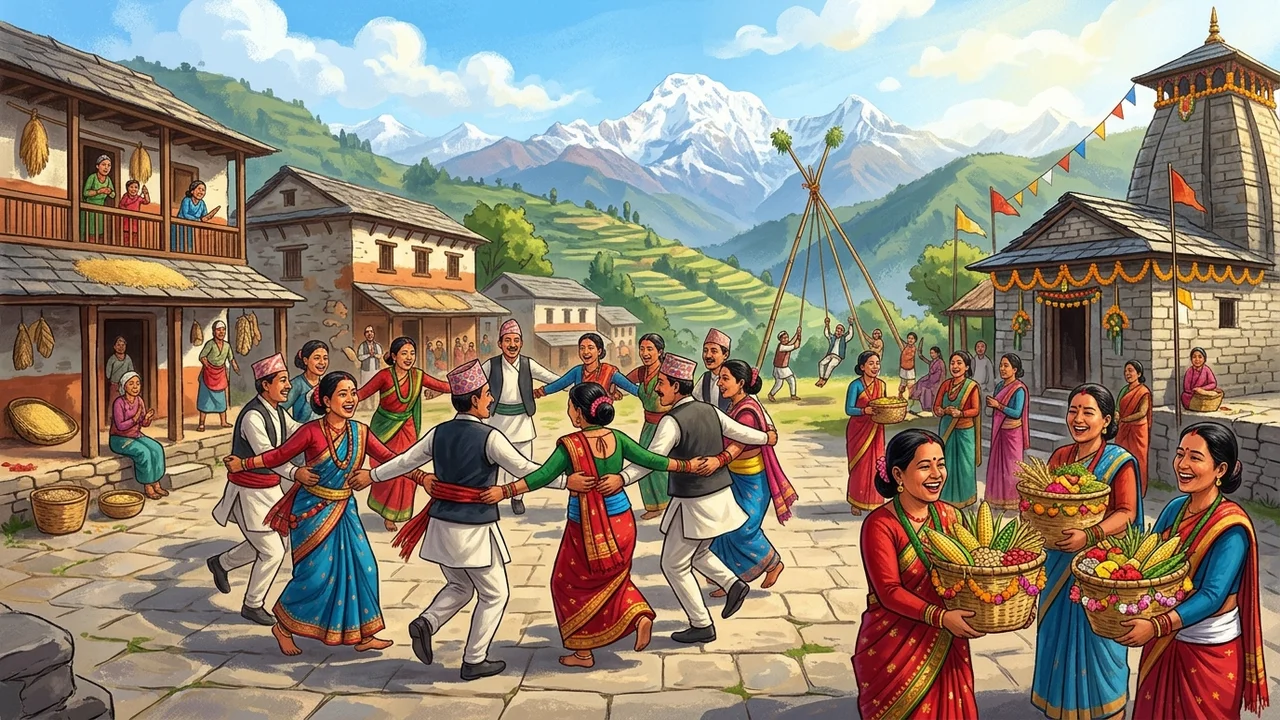
On the central day of Gaura Ashtami, the soaked seeds are ceremonially washed and offered to the goddess, who is embodied as a graceful anthropomorphic idol fashioned from wild meadow grasses (kuśa and sau), draped in colorful vestments, and consecrated inside temple courtyards. Women receive the sanctified biruḍā as an auspicious head blessing and tie the sacred woolen thread (dubudhāgo) around their necks, invoking lifelong health for their husbands and offspring. In the afternoons and evenings, village squares fill with the thunderous cadences of Deudā—a world-renowned circular chain dance where men and women clasp hands or link shoulders, swaying back and forth in synchronized steps while improvising poetic verses on history, mythology, social justice, and romantic yearning in the archaic Khas language.
गौरा अष्टमीका दिन नजिकैको खेत वा खोलाबाट कुश र साउँ घाँस ल्याएर गौराको आकर्षक प्रतिमा बनाइन्छ र परम्परागत गहना तथा कपडाले सिँगारिन्छ। महिलाहरूले उपवास बसेर गौरा र महेश्वरको पूजा गर्छन्, र काँचो धागोबाट बनेको विशेष 'दुबुधागो' गलामा धारण गर्दछन्। प्रसादका रूपमा टाउकोमा बिरुडा हालेर आशीर्वाद लिइन्छ। दिउँसो र साँझपख गाउँका खुला चौरहरूमा 'देउडा' खेलको भव्य रौनक सुरु हुन्छ। हातमा हात बाँधेर, पाइला मिलाउँदै गोलाकार घेरामा नाचिने देउडामा पुराना पौराणिक कथा, राजा-रजौटाका इतिहास, र समसामयिक विषयमा सवाल-जवाफका माध्यमबाट अत्यन्त मार्मिक गीतहरू गाइन्छन्, जसले सुदूरपश्चिमको मौलिक पहिचानलाई विश्वभर झल्काउँछ।
The pole is raised, and the masked dancer comes into the square.खम्बा ठडिन्छ, र मुखुण्डो नाच्ने चोकमा आउँछ।
Dimension
Details
Civic & Cosmological Significance
Calendar Duration
Bhadra Shukla Dwadashi to Ashwin Krishna Chathurthi (8 days)
Apex autumn civic celebration marked by the Yosiñ pine pole erection.
Central Myth
Capture of Indra in Maru Tol & Diti's Dew Covenant
Mortal justice applied to a celestial king yielding agricultural abundance and mist.
Living Divinity
Kumari, Ganesh, and Bhairav Chariot Procession
Royal legitimation and public darshan of the Living Goddess of Kathmandu.
Sacred Iconography
Śweta Bhairav liquor fountain (Hathī Hyāu)
Fierce protector deity distributing consecrated rice beer to ecstatic crowds.
Ritual Dances
Majipā Lakhe, Pulukisi, Daśāvatāra, Sawa Bhakku
Masked theatrical dances harmonizing demonic energy with cosmic order.
The story
Spanning eight glorious days in the bright lunar fortnight of Bhadra (culminating on Bhādra Śukla Chaturdashi), Indra Jatra—known natively in the Newar tongue as Yenyā (the Festival of Kathmandu)—stands as the urban valley's grandest, most spectacular civic spectacle. Initiated by the formal erection of the colossal pine ceremonial mast (Yosiñ) before the ancient palace gates of Hanuman Dhoka, the festival commemorates the descent of Indra, King of Heaven, into the Kathmandu Valley. According to urban chronicle, Indra descended incognito to pluck the rare, fragrant night-blooming jasmine flowers (pārijāta) from a courtyard in Maru Tol to fulfill his mother Diti's autumn rituals; mistaking the celestial sovereign for an ordinary garden thief, local farmers apprehended him, tied his arms with ropes, and displayed him in public disgrace at the crossroads.
भाद्रपद महिनाको शुक्ल पक्षको द्वादशीदेखि सुरु भई आठ दिनसम्म काठमाडौँको मुटु वसन्तपुर दरबार क्षेत्रवरिपरि मनाइने इन्द्रजात्रा अर्थात् 'येँयाः' उपत्यकाको सबैभन्दा भव्य, ऐतिहासिक, र रोमाञ्चक सडक उत्सव हो। हनुमानढोका अगाडि विधिपूर्वक सल्लाको विशाल लिङ्गो (योसिं) ठड्याएपछि यस जात्राको विधिवत् थालनी हुन्छ। पौराणिक कथाअनुसार स्वर्गका राजा इन्द्र आफ्नी आमा दितीका लागि वसुन्धरा व्रत बस्न आवश्यक पारिजातको फूल टिप्न भेष बदलेर मरु टोलको बगैँचामा ओर्लिएका थिए। बगैँचाका किसानहरूले उनलाई चोर ठानेर डोरीले बाँधी दोबाटोमा सबैले देख्ने गरी सार्वजनिक रूपमा उभ्याइदिएका थिए।
Realizing her son was imprisoned, his mother Diti descended to the valley accompanied by the celestial white elephant (Airavata, manifested in the streets as Pulukisi). Upon revealing their divine identity to the astonished citizens, Diti offered a cosmic covenant in exchange for Indra's release: she pledged to blanket the valley in dense autumnal morning mists and nurturing dew, guaranteeing the ripening of winter crops and conducting the souls of all who had died that year directly to heaven. Deeply moved, the citizens liberated Indra and honored him with an eternal annual festival. The week is electrified by the three-tiered chariot procession of the Living Goddess Kumari, flanked by the minor chariots of Ganesh and Bhairav, as she blesses the sovereign and the masses through the historic sectors of Kathmandu.
आफ्नो छोरा इन्द्र बन्दी बनेको थाहा पाएपछि उनकी आमा दिती ऐरावत हात्ती (जसलाई जात्रामा 'पुलुकिसी' को रूपमा नचाइन्छ) चढेर काठमाडौँ आइन्। आफ्नो वास्तविक रूप प्रकट गरेपछि, उनले इन्द्रलाई मुक्त गरिदिएबापत उपत्यकाका बालीनाली सप्रियोस् भनी पर्याप्त कुहिरो र शीत दिने तथा त्यस वर्ष दिवङ्गत भएका पितृहरूलाई स्वर्ग लैजाने वरदान दिइन्। यसरी इन्द्र बन्धनमुक्त भएको खुसीयालीमा सहरभरि जात्रा मनाउन थालियो। यसै पावन अवसरमा जीवित देवी श्री कुमारी, गणेश, र भैरवको रथलाई काठमाडौँका तल्लो र माथिल्लो टोलहरूमा परिक्रमा गराइन्छ र राष्ट्राध्यक्ष स्वयम् उपस्थित भएर कुमारीको हातबाट टीका र आशीर्वाद ग्रहण गर्ने गर्दछन्।
Throughout the eight nights, Kathmandu's medieval squares become an open-air amphitheater of divine ecstasy. Behind a gilded lattice at Hanuman Dhoka, the colossal, terrifying mask of Śweta Bhairav is unveiled, spouting consecrated rice liquor and beer (hathī hyāu) from its mouth directly into the jostling crowd of devotees. Masked dances surge through the cobblestone alleys—most famously the wild, frenetic Majipā Lakhe demon dance, who whirls with streaming red hair to fierce drum cadences while tenderly protecting the child Jhyāliñchā, alongside the masked court dance of the Ten Avatars (Daśāvatāra). At midnight, families trace the historic perimeter of the city with oil lamps (Upāku Wanegu), dedicating their prayers to the peaceful rest of ancestors who ascended on Indra's celestial fog.
जात्राका रातहरूमा हनुमानढोकामा रहेको विशाल श्वेत भैरवको भयानक मुखौटा खुला गरिन्छ, जसको मुखबाट नलीमार्फत प्रसादका रूपमा जाँड र रक्सी (हथु हायेकेगु) धारा बगाइन्छ, जसलाई ग्रहण गर्न हजारौँ मानिसहरूको तँछाडमछाड चल्छ। सहरका गल्लीहरूमा डरलाग्दो रातो कपाल भएको 'मजिपा लाखे' ले धिमे बाजाको तालमा उन्मत्त भएर नाच्ने र उसैसँग सानो 'झ्यालिन्चा' ले जिस्क्याउने दृश्य अत्यन्त चित्ताकर्षक हुन्छ। यसका साथै सडकमा हल्चोक आकाश भैरव, दशअवतार, र पुलुकिसीको नाचले सहरलाई रातभर गुञ्जायमान बनाउँछ। आफन्त गुमाएका परिवारहरूले हातमा दियो लिएर सहरको सीमा परिक्रमा गर्ने 'उपाकु वनेगु' परम्पराले दिवंगत आत्माहरूको चिरशान्तिको कामना गर्दछ।