Household stories / Pujas / Satya Narayan
Satya Narayan Vrata Katha (Satyanārāyaṇa / सत्यनारायण व्रतकथा)सत्यनारायण व्रतकथा
| Scriptural Origin | Skanda Purāṇa (स्कन्दपुराण, Revā-khaṇḍa, chapters 1–5) |
|---|---|
| Presiding Deity | Bhagavān Satyanārāyaṇa (भगवान् सत्यनारायण — The Embodiment of Supreme Truth and Preservation) |
| Auspicious Timing | Every full moon (Pūrṇimā), solar ingress (Saṅkrānti), or upon the fulfillment of personal vows (Bhākal) |
| Liturgical Core | Five narrative chapters (Adhyāyas), Pañcāmṛta libation, Kasār prasad (ghee-roasted flour with raw sugar and banana), conch chimes (Śaṅkhadhvani) |
| Social Philosophy | Radical egalitarianism; dismantling caste and royal vanity before divine truth; mandatory sharing of sacred food across all strata |
The Universal Vow of Truth
Across the terraced foothills and ancient courtyards of Nepal, the worship of Satya Narayan (Satyanārāyaṇa / सत्यनारायण) represents the most widespread and democratic devotional liturgy in the Hindu domestic tradition. While monumental Vedic sacrifices historically demanded elaborate royal patronage, rigid caste prerequisites, and exorbitant retinues of priests, the Satyanārāyaṇa Vratakathā—drawn from the Revā-khaṇḍa of the Skanda Purāṇa—emerged as a universal covenant of grace. It requires no aristocratic wealth or ascetic withdrawal, but merely sincere faith, domestic harmony, seasonal fruits, and the shared distribution of roasted wheat-flour prasad (Kasār / कसार) among family, kinfolk, and wandering neighbors.
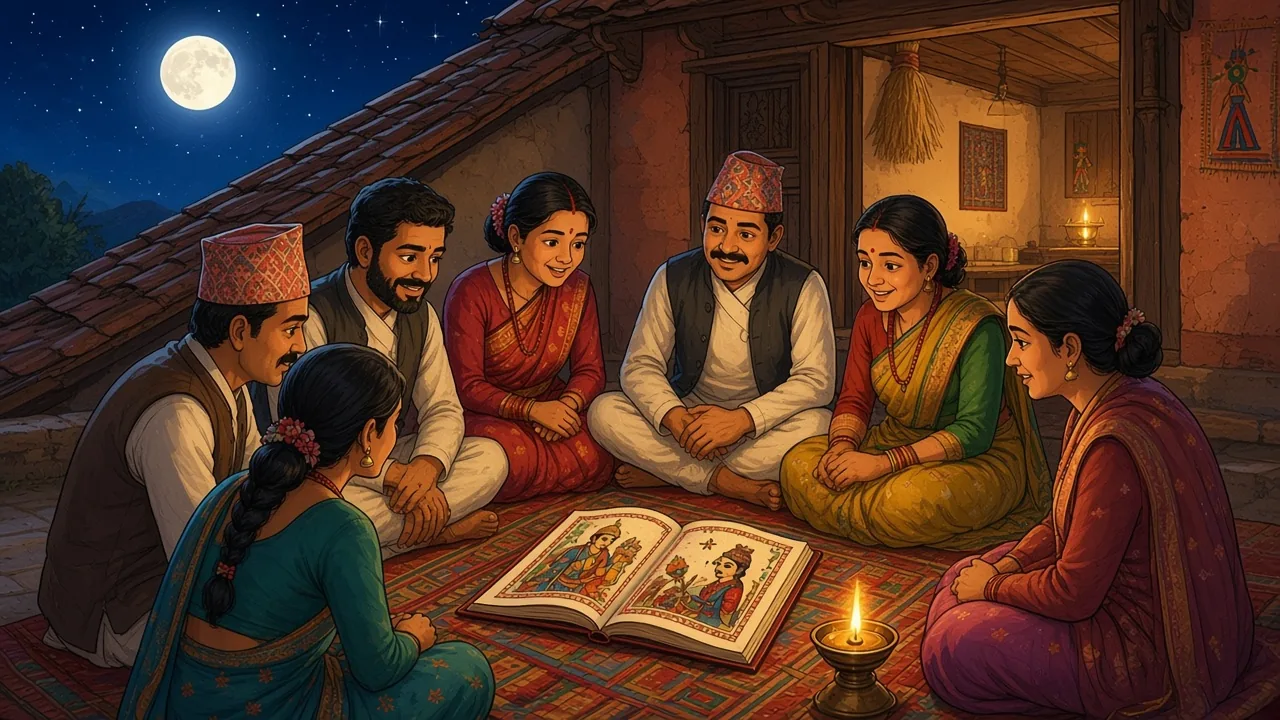
Conducted typically upon the luminous rise of the full moon (Pūrṇimā / पूर्णिमा), on monthly solar transitions (Saṅkrānti), or following the successful resolution of illness, examination, or perilous travel, the puja transforms the home into a sacred threshold. A square mandala altar is demarcated with rice flour, bounded by four auspicious banana saplings (*Kadali-stambha*), and centered upon a consecrated copper vessel (*Kalaśa*). As twilight settles and conch shells reverberate through the rooms, the family priest or household elder recites the five didactic chapters (*Adhyāyas*), weaving an allegorical drama of poverty, commerce, moral forgetfulness, and divine redemption.
The Five Parables of the Vratakathā
Chapter I: The Celestial Inquiry in Vaikuntha. The narrative opens in the primeval forest of Naimisharanya, where the sage Shaunaka asks Suta Goswami how mortals in the troubled age of Kali (*Kaliyuga*) may cross the ocean of suffering without complex rituals. Suta recounts how the celestial wanderer Narada Muni (Nārada / नारद), witnessing mankind racked by chronic sickness and unquenchable worldly desires, approached Lord Vishnu in the celestial realm of Vaikuntha. Moved by human distress, Vishnu revealed this supreme vow of truth: whenever human beings find themselves besieged by sorrow or wish to offer thanks for prosperity, gathering kinfolk to recite these parables and partake of consecrated offerings with an honest heart will dissolve worldly anxieties and awaken spiritual clarity.
Chapter II: The Destitute Brahmin of Kashi. In the sacred alleyways of Varanasi (Kāśī / काशी), an impoverished Brahmin spent his life wandering barefoot in search of alms, perpetually tormented by hunger and the humiliation of an empty kitchen. Observing his unblemished character, Lord Vishnu assumed the mortal guise of a radiant, elderly sage and inquired about his weeping. When the Brahmin confessed his unending destitution, the divine elder revealed the simple observance of Satya Narayan. The following morning, resolving with renewed hope to perform the vow, the Brahmin set forth into the city; through divine grace, he received far more alms than ever before. Purchasing unrefined sugar, ghee, fresh milk, and wheat flour, he convened his household and observed the rite. His poverty immediately dissolved, his hearth was replenished with abundant grain, and he attained lifelong spiritual peace.
Chapter III: The Woodcutter's Spontaneous Faith. While the Kashi Brahmin was joyfully distributing *Kasār* prasad to his neighbors, a weary woodcutter (Kāṣṭha-vikretā / काष्ठविक्रेता), carrying a heavy bundle of firewood upon his shoulders, entered the courtyard to quench his thirst. Struck by the serene radiance of the congregation, he set down his timber, prostrated before the altar, and asked the meaning of the worship. The Brahmin explained the vow without condescension. Deeply moved, the humble laborer made an immediate, unhesitating vow: he pledged that whatever money he earned from selling his wood in the city bazaar that afternoon would be spent entirely on the worship of Satya Narayan. In the town square, wealthy merchants competed for his dry timber, paying him double the customary price. Weeping with gratitude, the woodcutter purchased ripe bananas, pure cow ghee, flour, and brown sugar, returned to his humble hut, gathered his family, and kept the promise—thereafter enjoying plentiful sustenance and freedom from fear.
Chapter IV: The Merchant Sadhu, Lilavati, and Kalavati. The narrative transitions from poverty to the far more subtle perils of wealth and commercial pride. A wealthy merchant named Sadhu, endowed with immense maritime fleets yet grieving his childlessness, witnessed a righteous king performing the vrata. Inspired by desire rather than pure devotion, the merchant vowed to observe Satyanarayan if blessed with an heir. Soon after, his devoted wife Lilavati gave birth to a radiant daughter named Kalavati (Kalāvatī / कलावती). Yet when reminded of his promise, the merchant repeatedly deferred it—first until her weaning, then until her schooling, and finally until her wedding day. When Kalavati was married to an accomplished young merchant from Kanchannagar, Sadhu celebrated the lavish nuptials but dismissed his vow once more, boarding his cargo vessels with his new son-in-law to trade in the coastal kingdom of Ratnasara (ruled by King Chandraketu).
Displeased by this cynical procrastination, divine providence tested the merchant's pride. Real thieves robbed the royal treasury of King Chandraketu and fled through the seaport, accidentally dropping the stolen gold inside Sadhu's warehouse. The royal guards apprehended the innocent merchants, who were immediately dragged in chains before the king and thrown into subterranean dungeons without a hearing, their entire wealth confiscated. Meanwhile, back at their home, thieves plundered Lilavati's mansion, reducing mother and daughter to destitute beggars. One evening, wandering the streets in search of scrap food, Kalavati stumbled upon a neighborhood house performing the Satyanarayan Vrata. She sat among the devotees, listened to the holy stories, and received the sweet *Kasār* prasad. Returning home, she tearfully urged her mother to fulfill their long-forgotten pledge. Lilavati immediately gathered humble ingredients and performed the worship with genuine tears of repentance.
That very night, Lord Vishnu appeared in a dream to King Chandraketu, declaring the merchants innocent and warning him of catastrophe unless they were freed. The king released them at dawn, restored twice their wealth, and sent them home in triumph. Yet on the open river, Vishnu appeared in the guise of a wandering mendicant ascetic, testing the elder merchant's heart: "O merchant, what cargo carries your great ships?" Fearing that the beggar would demand charity or taxes, Sadhu sneered derisively: "Why do you ask, beggar? Do you seek our gold? There is nothing in our hulls but dried leaves and straw!" The ascetic smiled gently and said: "So may your words be true," and walked away. When the merchant inspected the holds, every casket of pearls and gold had transformed into dry straw! Falling prostrate in the mud before the ascetic, Sadhu wept bitterly, confessing his duplicity. Compassionate to the contrite, the Lord restored his treasures, admonishing him that truth alone sustains life.
As their ships neared their home harbor, the merchant sent a messenger to announce their safe arrival. Overjoyed, Lilavati and Kalavati completed their domestic worship and hurried toward the docks. In her ecstatic haste to embrace her returning husband, Kalavati committed a fatal error: she rushed out the door before tasting her portion of the sacred Prasāda. Instantly, an inexplicable tempest roared across the harbor, capsizing the son-in-law's ship and plunging it beneath the waves before their horrified eyes! As Kalavati prepared to drown herself in grief, a celestial voice echoed from the sky: "Your daughter abandoned the sacred food of the Lord in her thoughtless haste. Let her return home, eat the consecrated Prasad with folded hands, and her husband shall be restored." Racing home, Kalavati partook of the prasad with profound reverence; upon her return to the shoreline, the storm parted, the waters smoothed, and her husband stepped safely onto the sand amidst his floating cargo.
Chapter V: King Tungadhvaja and the Cowherds. The fifth chapter warns against the ruinous illusion of social superiority. A proud monarch named King Tungadhvaja (Tuṅgadhvaja / तुङ्गध्वज), riding through his royal hunting reserves, came upon poor village cowherd children (Gopālas) gathered under the shade of a banyan tree, conducting the Satyanarayan Vrata with wild jungle fruits and water. Bound by royal arrogance, the king refused to dismount, looked down upon the peasant children with contempt, and rode away without accepting the offered prasad. Upon returning to his capital, he found his empire in smoking ruins: his hundred sons lay lifeless on their beds, his royal treasury was empty, and his cattle herds had vanished. Recognizing that his contempt for humble devotion was the cause of his downfall, the king cast aside his crown, walked barefoot into the forest, knelt in the dust with the cowherd boys, and ate the humble prasad with heartfelt tears. Through his surrender, his sons were restored to life, his herds returned, and his kingdom flourished in lasting righteousness.
सत्यनारायण व्रतकथा: दार्शनिक समीक्षा र सामाजिक चेतना
नेपाली जनजीवन र सनातन पारम्परिक समाजमा भगवान् सत्यनारायणको पूजा केवल एउटा धार्मिक अनुष्ठान मात्र नभई, पारिवारिक एकता, नैतिक जागरण र सत्यप्रतिको अटल समर्पणको शाश्वत प्रतीक हो। स्कन्दपुराणको रेवाखण्डअन्तर्गत वर्णित यो पाँच अध्यायको कथाले मानिसलाई सांसारिक लोभ, अहंकार र विस्मृतिबाट मुक्त भई सत्यको मार्गमा अडिग रहन निरन्तर सन्देश दिन्छ। वेदका जटिल कर्मकाण्ड र राजसूय-अश्वमेध जस्ता खर्चिला यज्ञहरू जनसामान्यको पहुँचमा नहुँदा, कलियुगमा सत्यको आराधना नै समस्त दुःख निवारणको सर्वसुलभ माध्यम हो भनी यो व्रतकथाले उद्घोष गरेको छ।
यो व्रतकथाका पाँचवटै अध्यायहरूले मानव जीवनका विभिन्न वर्ग र मनोवृत्तिको गहिरो सामाजिक तथा मनोवैज्ञानिक विश्लेषण प्रस्तुत गर्दछन्। काशीका गरिब ब्राह्मण र दाउरा बेच्ने घाँसी (काष्ठविक्रेता) को प्रसङ्गले देखाउँछ कि भगवान् केवल भाव, निष्कपट श्रद्धा र सरलताका भोका हुनुहुन्छ; त्यहाँ विपन्नता कहिल्यै ईश्वरप्राप्तिको बाधक बन्दैन। दाउरा बेचेर आएको दैनिक ज्यालाबाटै प्रसाद जोहो गर्ने घाँसीको निष्काम समर्पणले श्रमको मर्यादा र भक्तिमा रहने समानतालाई उजागर गर्दछ।
साधु साहु, लीलावती र कलावतीको आख्यानले समृद्धिसँगै आउने मानवीय कमजोरी, प्रतिज्ञा बिर्सने बानी र धनको दम्भलाई उदाङ्गो पार्दछ। सन्तानको चाहनामा राखिएको भाकल धन र सुख पाएपछि पटक-पटक पन्छाउने साहुको प्रवृत्ति आधुनिक उपभोक्तावादी समाजकै विम्ब हो। झुटो बोल्दा हिजोको सुन परालमा परिणत हुनु र सत्य स्वीकारेपछि पुनः सम्पन्नता फर्कनुले कर्मको अनिवार्य फल र सत्यको विजयलाई स्थापित गर्छ। त्यस्तै, प्रसादको अनादर गरी पति भेट्न हतारिँदा डुङ्गा डुब्नु र प्रसाद ग्रहण गरेपछि पुनः पति फेला पर्नुले ईश्वरको प्रसाद अर्थात् कृपा र आशीर्वादप्रतिको गहिरो आदरभावलाई सङ्केत गर्दछ।
अन्तिम अध्यायमा वर्णित राजा तुङ्गध्वजको कथा सत्ता, पद र जातीय अहंकारविरुद्धको शक्तिशाली प्रहार हो। जङ्गलमा गोठाला बालकहरूले रुखमुनि बसेर गरेको पूजालाई हेय दृष्टिले हेर्ने र प्रसाद अस्वीकार गर्ने राजाको सम्पूर्ण राज्य र सय छोराहरू नष्ट हुनुले सन्देश दिन्छ—सत्यको दरबारमा राजा र रङ्क सबै समान हुन्। जब राजाले मुकुट उतारेर गोठालाहरूसँगै धुलोमा बसी प्रसाद ग्रहण गर्छन्, तब मात्र उनको राज्य र सन्तान बौरिन्छन्। यसरी घ्यूमा भुटेको कसार, पञ्चामृत र केराको पातमा सजाइएको प्रसाद सबैलाई समान रूपमा बाँड्ने यो पूजा नेपाली समाजको लोकतान्त्रिक र समतामूलक आध्यात्मिक आधारशिला हो।