Household stories / The marriage
The marriage
The story
Fog lies in the lane, and the listeners sit under wool with their feet cold on the mat. It is Māgha (माघ). The Swasthānī reader reaches the marriage of Śiva (शिव) and Pārvatī (पार्वती), then pauses as someone might pause at a door. For nights the household has followed the tale among the peaks. Now the two are to be joined, and beyond their wedding another household waits.
Pārvatī has already made her choice. Her resolve has brought her to Śiva, among the wind, rock, and snow of Himālaya (हिमालय). A listener who saw the peaks that morning can still picture the snow while the reader speaks. Last night's telling left the two apart. Tonight they marry.
Some tellings linger first over Kāma (काम), the god of desire, burned when he tries to hasten their union. Others move more quickly toward the wedding. The pace changes with the book and the voice reading it, as it does from one household to another.
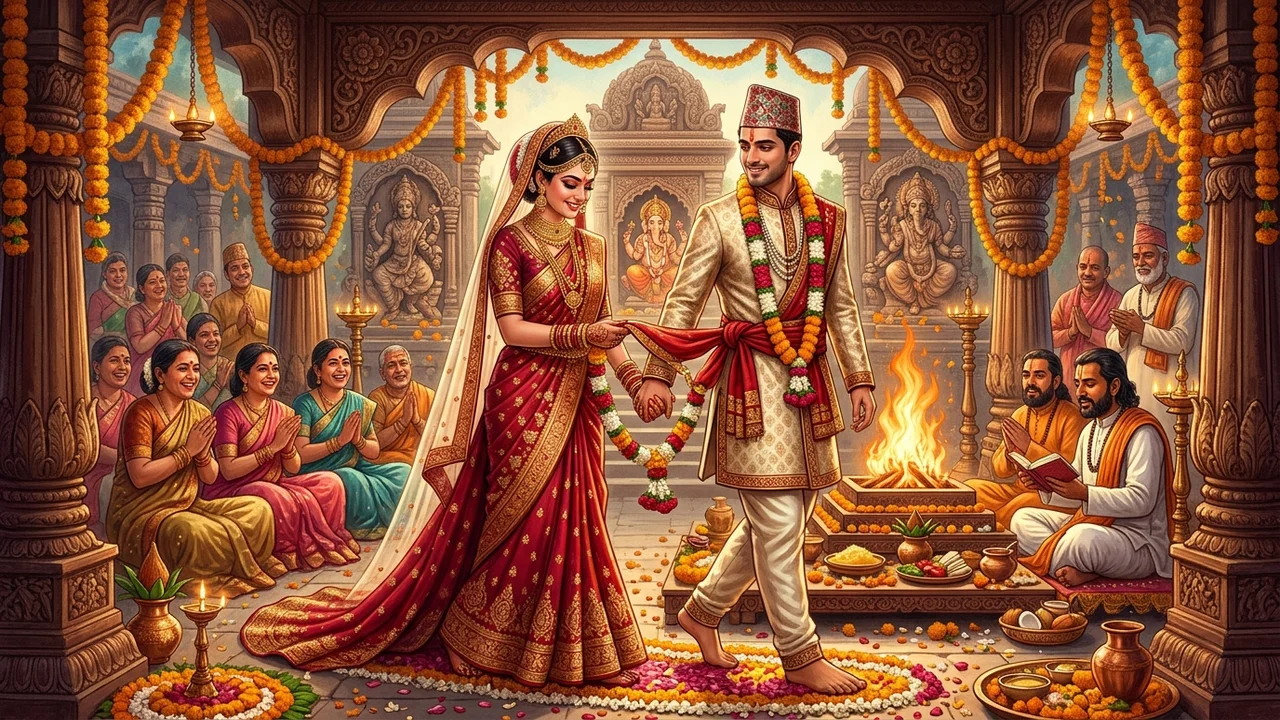
The wedding itself may fill with a bright company from heaven or pass in the stillness of a quieter meeting. A grandmother remembers the colors; a neighbor remembers distant music. In one printed picture, the couple stands against a mountain; in another, a doorway frames them. Each household keeps its own image of the moment when Śiva and Pārvatī are joined. In the dim room, frost still lies along the window beside the book.
As the tale descends from the mountain, snow gives way to a courtyard and daylight falls on brick. Here is a door someone could knock on. The speech sounds like speech from the lane. From the kitchen comes the sound of a pot being set down, and for a moment the house in the story seems close enough to enter.
The wedding does not yet reach Gomā's door. After Śiva and Pārvatī are married, the book still tells the Kirāta night in the Śleṣmāntaka forest, Gaṇeśa and Kumāra, the death of Tārakāsura, Śiva as a deer, Vṛndā, and the serpent wives, to whom Swasthānī appears. Only then does a brāhmaṇa house receive a daughter named Gomā (गोमा). Those nights are the chapters. This page stays with the wedding. The children still want to know what happens when the book comes down from the mountain.
The day
Śiva and Pārvatī's marriage is remembered at Tīj, Gaurā, and Śivarātri. Many households know Śivarātri both as the night of their wedding and as the night of the hunter's story. At Janakpur, Vivāha Pañcamī celebrates another marriage: that of Rāma, Viṣṇu's incarnation, and Sītā.
Also Recommended
Behind the wedding lies Pārvatī's tapas, the sustained austerity through which she pursues her chosen union. Ahead lies Kumāra, the son the gods hoped for, remembered at Sithi Nakha. The Swasthānī gives him chapters of his own; this telling follows the path toward Gomā's household.
नेपालीमा
गलीमा कुहिरो छ, र सुन्नेहरू ऊनमुनि बसेका छन्; चकटीमा तिनका खुट्टा चिसो छन्। माघ महिना हो। स्वस्थानी पढ्नेले शिव र पार्वतीको विवाहमा पुगेर ढोकामा मान्छे रोकिएझैँ रोकिन्छ। रातौँदेखि घरपरिवारले चुचुराहरूबीचको कथा पछ्याएको छ। अब ती दुई जोडिन लागेका छन्, र तिनको विवाहपछि अर्को घर पर्खिरहेको छ।
पार्वतीले आफ्नो छनोट गरिसक्नुभएको छ। उहाँको दृढताले उहाँलाई हावा, चट्टान र हिमालयको हिउँबीच शिवसमक्ष पुर्याएको छ। बिहान चुचुराहरू देखेको सुन्नेले पाठक बोल्दा पनि हिउँको तस्बिर सम्झिराख्न सक्छ। अघिल्लो रातको कथनले ती दुईलाई छुट्टै छोडेको थियो। आज राति तिनको विवाह हुन्छ।
केही कथन पहिले कामदेवमा रोकिन्छन् — इच्छाका देवता, जो तिनको मिलन हतार्याउन खोज्दा जल्छन्। अरू विवाहतिर छिटो बढ्छन्। गति किताब र पढ्ने स्वरअनुसार फरक पर्छ, जसरी घरैपिच्छे फरक पर्छ।
विवाह आफैँ स्वर्गको उज्यालो समूहले भरिन सक्छ, वा शान्त भेटको स्थिरतामा बित्न सक्छ। हजुरआमाले रङ सम्झनुहुन्छ; छिमेकीले टाढाको सङ्गीत सम्झन्छ। एउटा छापिएको तस्बिरमा दम्पती हिमालअगाडि उभिन्छन्; अर्कोमा ढोकाले तिनलाई घेर्छ। शिव र पार्वती जोडिने क्षणको आफ्नै तस्बिर हरेक घरले राख्छ। धमिलो कोठामा किताबछेउको झ्यालमा अझै तुसारो छ।
कथा हिमालबाट तल ओर्लँदै जाँदा हिउँको ठाउँमा आँगन आउँछ र इँटामा घाम पर्छ। यहाँ ढकढक्याउन मिल्ने ढोका छ। बोली गलीको बोलीजस्तै सुनिन्छ। भान्साबाट भाँडो राख्ने आवाज आउँछ, र एकछिन कथाको घर पस्न सकिनेजत्तिकै नजिक लाग्छ।
यो विवाह अझै गोमाको ढोकासम्म पुग्दैन। शिव र पार्वतीको विवाहपछि पनि किताबले श्लेष्मान्तक वनको किरात रात, गणेश र कुमार, तारकासुरको वध, मृगरूप शिव, वृन्दा, र नागिनीहरू भन्छ, जसका अघि स्वस्थानी प्रकट हुनुहुन्छ। त्यसपछि मात्र ब्राह्मणको घरले गोमा नामकी छोरी पाउँछ। ती रात अध्याय हुन्। यो पृष्ठ विवाहमै बस्छ। किताब हिमालबाट ओर्लिँदा के हुन्छ भनेर बच्चाहरूले अझै जान्न चाहन्छन्।
गोमाका दुःख र छोरा नवराजको कथा त्योभन्दा पछिका अध्यायमा छन्।
शिव र पार्वतीको विवाह तीज, गौरा र शिवरात्रिमा सम्झिन्छ। धेरै घरले शिवरात्रिलाई तिनको विवाहको रात र शिकारीको कथाको रात दुवै मान्छन्। जनकपुरमा विवाह पञ्चमीले अर्को विवाह मनाउँछ: राम — विष्णुको अवतार — र सीताको।
विवाहपछाडि पार्वतीको तप छ — आफ्नो रोजेको मिलनका लागि उहाँले गर्नुभएको निरन्तर तपस्या। अगाडि कुमार छन्, देवताले आशा गरेका छोरा, सिठी नखमा सम्झिन्छन्। स्वस्थानीले उहाँलाई आफ्नै अध्याय दिन्छ; यो कथन गोमाको घरतिरको बाटो पछ्याउँछ।
विवाहपछि किताबले अझै किरात रात, गणेश, कुमार, मृग, वृन्दा र नागिनी भन्छ। गोमाको घर त्यसपछि आउँछ।
Where it sits
After this wedding the Swasthānī still tells the Kirāta night, Gaṇeśa, Kumāra, the deer, Vṛndā, and the serpent wives. Gomā's house comes after those nights.