Bisket Jatra is Bhaktapur's own street festival at the turn into Baisakh, when a tall pole comes down, one quarter of the town pulls against another, and the chariots meet in the square. The same kind of street festival fills Patan (पाटन), which is also called Lalitpur (ललितपुर), Bhaktapur (भक्तपुर), which is also called Khvopa (ख्वप), Kirtipur (कीर्तिपुर), Thimi (ठिमी), and Panauti (पनौती). A jātrā (जात्रा) ties a neighborhood to its own crossroads (tvāḥ / त्वाः), its square (dabū / दबू), and its old gate, and a hereditary trust, the guthi (गुठी), carries the procession, keeping a local history that the national calendar does not give its own page. Each town carries the god in its own way, so bronze images ride decorated wooden palanquins (khaḥ / खः), some processions carry swords, and courtyards hold sacred masked dances (pyākhan / प्याखँ).बिस्केट जात्रा भक्तपुरको आफ्नै सडक जात्रा हो, वैशाखको मोडमा, जब अग्लो खम्बा ढल्छ, सहरको एक भागले अर्को भागलाई तान्छ, र रथ चोकमा जुध्छन्। त्यस्तै सडक जात्राले पाटन, जसलाई ललितपुर पनि भनिन्छ, भक्तपुर, जसलाई ख्वप पनि भनिन्छ, कीर्तिपुर, ठिमी, र पनौती भरेका छन्। जात्राले टोललाई आफ्नै दोबाटो, त्वाः, चोक, दबू, र पुरानो ढोकासँग बाँध्छ, र वंशानुगत गुठीले जात्रा बोक्छ, जसले त्यो स्थानीय इतिहास राख्छ, जसलाई राष्ट्रिय पात्रोले छुट्टै पृष्ठ दिँदैन। हरेक सहरले देवतालाई आ-आफ्नै ढङ्गले बोक्छ, त्यसैले काँसाका मूर्ति सजाइएका काठका खःमा चढ्छन्, कति जात्रामा तरवार हिँड्छ, र चोकमा पवित्र मुखुण्डो नाच, प्याखँ, हुन्छ।
1. New year
१. नयाँ वर्ष
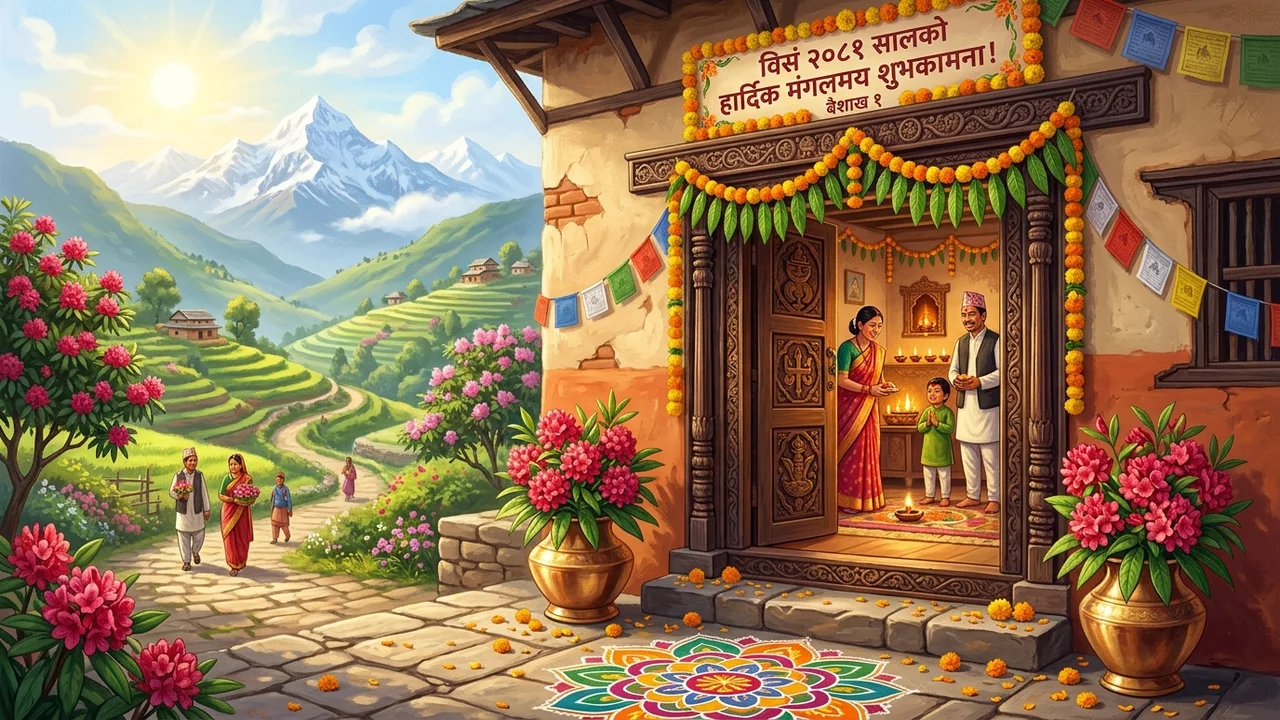
New year at the door: blooming rhododendrons, copper kalash, and mango leaf torans on Baisakh 1.ढोकामा नयाँ वर्ष। बैशाख १ मा लालीगुराँस, तामाको कलश, र आँपका पातको तोरण।
National civil new year observed across all administrative, commercial, and household spheres in Nepal
Presiding Influence
Surya (the Sun transitioning into Aries / Mesha Rāśi)
Iconic Traditions
Dawn bathing, family blessings from elders, reading the annual astrological almanac (Pātro Vācana), community fairs (Melā), opening fresh commercial ledgers
Related Observances
Intertwined with Bhaktapur’s Bisket Jatra and Mithila’s Jude Shital (Jur Sital)
The story
As the sun enters the first zodiacal constellation of Aries on Mesha Sankranti, the morning of the first of Baisakh inaugurates the national civil year of Nepal. Governed by the venerable Bikram Sambat era—which began in 57 BCE and runs approximately fifty-seven years ahead of the Gregorian calendar—this dawn marks not merely an administrative transition, but a deeply personal domestic renewal. While community-specific lunar calendars calculate their sacred festivals according to the waxing and waning fortnights of the moon, this solar opening stands as the shared anchor that coordinates the classrooms, the merchant ledgers, the government gazettes, and the letters dispatched across the hills and the Tarai.
Inside household courtyards, the morning begins with early purification and the crisp rustle of newly laundered garments. Elders take their customary seats in the warm morning light, dipping their fingers into bowls of crimson vermilion and sandalwood paste to touch the brows of children and grandchildren with blessings for health, prosperity, and longevity. On low wooden tables, family priests or household heads unroll the newly printed astrological almanacs (Pātro), reading aloud the planetary predictions for the upcoming four seasons, forecasting monsoon rains, crop yields, and auspicious wedding windows while relatives listen with shared contemplation.
Beyond the family room, village pathways and urban thoroughfares shed the dry quiet of late winter. In Mithila, families celebrate Jur Sital by sprinkling cooling well water over younger relatives to ward off the escalating summer heat; in the mid-hills, temple hilltops host lively seasonal fairs where swings (Liṅge Piṅ) are erected from forest bamboo; and in market towns, shopkeepers settle ancient accounts before lighting incense to inaugurate fresh books of business. Across these diverse landscapes, the first of Baisakh binds disparate valleys into one collective threshold of hope.
In the cities the day is celebrated through warm family visits, the exchange of greetings, and festive community meals. In Bhaktapur the same turn of the year forms the climax of a magnificent historic chariot festival, Bisket Jatra, wherein the ancient struggle between divine vigilance and serpentine malice culminates in the felling of the sacred pole. Concurrently across the western Terai and Mithila, households celebrate Jude Shital with water rites, while at the other seasonal threshold of late winter, Ghode Jatra sends cavalry hooves across Tundikhel to ensure the demon Gurumapa remains safely entombed beneath the earth.
Also Recommended
While the first of Baisakh marks the national civil threshold, other cultural new years grace different seasons across the country. Mha Puja inaugurates the indigenous Nepal Sambat during the autumn lights of Tihar, while Maghi heralds the New Year of the Tharu community upon the winter solstice ingress into Capricorn. High in the Himalayan valleys, three distinct Lhosār mornings greet the seasons of midwinter and spring. Looking forward in the agricultural calendar, this new year gazes toward the monsoon planting celebrated on the fifteenth of Ashad, and the highland Kirat invocation of Ubhauli.
नेपालीमा
सौर गणनाअनुसार सूर्य मीन राशिबाट मेष राशिमा प्रवेश गर्ने मेष संक्रान्तिको पावन दिन नै वैशाख १ गते अर्थात् नेपाली राष्ट्रिय नयाँ वर्षको शुभारम्भ हो। ईसापूर्व ५७ मा सुरु भएको ऐतिहासिक विक्रम संवत्ले निर्धारण गरेको यो दिन नेपालभरिको नागरिक, शैक्षिक, व्यापारिक र पारिवारिक जीवनलाई एउटै समय-सूत्रमा बाँध्ने साझा आधार हो। चन्द्रपात्रोमा आधारित अन्य पर्वहरू तिथिका आधारमा चले पनि यो सौर बिहानीले देशैभरि नयाँ उत्साह र संकल्पको ढोका खोल्छ।
बिहानीपख घरका आँगनहरू सफा गरेर नयाँ पोसाकमा सजिएका परिवारजनले आफ्ना ज्येष्ठ नागरिकहरूबाट टीका-अक्षता र दीर्घायुको आशीर्वाद ग्रहण गर्छन्। घरघरमा नयाँ वर्षको नयाँ पात्रो (पञ्चाङ्ग) भित्तामा टाँगिन्छ र वर्षभरिको ग्रहगोचर, वर्षाको सम्भावना तथा शुभमुहूर्तको भविष्यवाणी सुनिन्छ। तराई-मधेशमा यस दिनलाई जुडशीतलका रूपमा मनाउँदै अग्रजहरूले कनिष्ठहरूको शीरमा चिसो पानी छर्किएर शीतलताको कामना गर्छन् भने पहाडी इलाकाहरूमा डाँडाकाँडाका मन्दिरहरूमा नयाँ वर्षका मेलाहरू लाग्छन्। यसरी वैशाखको पहिलो प्रभातले विगतका हिसाबकिताबलाई बिदा गर्दै नयाँ सम्भावना र पारिवारिक मिलनको उज्यालो छर्दछ।
Where it sits
The year on these pages starts here and goes on to Rama's birth. Bhaktapur's chariot on these same days is Bisket.
2. Bisket Jatra
२. बिस्केट जात्रा
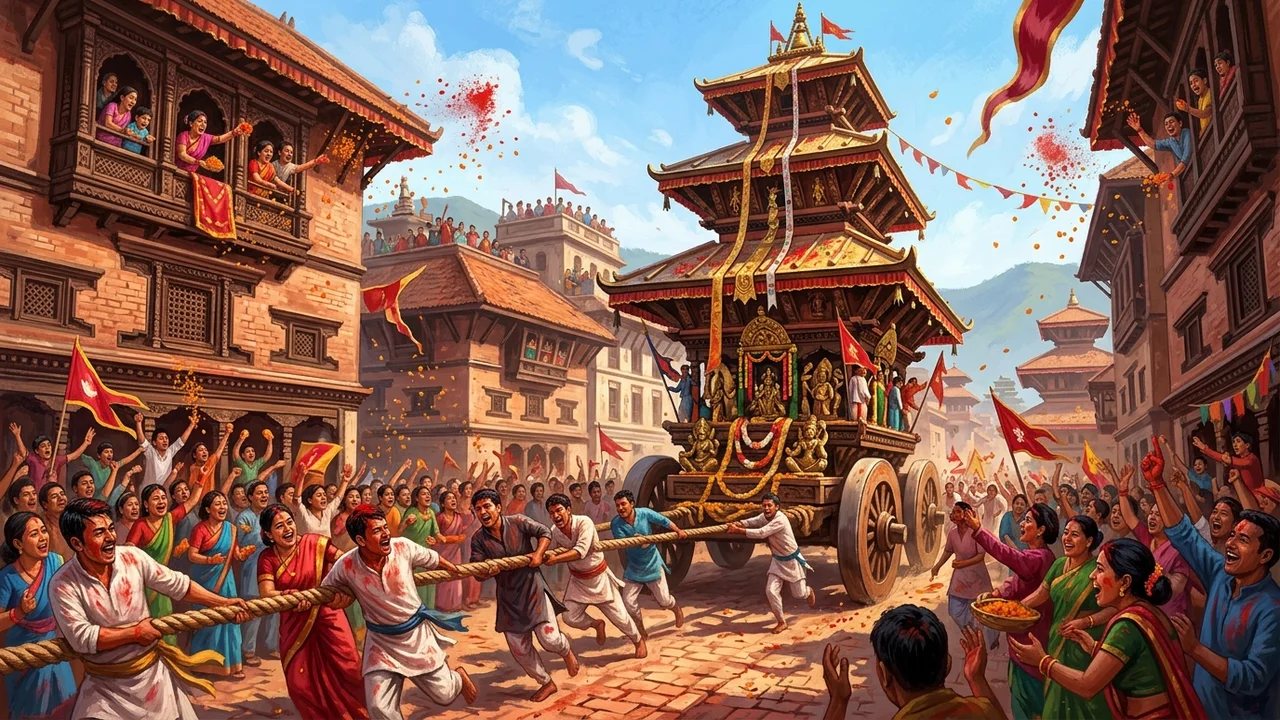
The heavy wooden chariot stands against the brick houses of Bhaktapur.भक्तपुरका इँटाका घरअगाडि काठको गह्रुँगो रथ उभिन्छ।
Festival Duration
8 nights and 9 days (concluding days of Chaitra through the opening week of Baisakh)
Primary Location
Bhaktapur (Khwopa) Durbar Square, Taumadhi Tol, Bhelukhel (Lyasinkhel), and Bode
Presiding Deities
Kash Bhairav (Bhairavnath) and Bhadrakali
Sacred Monuments
Erection and felling of the 55-cubit wooden Yosin (Vishwa Dhwaja) pole; towering multi-tiered chariot of Bhairavnath
Key Ritual Highlights
Chariot tug-of-war (Thaneyne vs. Kwheyne); union of Bhairav and Bhadrakali; tongue-piercing rite (Jibro Chhedne) in Bode
The story
In the ancient royal city of Bhaktapur, the turn of the year is celebrated through an eight-night, nine-day festival rooted in a chilling legend of royal doom and divine courage. According to folklore, a Licchavi princess possessed a fatal nocturnal curse: every suitor who wed her was found lifeless on the bridal bed by sunrise, strangled by venomous serpents that slithered forth from her nostrils the moment she drifted into sleep. As mourning swept the palace morning after morning, the throne faced ruin until an intrepid foreign prince accepted the royal bride, determined to pierce the mystery of her bedroom.
Forewarned by a nocturnal vision of Goddess Bhadrakali, the prince steadfastly resisted sleep throughout the long, quiet night. As the candle flickered low and the princess fell into deep slumber, two deadly serpents emerged from her nostrils, growing in size as they approached his throat. Leaping forward with his drawn sword, the vigilant prince decapitated both serpents before they could strike, thereby breaking the demonic curse and restoring life and lineage to the city. King Jagajjyoti Malla later codified this victory as Bi-Syāta—Newar for "the slaying of the serpents"—a phrase that gradually evolved over centuries into the beloved name Bisket.
The day
The modern festival transforms this ancient myth into a magnificent urban spectacle that draws the entire valley into Bhaktapur’s brick courtyards. In Taumadhi Square, beside the soaring five-roofed Nyatapola temple, thousands of citizens seize colossal hemp ropes to wage an exhilarating tug-of-war, pulling the three-tiered wooden chariot of Bhairavnath toward either the upper town (Thaneyne) or the lower town (Kwheyne). On the final evening of Chaitra, a straight 55-cubit pine trunk—the Yosin or Vishwa Dhwaja, hung with two long ceremonial banners representing the slaughtered serpents—is hoisted upright at Lyasinkhel, only to be deliberately felled on the afternoon of New Year’s Day to dramatize the death of evil and the rebirth of cosmic order. Concurrently in nearby Bode, a devotee from the Shrestha clan undergoes the historic tongue-piercing ritual (Jibro Chhedne), carrying a flaming bamboo rack through the streets to ward off epidemics and misfortune.
Also Recommended
The slaughtered serpents of Bisket connect with the subterranean guardians venerated during Nāg Panchami, though those monsoon rites seek life-giving groundwater rather than liberation from palace curses. Kathmandu’s festive counterweight at the other end of Chaitra is Ghode Jatra, whose galloping cavalry tramples the demon Gurumapa beneath the soil of Tundikhel. In the divine realm of celestial weddings where the groom never perishes, households turn to the eternal union of Shiva and Pārvatī.
भक्तपुरको ऐतिहासिक बिस्केट जात्रा आठ रात नौ दिनसम्म अत्यन्त हर्षोल्लासका साथ मनाइने एक प्राचीन सांस्कृतिक उत्सव हो, जसको नाम नेवारी भाषाको 'बि-स्यात' (अर्थात् सर्प मारियो) बाट अपभ्रंश भई 'बिस्केट' रहन गएको हो। किंवदन्तीअनुसार प्राचीन कालमा भक्तपुरकी एक राजकुमारीसँग विवाह गर्ने हरेक दुलहा बिहान ओछ्यानमै मृत भेटिन्थे, किनकि राजकुमारी निदाउनासाथ उनका नाकका प्वालबाट दुई विषालु नाग-नागिनी निस्किएर दुलहालाई डस्ने गर्दथे। राज्यमा ठूलो शोक र सन्त्रास छाएको बेला एक साहसी विदेशी राजकुमारले देवी भद्रकालीको आराधना गरी सल्लाहबमोजिम विवाहको रातभर जागा बस्ने अठोट गरे।
रातको निस्तब्धतामा राजकुमारी निदाएपछि जब उनका नाकबाट दुई भयानक सर्पहरू निस्किए, तरवार हातमा लिएर कुरिरहेका चतुर राजकुमारले तत्कालै प्रहार गरी दुवै सर्पलाई मारिदिए। बिहान उज्यालो हुँदा राजकुमार सकुशल रहेको र राजकुमारीको श्राप मुक्ति भएको देखेर राजा जगज्ज्योति मल्लले त्यसै दिनदेखि यस विजयलाई राष्ट्रिय उत्सवका रूपमा मनाउन सुरु गराए। यस जात्रामा ताउमढी चोकमा भैरवनाथ र भद्रकालीको विशाल काठको रथलाई हजारौँ नागरिकले माथिल्लो (थाने) र तल्लो (क्वेने) टोलतर्फ तानातान गर्छन्। चैतको मसान्तमा भेलुखेलमा ५५ हात लामो लिंगो (योसिँद्यः) ठड्याइन्छ, जसको टुप्पामा ती मारिएका सर्पका प्रतीक दुई ध्वजा झुन्ड्याइन्छ र नयाँ वर्षको दिन ढालेर शत्रुनाशको सन्देश दिइन्छ। यस्तै मध्यपुर थिमीको बोडेमा जिब्रो छेड्ने अनौठो र ऐतिहासिक जात्रासमेत यसै अवसरमा सम्पन्न हुन्छ।
Where it sits
This is Bhaktapur's story of the new year. The civil opening of the same days is the first of Baisakh. The horse festival at the other end of Chaitra is Ghode Jatra.
3. Ubhauli
३. उभौली
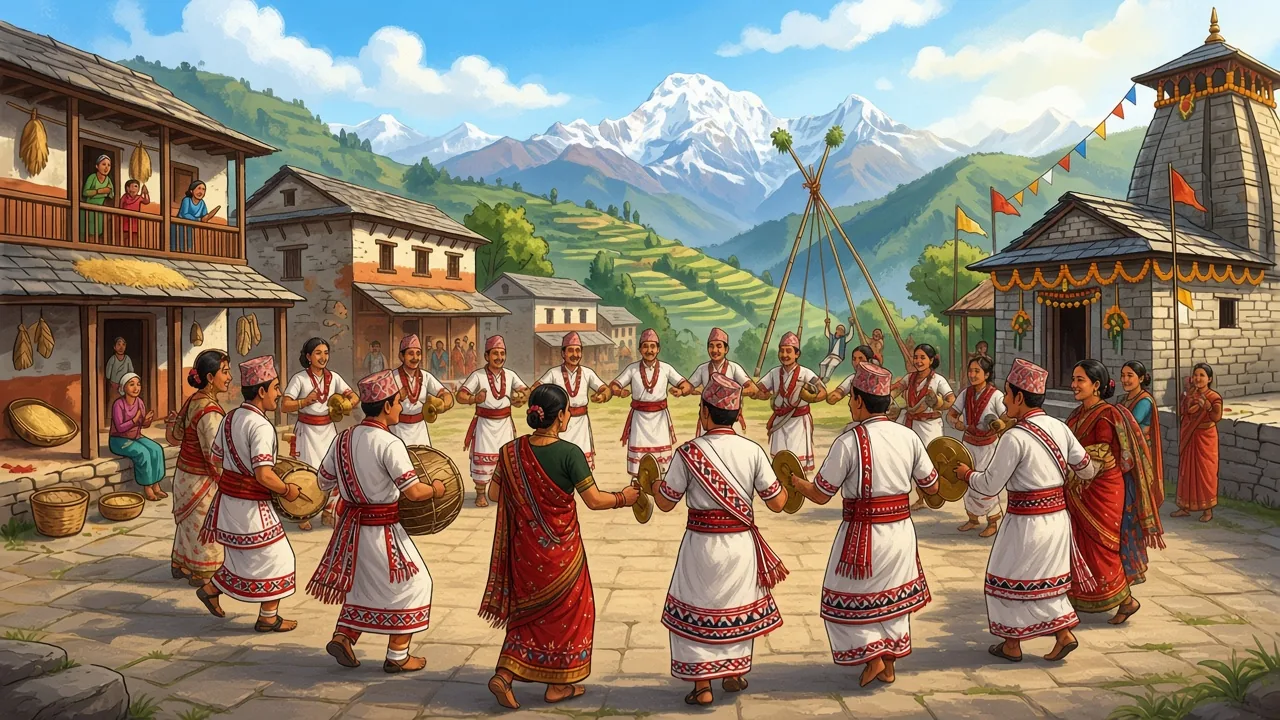
The line of dancers faces the high fields.नाच्नेहरूको लाम माथिल्ला खेततिर फर्किन्छ।
Calendrical Timing
Baishākh Śukla Purnima (the auspicious full moon of Baisakh)
Primary Communities
Kirat people (Rai, Limbu, Yakkha, Sunuwar) of Eastern Nepal and diaspora
Presiding Divinity
Supreme Creator Tagera Ningwaphuma, ancestral deities Paruhang and Sumnima
Sakela Sili circle dance, led by the tribal priest (Nokcho), reenacting animal courtship and farming steps
The story
Perched along the emerald, mist-shrouded ridges of eastern Nepal, the stone homesteads of the Rai and Limbu communities greet the full moon of Baisakh with the spiritual festival of Ubhauli (Ubhauli / उभौली). Deeply anchored in the oral philosophy of the Kirati Mundhum, Ubhauli celebrates the summer phase of seasonal transhumance: the necessary upward movement (Ubho) of humans, livestock, and mountain wildlife toward cooler alpine pastures and fertile highland terraces as the oppressive heat and monsoon moisture begin to settle over the lower river valleys.
Because the planting season is now imminent, the community turns collectively toward Mother Earth (Bhumi Puja) to seek divine protection for the tender seeds soon to be sown in the newly ploughed terraces. In the sacred cosmology of the Kirat, humanity does not stand separate from the ecological order; rather, survival and prosperity depend upon living in conscious balance with the spirits of the forest, the water channels, and the towering mountain peaks where ancestral spirits abide.
The day
On the festival morning, village squares and open gathering grounds echo with the resonant heartbeat of the double-headed Dhol and the bright crash of the brass Jhyāmtā cymbals. Led by the Nokcho or village elder who carries a holy brass vessel and ceremonial ginger leaves, a long, unbroken circle of men, women, and children forms for the Sakela Sili dance. Dressed in brilliant traditional handwoven attire—the women adorned in scarlet waistbands, golden head ornaments, and silver coin necklaces—the dancers execute dozens of distinct Silis, each sequence gracefully mimicking the movements of nesting partridges, soaring eagles, forest deer, and the human rhythms of sowing, weeding, and reaping grain.
Also Recommended
The cyclical counterweight to this highland ascent arrives with the winter harvest in Mangsir, when the same communities celebrate Udhauli, turning their steps downward as grain fills the home bins. The national rice transplantation rite arrives midway through the rains on the fifteenth of Ashad, while the primeval spirits of soil and water are propitiated during Nāg Panchami.
पूर्वी नेपालका डाँडाकाँडा र पाखाहरूमा बसोबास गर्ने प्रकृतिपूजक किरात समुदाय (राई, लिम्बू, याक्खा र सुनुवार) ले वैशाख पूर्णिमाको दिन भव्य रूपमा मनाउने महान् सांस्कृतिक पर्व उभौली हो। किरात मुन्धुम दर्शनमा आधारित यो चाडले ऋतु परिवर्तनसँगै हुने बसाइँसराइ वा उँभो लाग्ने (गर्मी छल्न लेक वा उच्च पहाडतर्फ प्रस्थान गर्ने) प्राकृतिक नियमलाई प्रतिनिधित्व गर्दछ। यसै बेलादेखि बालीनाली लगाउने समय सुरु हुने भएकाले अन्नबाली सप्रियोस्, कुनै रोगव्याधि नलागोस् र प्राकृतिक विपत्ति नआओस् भनी आमा पृथ्वी (भूमे) र कुलपितृहरूको पूजा-आराधना गरिन्छ।
यस पावन दिनमा किरात बस्तीहरू र सहरी खुला मैदानहरू ढोल र झ्याम्टाको गम्भीर गुञ्जनले मुखरित हुन्छन्। कुलपुरोहित (नोक्छो वा बिजुवा) ले पूजाआजा सम्पन्न गरेपछि परम्परागत भेषभूषामा सजिएका बालबालिकादेखि वृद्धवृद्धासम्म एउटै गोलो घेरामा बाँधिएर 'साकेला सिली' नाच्छन्। यस नाचका विभिन्न सिलीहरूमा चराचुरुङ्गीको चाल, जनावरको हाउभाउ, खेतीपातीका विभिन्न चरणहरू र मानव जातिको उत्पत्तिको कथालाई शारीरिक मुद्राद्वारा सजीव ढङ्गमा अभिनय गरिन्छ। उभौलीले प्रकृति र मानवबीचको घनिष्ठ सम्बन्ध तथा किराती पुर्खा 'पारुहाङ' र 'सुम्निमा' प्रतिको अनन्त श्रद्धालाई जीवन्त तुल्याउँछ।
Where it sits
On these pages, Ubhauli comes first among the days other families keep. The return later in the year is Udhauli. The national planting day is the fifteenth of Ashad.
4. Mata Tirtha Aunsi/Aama ko Mukh Herne
४. मातातीर्थ औंसी / आमाको मुख हेर्ने
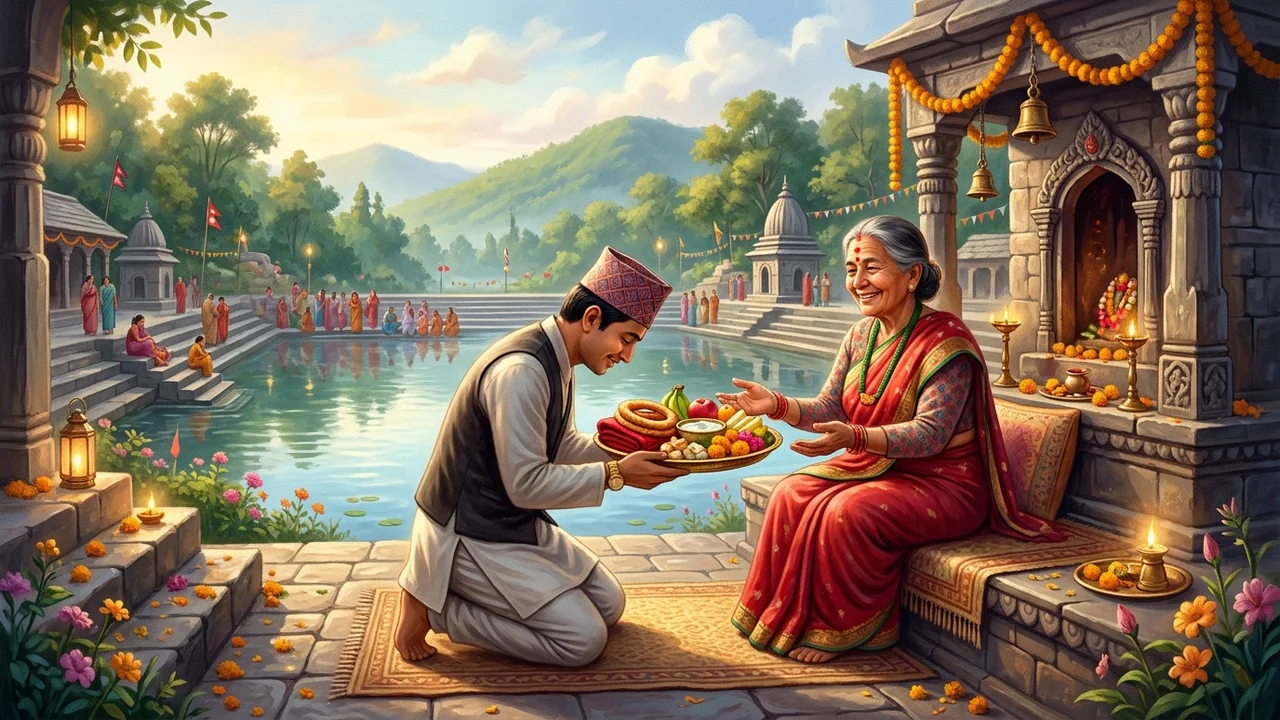
The pond at Mata Tirtha reflects the morning hills.मातातीर्थको पोखरीमा बिहानीका डाँडाको प्रतिबिम्ब देखिन्छ।
Calendrical Timing
Baishākh Krishna Amavasya (the new moon day of Baisakh)
Cultural Scope
Pan-Nepalese observance honoring biological mothers and maternal lineage
Presiding Deities
Mātṛ Deva (mothers revered as living embodiments of the divine principle)
Traditional Offerings & Foods
Sweets, seasonal fruits, curd, fine garments; for departed mothers: Piṇḍa, black sesame seeds, and sacred Kuśa grass
Primary Pilgrimage Site
The sacred freshwater spring and ponds of Mata Tirtha at the western base of the Chandragiri hills
The story
Falling on the dark new moon of Baisakh, Mātā Tīrtha Aunsi is Nepal’s time-honored day of maternal veneration, uniting living filial devotion with sacred remembrance for ancestors. For living mothers, the day is affectionately known as Āmā ko Mukh Herne ("gazing upon mother’s face"). Sons and daughters return home from distant duties bearing delicacies, fresh fruits, curd, and fine clothes. In a touching domestic rite, children bow their foreheads directly onto their mother’s feet, seeking forgiveness for past shortcomings and receiving her unconditional blessings and sweetmeats in return.
For those whose mothers have departed this earthly life, the day centers upon pilgrimage, obsequies, and spiritual release. Thousands travel southwest from Kathmandu to the ancient pond of Mata Tirtha, situated beneath the pine forests of Chandragiri. According to local lore, in antiquity a grief-stricken cowherd boy was sitting by the pool lamenting the loss of his beloved mother while eating his mid-day bread. Suddenly, glancing into the calm, clear spring water, he beheld the living countenance of his departed mother gazing back at him with radiant tenderness and lovingly reaching out to accept his offering. Comforted by this miracle, he returned home in peace, establishing the pond forever as a sanctified thin place where offerings of Tarpaṇa and Piṇḍadāna directly nourish and liberate the maternal soul.
The day
At the pond, the gathering comprises children and adults who have lost a mother, bringing the traditional elements of Vedic obsequies: sacred water, earthen oil lamps, sesame seeds, and cooked rice balls offered in her memory. In the homes of living mothers, the day unfolds with emotional bows, colorful gifts, and festive family meals prepared in her honor. Together, these two distinct observances complete the sacred circle of maternal veneration across generations.
Also Recommended
Fathers have their corresponding day of filial devotion four months later during Kushe Auṃsī, observed on the dark moon of Bhadra at the Gokarneshwar temple on the Bagmati. All departed family ancestors are collectively nourished during Sohra Shraddha just prior to Dashain, while the bovine procession that guides souls across the river Vaitarani fills the streets in Gai Jatra.
वैशाख कृष्ण औंसीका दिन मनाइने मातातीर्थ औंसीलाई नेपाली समाजमा 'आमाको मुख हेर्ने दिन' वा 'मातृसम्मान दिवस' का रूपमा अत्यन्त श्रद्धाका साथ हेरिन्छ। यस दिन सन्तानहरूले आफ्नी जन्मदात्री आमाप्रति अनन्त कृतज्ञता व्यक्त गर्दै मीठा-मीठा परिकार, फलफूल, वस्त्र उपहार दिन्छन् र आमाको गोडामा शीर राखेर ढोग्दै आशीर्वाद थाप्छन्। टाढा-टाढा रहेका छोराछोरीहरू पनि आफ्नी आमालाई भेट्न घर पुग्छन्, जसले गर्दा यो दिन पारिवारिक स्नेह र पुनर्मिलनको उत्सव बन्दछ।
आमा गुमाइसकेका सन्तानहरूका लागि भने यो दिन दिवंगत मातृआत्माको शान्ति र मोक्षका लागि विशेष तीर्थस्नान र पिण्डदान गर्ने दिन हो। काठमाडौं उपत्यकाको पश्चिमपट्टि चन्द्रागिरिको फेदीमा अवस्थित पवित्र 'मातातीर्थ' कुण्डमा हजारौँ श्रद्धालुहरू पुगेर श्राद्ध तथा तर्पण गर्छन्। पौराणिक कथाअनुसार उहिल्यै एक गोठालोले आफ्नी मृत आमाको वियोगमा रोएर रोटी खाँदै गर्दा मातातीर्थको पोखरीको पानीमा आफ्नी आमाको स्पष्ट अनुहार देखेको र आमाले स्नेहपूर्वक त्यो रोटी ग्रहण गरेको विश्वास गरिन्छ। सोही अलौकिक घटनापछि मातातीर्थ कुण्डमा स्नान गरी पिण्डदान गर्नाले दिवंगत आमाले तृप्ति पाउने र सन्तानलाई मातृऋणबाट मुक्ति मिल्ने धार्मिक विश्वास रहिआएको छ।
Where it sits
This dark moon is the springtime commemoration of mothers. Its companion festival for honoring fathers arrives four months later on the new moon of Bhadra, Kushe Auṃsī, celebrated at the Gokarneshwar temple on the Bagmati.
5. Buddha Jayantī
५. बुद्ध जयन्ती
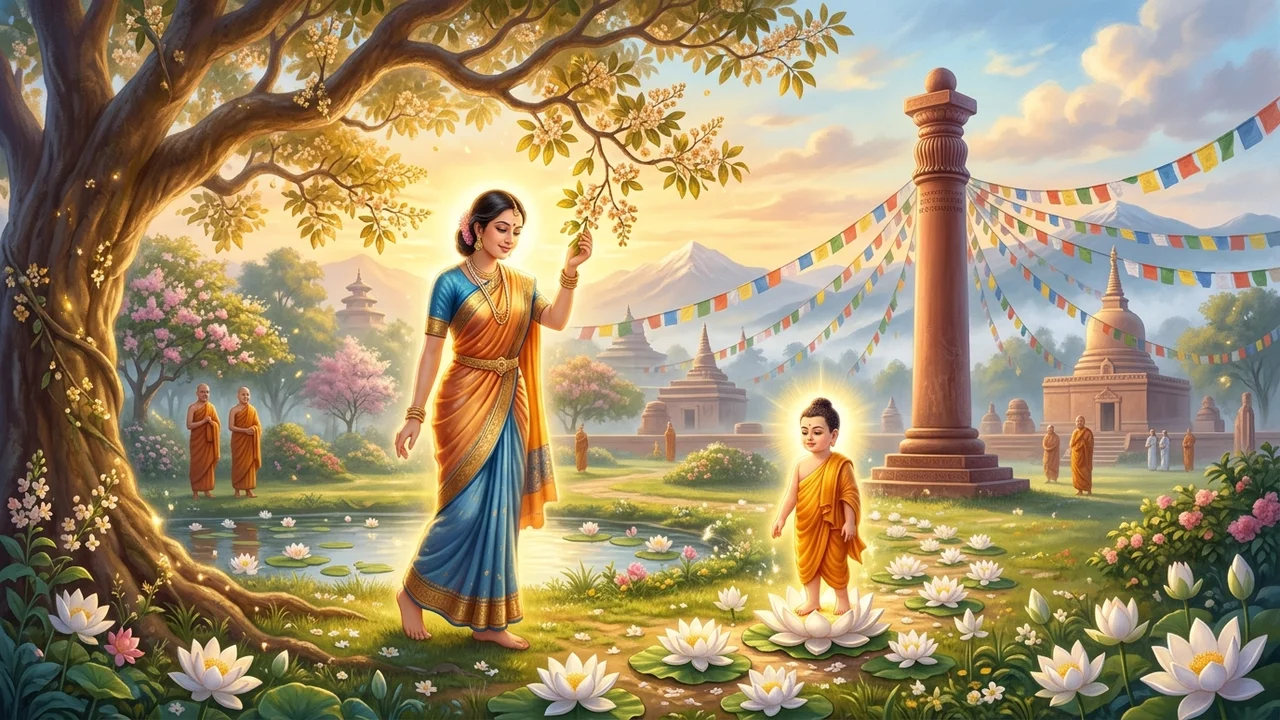
The Mayadevi temple and Ashoka pillar stand in the garden.बगैँचामा मायादेवीको मन्दिर र अशोक स्तम्भ उभिन्छन्।
Calendrical Timing
Baishākh Śukla Purnima (the auspicious full moon of Baisakh)
Cultural Scope
National holiday celebrated across Nepal by Buddhist, Hindu, and international pilgrims; known globally as Vesak or Saga Dawa
Central Figure
Siddhartha Gautama (Shakyamuni Buddha, the Awakened One)
Key Sacred Sanctuaries
The Mayadevi Temple & Ashoka Pillar (Lumbini), Swayambhunath, Boudhanath, and Namo Buddha
The Triad of Significance
The "Thrice-Blessed Day" commemorating the Buddha’s miraculous Birth (623 BCE), Supreme Enlightenment (Bodhi at age 35), and Mahāparinirvāṇa (at age 80)
The story
On the luminous full moon of Baisakh, Nepal and the global Buddhist world celebrate the Thrice-Blessed Day of Buddha Jayanti (Buddha Jayantī / बुद्ध जयन्ती). In Theravāda, Mahāyāna, and Vajrayāna traditions alike, this extraordinary date marks three paramount milestones in the life of Siddhartha Gautama: his miraculous birth in the sal grove of Lumbini in 623 BCE, his supreme awakening (*Bodhi*) under the Bodhi tree at Bodh Gaya thirty-five years later, and his final departure into liberation (*Mahāparinirvāṇa*) at Kushinagar at the age of eighty. Thus, a single spring full moon encompasses the dawn, zenith, and culmination of an enlightened human life.
In Lumbini, where Emperor Ashoka erected his famous stone pillar in 249 BCE to proclaim "Hida Budhe Jate Sakyamuniti" (*"Here was born the Buddha, Sage of the Shakyas"*), pilgrims from every continent circumambulate the sacred Pushkarini pond and the nativity marker stone. In the Kathmandu Valley, Newar Buddhists observe the day as Swānyā Punhi ("the full moon of flowers"), honoring the Buddha as the ninth avatar of Vishnu in an enduring syncretic bond that unites Hindu and Buddhist households in shared reverence for non-violence (Ahiṁsā) and universal compassion (Karuṇā).
The day
From early dawn, the whitewashed domes of Swayambhunath and Boudhanath are ringed with endless streams of devotees carrying butter lamps, fresh lotus flowers, and incense sticks. Monks in saffron, maroon, and crimson robes chant the protective verses of the *Mangala Sutta* while spinning thousand-fold rows of copper prayer wheels. Devout laypeople take the eight precepts, abstaining from harm and releasing captive birds and fish to affirm the sanctity of all sentient life. As twilight falls over the valley, thousands of golden butter lamps illuminate the great stupas, sending their warm, flickering glow against the dark Himalayan horizon.
Also Recommended
The Kathmandu Valley’s dedicated Buddhist holy month arrives later in the rainy season during Gunlā, when early-morning musical processions make the daily pilgrimage to Swayambhu. The great serpent Mucalinda, who sheltered the Buddha from storms following his enlightenment, echoes the protective serpent veneration kept on Nāg Panchami.
वैशाख शुक्ल पूर्णिमाको दिन विश्व शान्तिका अग्रदूत भगवान् गौतम बुद्धको 'त्रि-संयोग' को पावन स्मृतिमा बुद्ध जयन्ती मनाइन्छ। बौद्ध परम्परामा यस पूर्णिमालाई अत्यन्त दुर्लभ र पावन मानिन्छ, किनकि ईसापूर्व ६२३ मा रूपन्देहीको लुम्बिनीस्थित शाल वनमा सिद्धार्थ गौतमको जन्म भएको, ३५ वर्षको उमेरमा बोधगयास्थित बोधिवृक्षमुनि उहाँलाई सम्यक सम्बोधि (ज्ञान) प्राप्त भएको, र ८० वर्षको उमेरमा कुशीनगरमा महापरिनिर्वाण प्राप्त भएको—यी तीनै महान् ऐतिहासिक घटनाहरू वैशाख पूर्णिमाकै दिन घटेका थिए। यसैले यस दिनलाई विश्वभर 'वैशाख दिवस' (भेसाक) का रूपमा पनि श्रद्धापूर्वक मनाइन्छ।
नेवार बौद्ध समुदायमा यस दिनलाई 'स्वाँया पुन्हि' (फूल फुल्ने पूर्णिमा) भनिन्छ, जहाँ बुद्धलाई करुणा र अहिंसाका प्रतिमूर्तिका रूपमा पूजा गरिन्छ। काठमाडौंको स्वयम्भूनाथ, बौद्धनाथ र नमोबुद्धलगायत देशैभरिका गुम्बा तथा विहारहरूमा बिहानैदेखि दीप प्रज्वलन, शान्ति पदयात्रा, अष्टशील ग्रहण र सूत्रपाठ गरिन्छ। सम्राट अशोकले तेस्रो शताब्दी ईसापूर्वमा लुम्बिनीमा ठड्याएको ऐतिहासिक स्तम्भले बुद्धको जन्मभूमि नेपाल भएको तथ्यलाई संसारभर प्रमाणित गर्दछ। यसरी बुद्ध जयन्तीले बुद्धका चार आर्यसत्य, अष्टाङ्गिक मार्ग तथा करुणा र मैत्रीभावको शाश्वत सन्देशलाई पुनः स्मरण गराउँछ।
Where it sits
This is a national public holiday on the Baisakh full moon. The Kathmandu Valley's intensive month of daily Buddhist dawn circumambulations arrives later in Shrawan, Gunlā.