Nepali Readings / Ambalika Devi
Ambalika Devi (अम्बालिकादेवी)अम्बालिकादेवी
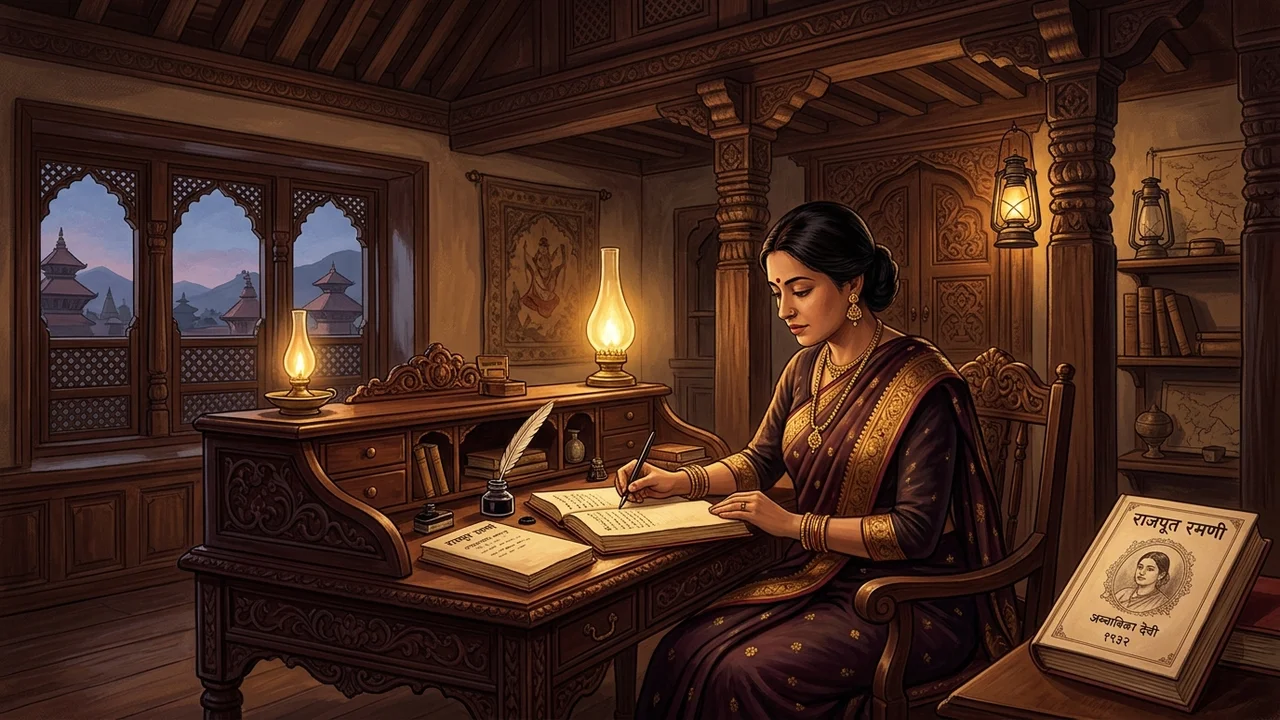
The first woman to publish a Nepali novel
| Historic Milestone | First Female Novelist in the History of Nepali Literature |
|---|---|
| Lifespan & Origins | 1894–1936 CE (1951–1993 BS) · Born in Makhan, Kathmandu · Lived in Patna, India |
| Inaugural Masterpiece | Rajput Ramani (1932, "The Rajput Heroine" — historical-romantic novel published by Khadgavilas Press in Bankipore, Patna) |
| Significance | Demonstrated that Nepali women could author intricate extended prose fiction decades before modern public universities opened in Nepal. |
In 1932 CE (1989 BS), Ambalika Devi (Ambālikādevī / अम्बालिकादेवी) achieved a monumental milestone in Himalayan literary history by publishing Rajput Ramani (Rājapūta Ramaṇī / राजपूत रमणी, "The Rajput Heroine") through the Khadgavilas Press in Bankipore, Patna, thereby becoming the very first woman to author and publish a novel in the Nepali language.
Born Putali ("Butterfly") Nepal in 1894 in the historic Kathmandu neighborhood of Makhan into an aristocratic family connected to the royal court, she was married at age seven to the eminent jurist and scholar Ambika Prasad Upadhyaya, following him to Patna where she immersed herself in multilingual libraries and modern world literature while enduring chronic physical frailty. Rather than succumbing to the domestic seclusion mandated by feudal orthodoxy, she marshaled an extraordinary autodidactic discipline to produce a 115-page historical romance—defiantly prefixing her own portrait opposite the title page as an unyielding assertion of female authorship and intellectual presence.
Weaving alternating prose narratives and metered verses, Rajput Ramani constructs a moral and psychological dialectic in which feminine virtue (satītva) is transformed from passive submission into an active, luminous spiritual power that incinerates oppressive male tyranny. Long marginalized by patriarchal literary historiography, Ambalika Devi's pioneering contribution stands as a foundational monument of early modern Nepali fiction.
Makhan, the nurse's granddaughter, Patna
Her father Ekrishna Nepal was a subba in the Rana (राणा) administration. Her mother was Ratna Kumari. The mother's mother, Devkumari Koirala (कोइराला), had been a wet-nurse to King Prithvi Bir Bikram, and "Koiralni Bajyai" was a name the city knew. The Nepal house had means and a standing. Putali was the middle daughter of seven, and she was called Butterfly because she was, by every account that loves her, strikingly beautiful as a child. Beauty is not usually a literary fact. In her case it is, because the novel's whole engine is the danger and the authority of a beautiful woman, and because the nickname survived into the biographies as if the person and the subject had been introduced in the same breath.
At seven she was married to Ambika Prasad Upadhyaya, also called Paudel, of Ramnagar in Bihar. The custom changed her name to match his: Ambalika. She went to her husband's house in Patna. He read for an M.A. and a law degree and practiced at the High Court of Bihar and Orissa. Accounts call him the first lawyer of Nepali (नेपाली) origin to practice in India, and if the "first" is the kind of first that later research sometimes complicates, the secure sentence is still strong. A Nepali (नेपाली) woman of the Rana (राणा) years was living in Patna as the wife of a serious lawyer, taught at home by tutors, in an English-medium education, in a house where the shelves held the novels she had finished. One memoir-like account puts those finished novels and story collections near two thousand. She watched films. She began to write poems, songs, and stories. The body was already ill. She wrote the novel anyway.
They had no child of their own. They adopted Rajeshwar Prasad, a son of Ambika Prasad's brother. The adoption belongs in the life because the novel is so concerned with a woman's duty inside a marriage, and the marriage itself had to invent its heir. A dharma-son is not a footnote. It is the household's answer to the same pressure Mainali (मैनाली)'s Deviraman feels when the astrologers tell him to marry again. Ambalika's house answered differently. The answer did not become a long life. Patna, December 1936, is the end.
What the novel is, and what this page will not invent
Rajendra Subedi's criticism, as it is quoted by later Nepali (नेपाली) essays, puts Rajput Ramani (राजपूत रमणी) in a useful place. For the modern period of the Nepali (नेपाली) novel it feels early. For the middle period it feels late. The book is transitional. The story lifts off from men's attraction to a woman's beauty and settles on her surrender to her husband as a fierce example. Women, in its argument, are as gentle as they are beautiful, and the gentleness has a severity at its limit. The conclusion the essays draw is that a woman is the meeting of Lakshmi, Saraswati, and Mahakali. Prose and verse run together, so the book also wants to be a poem. She wrote the preface on 19 Baisakh (वैशाख) 1989, which is that 1 May, and Ishwari Prasad Upadhyaya saw it through the Varanasi press.
This page does not invent the characters' adventures. A historical novel about a Rajput woman can be retold scene by scene only with the book open, and the honest sitting is the one that says so. What is firm is the wager. In a decade when Yogmaya (योगमाया) was banned in the east for saying a widow's body was not fuel, a younger woman in Patna published a tale in which a wife's fidelity is a fire that burns the intruder. The two women are not the same politics. Yogmaya (योगमाया) organized. Ambalika fictionalized a virtue the orthodox already praised, and by fictionalizing it under her own name she made the virtue a woman's intellectual property. The photograph inside the book is the gesture to remember. She wanted the face and the idea to arrive together. An anonymous virtue was not enough.
The language will trouble a reader who wants today's Nepali (नेपाली). That trouble is a date, not a failure. A woman writing Nepali (नेपाली) prose in Patna in 1932 was not sitting in the Sharada (शारदा) circle that was about to form in Kathmandu. She was ahead of the circle and outside it. Lok Priya, her contemporary, will publish poems in Sharada (शारदा) and be legible as Devkota's (देवकोटा) sister. Ambalika published first, in a genre the men were only just making respectable, and then she died before the circle could adopt her. The forgetting is structural. A single novel, printed in Varanasi, by a woman who did not live to write the second, drops out of the syllabus more easily than a man who lived to be eighty and chair an academy. The recovery in 2014, naming her with the other missing women, is a correction this shelf should not have to wait for a conference to make.
What to carry out of the room
Carry Putali and the renamed wife. Carry one hundred and fifteen pages and a photograph. Carry Patna as a Nepali (नेपाली) literary capital that Kathmandu did not own. Carry the argument, Lakshmi and Saraswati and Kali in one woman, and carry your right to dispute the duty she calls highest. The dispute is only interesting if the book is allowed to have spoken first. She died at forty-two. The novel is the whole shelf she got.
नेपाली उपन्यास छाप्ने पहिली नारी
अम्बालिकादेवी नेपाली उपन्यास छापामा पुर्याउने पहिली नारी हुन्। किताबको नाम राजपूत रमणी हो। यो १ मे १९३२ मा पूरा भएको थियो र ११५ पृष्ठको छ। त्यही सेप्टेम्बरमा वाराणसीको जनरल ट्रेडिङ कम्पनीले यसलाई छापेको थियो। किताबभित्र आवरणपछि उनले आफ्नो तस्बिर राखिन्। किताबलाई उनले शिक्षाप्रद ऐतिहासिक कथा भनिन्। उनी पुतली नामले २० मे १८९४ (१९५१ जेठ ८) मा काठमाडौंको मखनटोलमा जन्मिएकी थिइन् र बयालीस वर्षको उमेरमा १५ डिसेम्बर १९३६ मा पटनामा बितिन्। उनको एउटा उपन्यास छ, जीवन छोटो रह्यो, र पछिल्ला साहित्यिक मान्यतालाई यो तथ्य सम्झाउनुपरेको छ। ई.सं. २०१४ मा नेपाली साहित्यको आधिकारिक इतिहासमा थोरै वा बिल्कुलै नलेखिएका नारीहरूमध्ये उनको नाम लिइयो, लोकप्रियादेवी र अरूसँगै।
उनी नेपालकी पहिली महिला उपन्यासकार हुन्। उनका पृष्ठ यहाँ नछापी समालोचनाले जति देख्न सक्छ, उनको शैली गद्य र पद्य मिसिएको हो, भाषा पछिल्लो नेपालीमा अभ्यस्त पाठकलाई बिझाउन सक्ने किसिमको छ, र नारीबारेको तर्क सशक्तीकरण शब्दभन्दा पुरानो छ तर त्यसमा सशक्तीकरणको भाव पहिले नै समेटिएको छ। सुन्दरताले पुरुषलाई तान्छ। पतिप्रतिको निष्ठा उनले रोजेको नैतिक केन्द्र हो। नारी कोमल छिन्, र कोमलताको अन्तिम छेउमा कठोर छिन्। लक्ष्मी, सरस्वती र काली एक रूपमा भेटिन्छन्। किताबको सतीत्व सानो उपदेश होइन। आलोचकहरू त्यसलाई शक्तिका रूपमा पढ्छन्। नारीको निष्ठा भङ्ग गर्न आउनेलाई त्यो निष्ठाको तेजले जलाउँछ। आजको पाठकले उनले प्रशंसा गरेको धर्मसँग बहस गर्न सक्छ। बहस यही तथ्यबाट सुरु हुनुपर्छ कि ई.सं. १९३२ मा एक नेपाली नारीले त्यो आफ्नै अनुहारसहित छापिन्।
मखन, धाईको नातिनी, पटना
उनका बुबा एककृष्ण नेपाल राणा प्रशासनका सुब्बा थिए। उनकी आमा रत्नकुमारी थिइन्। आमाकी आमा देवकुमारी कोइराला राजा पृथ्वीवीरविक्रमकी धाईआमा थिइन्, र कोइराल्नी बज्यै सहरले चिनेको नाम थियो। नेपाल परिवारसँग साधन र प्रतिष्ठा थियो। पुतली सात छोरीमध्ये माइली थिइन्, र उनलाई माया गर्ने हरेकको भनाइअनुसार बालिकाका रूपमा असाधारण सुन्दर भएकाले उनलाई पुतली भनिन्थ्यो। सुन्दरता प्रायः साहित्यिक तथ्य होइन। उनको हकमा भने हो, किनभने उपन्यासको सारा चालक शक्ति सुन्दर नारीको खतरा र अधिकार हो, र उपनाम जीवनीहरूमा यसरी टिकेको छ मानौं व्यक्ति र विषयको एउटै सासमा परिचय गराइएको थियो।
सात वर्षकै उमेरमा बिहारको रामनगरका अम्बिकाप्रसाद उपाध्यायसँग (पौडेल पनि भनिने) उनको विवाह भयो। चलनअनुसार उनको नाम उहाँको नामसँग मिल्ने गरी बदलियो: अम्बालिका। उनी पटनाको ससुराली गइन्। उहाँले एम.ए. र कानून पढ्नुभयो र बिहार तथा उडिसाको उच्च अदालतमा वकालत गर्नुभयो। विवरणहरूमा उहाँलाई भारतमा वकालत गर्ने नेपाली मूलका पहिलो वकिल भनिएको छ, र यो “पहिलो” पछिको अनुसन्धानले कहिलेकाहीँ जटिल बनाउने किसिमको भए पनि सुरक्षित वाक्य अझै बलियो छ। राणाकालकी एउटी नेपाली नारी एक गम्भीर वकिलकी पत्नीका रूपमा पटनामा बस्थिन्। उनी घरमै गुरुहरूबाट पढेकी थिइन्, अङ्ग्रेजी माध्यमको शिक्षा पाएकी थिइन्, र उनको घरमा उनले पढिसकेका उपन्यासले भरिएका दराज थिए। संस्मरणजस्तो एउटा विवरणले उनले पढिसकेका ती उपन्यास र कथासङ्ग्रहको सङ्ख्या दुई हजारको हाराहारी भनेको छ। उनी सिनेमा हेर्थिन्। कविता, गीत र कथा लेख्न थालिन्। शरीर पहिले नै बिरामी थियो। तैपनि उनले उपन्यास लेखिन्।
उनीहरूका आफ्नै सन्तान थिएनन्। अम्बिकाप्रसादका भतिजा राजेश्वरप्रसादलाई धर्मपुत्र बनाइयो। धर्मपुत्र जीवनमा अटाउँछ किनभने उपन्यास विवाहभित्रको नारीधर्ममा यति केन्द्रित छ, र विवाहले आफ्नै उत्तराधिकारी रच्नुपरेको थियो। धर्मपुत्र पादटिप्पणी होइन। यो त्यही दबाबप्रति घरको जवाफ हो, जुन दबाब ज्योतिषीले फेरि विवाह गर्न भन्दा मैनालीका देवीरमणले महसुस गर्छन्। अम्बालिकाको घरले अर्कै जवाफ दियो। जवाफ लामो जीवन बनेन। पटना, डिसेम्बर १९३६, अन्त्य हो।
उपन्यास के हो, र यो पृष्ठले के रच्दैन
पछिल्ला नेपाली निबन्धले उद्धृत गरेजस्तै राजेन्द्र सुवेदीको समालोचनाले राजपूत रमणीलाई काम लाग्ने ठाउँमा राख्छ। नेपाली उपन्यासको आधुनिक कालका लागि यो चाँडो लाग्छ। मध्यकालका लागि ढिलो लाग्छ। यो सङ्क्रमणकालको किताब हो। कथा नारीको सुन्दरताप्रति पुरुषको आकर्षणबाट उठ्छ र पतिप्रतिको समर्पणमा उग्र उदाहरणका रूपमा बस्छ। यसको तर्कमा नारी जति सुन्दर त्यति कोमल छन्, र कोमलताको सीमामा कठोरता छ। निबन्धले निकाल्ने निष्कर्ष नारी लक्ष्मी, सरस्वती र महाकालीको सङ्गम हुन् भन्ने हो। गद्य र पद्य सँगै चल्छन्, त्यसैले किताब कविता पनि बन्न चाहन्छ। उनले भूमिका १९८९ वैशाख १९ मा लेखिन्, त्यो दिन १ मे थियो, र ईश्वरीप्रसाद उपाध्यायले वाराणसीको छापाखानामा यसको छपाइ पूरा गराए।
यो पृष्ठले पात्रका साहसिक कथा रच्दैन। राजपूत नारीको ऐतिहासिक उपन्यास दृश्य-दृश्य गरी सुनाउन किताब खोलेरै मात्र मिल्छ, र इमानदार बैठक त्यही भन्ने हो। पक्का कुरा भने उनको बाजी हो। योगमायालाई पूर्वमा विधवाको शरीर इन्धन होइन भन्दा प्रतिबन्ध लगाइएको दशकमा एउटी कान्छी नारीले पटनाबाट यस्तो कथा छापिन्, जसमा पत्नीको निष्ठा घुसपैठ गर्नेलाई जलाउने आगो हो। दुई नारीको राजनीति एउटै होइन। योगमायाले सङ्गठन बनाइन्। अम्बालिकाले रूढिवादीहरूले पहिले नै प्रशंसा गरेको गुणलाई कथाको रूप दिइन्, र त्यो आफ्नै नाममा गरेर गुणलाई नारीको बौद्धिक सम्पत्ति बनाइन्। किताबभित्रको तस्बिर सम्झिराख्नुपर्ने इसारा हो। उनी अनुहार र विचार सँगै पुगून् भन्ने चाहन्थिन्। बेनामी गुण पर्याप्त थिएन।
आजको नेपाली चाहने पाठकलाई भाषा बिझाउला। बिझाइ मिति हो, असफलता होइन। ई.सं. १९३२ मा पटनामा नेपाली गद्य लेख्ने नारी काठमाडौंमा बन्न लागेको शारदा वृत्तमा बसेकी थिइनन्। वृत्तभन्दा अघि र बाहिर थिइन्। उनकी समकालीन लोकप्रियाले शारदामा कविता छाप्नेछिन् र देवकोटाकी दिदीका रूपमा चिनिनेछिन्। अम्बालिकाले पहिले छापिन्, पुरुषले भर्खर सम्मानित बनाउँदै गरेको विधामा, अनि वृत्तले अपनाउनुअघि मरिन्। बिर्सिइनु संरचनागत कुरा हो। वाराणसीमा छापिएको एउटा उपन्यास, दोस्रो उपन्यास लेख्न नबाँचेकी नारीको, असी वर्ष बाँचेर प्रज्ञा-प्रतिष्ठानको अध्यक्षता गर्ने पुरुषभन्दा पाठ्यक्रमबाट सजिलै खस्छ। ई.सं. २०१४ मा हराइरहेका अरू नारीसँगै उनको नाम लिइनु एउटा सच्याइ हो, जुन गर्न यो तहले सम्मेलनको पर्खाइमा बस्नु हुँदैन।
कोठाबाट के लैजाने
पुतली र नाम फेरिएकी पत्नीलाई लैजानुहोस्। एक सय पन्ध्र पृष्ठ र एउटा तस्बिर लैजानुहोस्। पटनालाई काठमाडौंको स्वामित्वमा नभएको नेपाली साहित्यिक राजधानीका रूपमा लैजानुहोस्। तर्क लैजानुहोस्, एक नारीमा लक्ष्मी र सरस्वती र काली, र उनले सर्वोच्च भनेको धर्मसँग बहस गर्ने आफ्नो हक पनि लैजानुहोस्। किताबले पहिले बोल्न पाएको छ भने मात्र बहस रोचक हुन्छ। उनी बयालीस वर्षको उमेरमा बितिन्। उपन्यास उनले पाएको सारा तह हो।
Where it sits
The page before this one is Yogmaya Neupane (योगमाया न्यौपाने). The page after it is Lok Priya Devi (लोकप्रियादेवी). The great later novelist is Parijat (पारिजात). The judge of childless houses is Mainali (मैनाली).