Nepali Readings / Yogmaya Neupane
Yogmaya Neupane (योगमाया न्यौपाने)योगमाया न्यौपाने
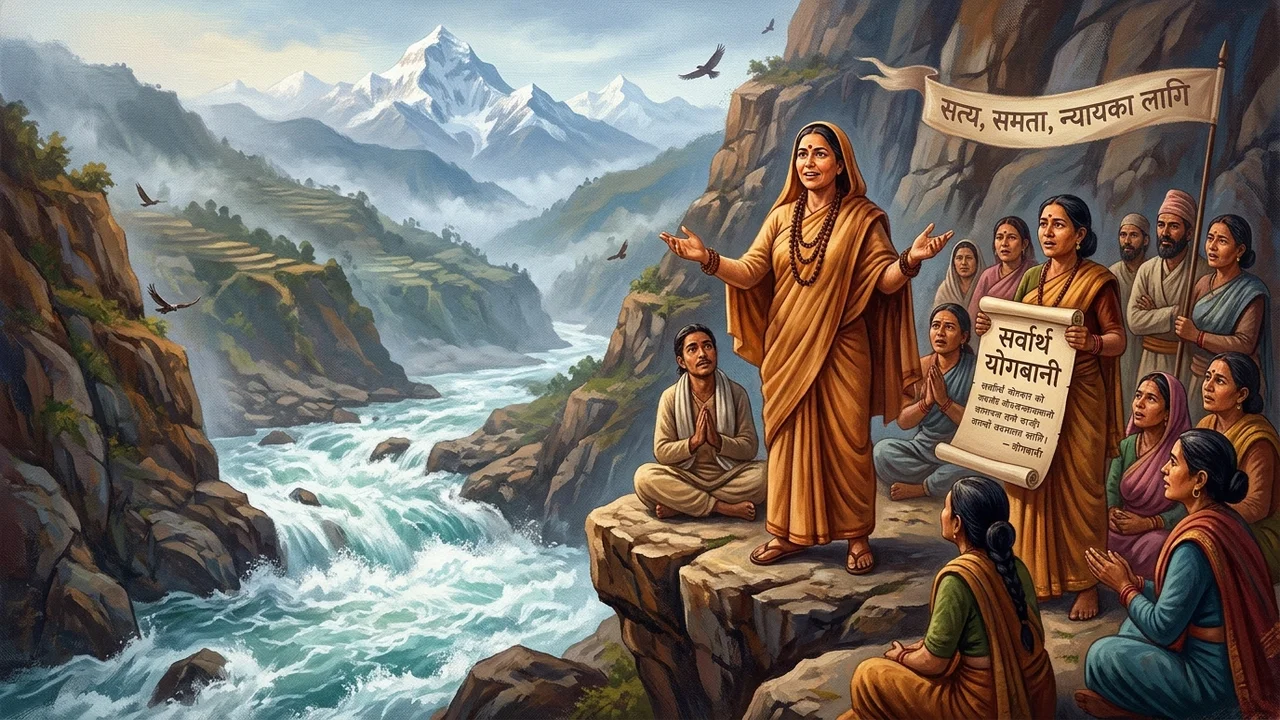
The voice before the salon
| Sacred Identity | Ascetic Reformer, Poetic Prophet of Social Equality, and Martyr for Freedom |
|---|---|
| Lifespan & Origins | 1867–1941 CE (1924–1998 BS) · Born in Majhuwabesi, Dingla, Bhojpur, eastern Nepal |
| Spiritual & Civic Movement | Non-violent spiritual revolt against the autocratic Rana regime of Juddha Shumsher and orthodox feudal patriarchy |
| The Call for Dharma Bhiksha | Demanded systemic state reform: eradication of caste untouchability, total abolition of child marriage, legal protection for widows, and an end to corrupt usury and priestly exploitation |
| Poetic Testament | Sarwartha Yogbani (extemporaneous rhymed verses of blistering moral clarity and egalitarian bhakti, composed without formal schooling and recorded by her disciple Prem Narayan Bhandari) |
| Historic Martyrdom (Jal-Samadhi) | On Haribodhini Ekadashi in 1941 (1998 BS), facing military encirclement by Rana troops sent to crush her commune, Yogmaya led 67 disciples into the roaring currents of the Arun River in collective martyrdom—the largest mass sacrifice for social justice in Nepali history. |
Long before modern political salons formed in Kathmandu or Banaras, a solitary Brahmin woman in the remote eastern hills of Bhojpur mounted one of the most radical, heroic revolts against feudalism, caste oppression, and patriarchal violence in South Asian history. Yogmaya Neupane (Yogamāyā Neupāne / योगमाया न्यौपाने) was an ascetic mystic whose extemporaneous devotional poetry and unyielding civic defiance shook the foundations of the autocratic Rana state.
Born in 1867 CE (1924 BS) in Majhuwabesi, Dingla, Bhojpur, Yogmaya was married as an infant at age seven and widowed at age nine, experiencing firsthand the brutal domestic and social degradation inflicted on child widows. Fleeing into ascetic renunciation across Assam and the high Himalayas, she returned to Dingla in her maturity to establish an egalitarian spiritual commune along the banks of the sacred Arun River. Preaching a radical bhakti that rejected caste distinctions, child marriage, and the exploitation of peasant debtors, she demanded Dharma Bhiksha ("the alms of true righteousness") from Prime Minister Juddha Shumsher.
Her spontaneous rhymed oral verses—memorized and compiled by her devoted follower Prem Narayan Bhandari as Sarwartha Yogbani—represent a blistering poetic assault on priestly hypocrisy, bureaucratic corruption, and patriarchal cruelty. In 1941, when the Rana regime dispatched military forces to disperse her commune, Yogmaya refused surrender. On the holy dawn of Haribodhini Ekadashi, she led sixty-seven disciples into the raging currents of the Arun River in a collective Jal-Samadhi (sacred martyrdom by water), leaving an immortal testament of spiritual and political resistance.
Marriages, the daughter, the ascetic
The early life is a series of marriages in a world that married girls early and called the result fate. The accounts say she had had enough of marriages and of the ordinary way of a house. She took the rare step, for a woman of that time, of living as an ascetic. Men left for the forest and were admired. A woman who did it was a scandal or a saint, depending on who was speaking. She came back to Majhuwabesi (मझुवाबेसी) with her daughter Nainakala (नैनकला) and gave the child to her brother Agnidhar Neupane (अग्निधर न्यौपाने) and her sister-in-law Ganga (गङ्गा). Then she set the household down. The poems begin in that freedom, which was also a loss. A mother who hands her daughter to a brother's house in order to speak for other women is not a symbol. She is a person making an ugly, costly bargain, and the book is what the bargain bought.
Nainakala (नैनकला) did not stay only in that house. She is with her mother at the end, in the river. The reader should hold both facts. The girl was given away so the ascetic life could start. The woman was not given away from her mother when the state closed in. The Yogbani (योगवाणी) is the speech of the years between those two decisions.
The committee, the ban, the river
The Nari Samiti (नारी समिति) is the work that keeps Yogmaya (योगमाया) from being only a mystic. A mystic can be admired and ignored. An organization that lobbies against the burning of widows is a political fact. Sati's (सती) abolition in Nepal in 1920 has many causes, and honest history does not give the whole law to one circle in Bhojpur (भोजपुर). It does say that Yogmaya's (योगमाया) women were a main pressure, and that is enough to change how a reader hears the verses. They are not private devotion with a social hobby attached. The devotion is the authority by which she could say, in public, that a woman's body was not a husband's pyre.
The Ranas (राणा) answered as they answered other inconvenient speech. The poems were banned. The group was watched. Unlike the poets who built Nepali (नेपाली) in Darjeeling, she did not make a career of exile. She stayed. Staying, under a ban, is a literary decision as well as a geographical one. Dharanidhar (धरणीधर) could print Naivedya (नैवेद्य) in a British hill town. Yogmaya's (योगमाया) book had to live in disciples' hands and in a memory the state wanted quiet. What was printed is, by the accounts, only a portion. The rest went on being composed until 1941, and then it went into the water with the people who knew it.
The jal-samadhi (जलसमाधि) is not a metaphor this page will soften. She and her followers entered the Arun (अरुण) and did not come out. Nainakala (नैनकला) was among them. Different tellings count the dead differently, and this page will not invent a number. What is stable is the form. A religious community, forbidden and finished with petition, chose the river rather than obedience or flight. In the Hindu imagination a jal-samadhi (जलसमाधि) can be a saint's controlled death. In the political imagination of the Rana (राणा) years it is also a refusal. Both readings are true enough to keep. The poems are the speech before the refusal. The river is the last line, and nobody wrote it down, because the writers were in it.
How to read her beside the others
Ambalika Devi (अम्बालिकादेवी), younger, will publish a novel from Patna and die of illness at forty-two. Lok Priya (लोकप्रिया) will write letters in verse in a Kathmandu house and be Devkota's (देवकोटा) sister. Parijat (पारिजात) will write the modern novel from a bed. Yogmaya (योगमाया) is earlier, harsher, and less literary in the salon sense, which is why she belongs at the start of the women's shelf and not as an appendix to the men. Her Nepali (नेपाली) is the east. Her authority is religious. Her politics are the body of a widow and the dignity of people without rank. A reader who wants only style will be impatient. A reader who wants to know what a woman could say in Nepal before women had a magazine will find that the saying was already loud, and that it cost a river.
What to carry out of the room
Carry Majhuwabesi (मझुवाबेसी) and the Arun (अरुण). Carry the Nari Samiti (नारी समिति) beside the 1920 end of sati (सती), as a pressure and not as a solitary miracle. Carry the illiteracy as part of the art: the poem existed in the mouth, and the book is a disciple's net. Carry the daughter twice, once given to a brother and once in the water. The Yogbani (योगवाणी) is the text. The death is not a metaphor.
बैठकभन्दा अघिको स्वर
योगमाया न्यौपाने पारिजातभन्दा अघि र काठमाडौंका कवयित्रीहरूभन्दा अघि पढ्नुपर्ने नारी हुन्, किनभने उनी कुनै पत्रिकाबाट आइनन्। उनको जन्म ई.सं. १८६७ मा भोजपुरको मझुवाबेसीमा भयो, र ई.सं. १९४१ मा अनुयायीहरूसहित अरुण नदीमा जलसमाधि, अर्थात् पानीमा गरिने धार्मिक मृत्युमा, उनको मृत्यु भयो। उनी र छोरी नैनकला पढ्न सक्दैनथिए। शिष्यहरूले श्लोक टिपे। किताब सर्वार्थ योगवाणी हो। उनलाई नेपालका पहिलो महिला कविमध्ये एक भनिन्छ, र उनी धार्मिक नेतृ तथा संगठक पनि हुन्। ई.सं. १९१८ मा उनले नारी समिति स्थापना गरिन्, जसलाई नेपाली महिलाको पहिलो संगठन मानिन्छ, र त्यो समूह ई.सं. १९२० मा नेपालमा सती प्रथा अन्त्य गराउने दबाबको एक अंश हो। राणाहरूले कविता प्रतिबन्ध लगाए र समूहमाथि निगरानी राखे। उनी पूर्वमै बसिन्। बाँचेका श्लोक नदीको वर्षसम्म उनले रचिरहेकामध्ये सानो अंश मात्र हुन्।
यो नामसँग शिरोमणि जोडिएको छैन। यो घरले इमानदारीपूर्वक प्रयोग गर्न सक्ने उपाधि उनको जीवनले पहिल्यै बोलिसकेको छ: योगिनी, गुरु, योगवाणीकी नारी। उनको शैली हिन्दू धार्मिक घेराभित्र मुखर छ। उनी आसाममा बसेकी थिइन्, र विद्वान्हरूले सुरुका विषयमा दयानन्द सरस्वतीको सुधारवादी आर्य मिजाजको प्रतिध्वनि सुन्छन्। कविताहरूले नारीको जीवन र राज्यले सानो ठानेका मानिसको कुरा गर्छन्, दरबारी कविताको शिष्टाचारबिना। राणाकालीन नेपाल र ब्रिटिस शासनको भारत उनको वरिपरिको मौसम हुन्। उनले जन्मेकै ठाउँमा बस्ने रोजिन्। त्यही रोजाइ अन्तिम अध्याय र काव्यशास्त्र पनि हो। काठमाडौं मात्र गन्ने साहित्यले राणाकालको सबैभन्दा चर्को नारीस्वर छुटाउँछ, किनभने उनी गनिन कहिल्यै आइनन्।
विवाह, छोरी, तपस्विनी
सुरुको जीवन केटीलाई चाँडै बिहे गरिदिने र त्यसको परिणामलाई भाग्य भन्ने संसारमा एकपछि अर्को विवाहको शृङ्खला थियो। भनिन्छ, विवाह र घरको साधारण बाटोबाट उनी आजित भइसकेकी थिइन्। त्यस बेलाकी नारीका लागि दुर्लभ कदम चाल्दै उनले तपस्विनी भएर बस्ने बाटो लिइन्। पुरुष वन जान्थे र प्रशंसा पाउँथे। यही काम गर्ने नारी बोल्ने मानिसअनुसार कि कलङ्क ठहरिन्थिन्, कि सन्त। नैनकलालाई लिएर उनी मझुवाबेसी फर्किन् र बालिकालाई दाजु अग्निधर न्यौपाने र भाउजू गङ्गाको जिम्मा लगाइन्। अनि घरको जिम्मेवारी छाडिदिइन्। कविताहरू त्यही स्वतन्त्रतामा सुरु हुन्छन्, जुन एक क्षति पनि थियो। अरू नारीका लागि बोल्न छोरीलाई दाजुको घरमा सुम्पने आमा प्रतीक होइनन्। उनी नराम्रो र महँगो मोलतोल गर्ने मानिस हुन्, र किताब त्यही मोलतोलले किनेको कुरा हो।
नैनकला त्यही घरमा मात्र रहिनन्। अन्त्यमा नदीमा उनी आमासँगै छिन्। पाठकले दुवै तथ्य मनमा राख्नुपर्छ। तपस्वी जीवन सुरु होस् भनेर केटीलाई अर्काको जिम्मा लगाइयो। राज्यले घेरा हाल्दा चाहिँ त्यही नारी आमाबाट अलग गरिइनन्। योगवाणी ती दुई निर्णयका बीचका वर्षको बोली हो।
समिति, रोक, नदी
नारी समितिको काम नै योगमायालाई केवल रहस्यवादी हुनबाट जोगाउँछ। रहस्यवादीको प्रशंसा गरेर बेवास्ता गर्न सकिन्छ। विधवालाई जलाउने चलनविरुद्ध दबाब दिने संगठन राजनीतिक तथ्य हो। नेपालमा ई.सं. १९२० मा सती प्रथा उन्मूलन हुनुका धेरै कारण छन्, र इमानदार इतिहासले सारा कानुनको श्रेय भोजपुरको एउटा समूहलाई दिँदैन। तर योगमायाका महिलाहरू मुख्य दबाबमध्ये थिए भन्न चाहिँ त्यसले सक्छ, र पाठकले श्लोक सुन्ने तरिका बदल्न त्यति नै पर्याप्त छ। ती सामाजिक शौक जोडिएको निजी भक्ति होइनन्। भक्ति त्यो अधिकार हो, जसले उनलाई सार्वजनिक रूपमा नारीको शरीर पतिको चिता होइन भन्न दिन्थ्यो।
राणाहरूले अरू असजिला बोलीलाई जवाफ दिएजस्तै जवाफ दिए। कविता प्रतिबन्धित भए। समूहमाथि निगरानी राखियो। दार्जिलिङमा नेपाली भाषा बनाउने कविहरूजस्तो उनले निर्वासनलाई पेसा बनाइनन्। उनी बसिन्। प्रतिबन्धमुनि बस्नु भौगोलिक निर्णय मात्र होइन, साहित्यिक निर्णय पनि हो। धरणीधरले ब्रिटिस पहाडी सहरमा नैवेद्य छाप्न सक्नुहुन्थ्यो। योगमायाको किताब शिष्यहरूका हातमा र राज्यले शान्त राख्न चाहेको स्मृतिमा बाँच्नुपर्थ्यो। भनाइअनुसार छापिएको अंश मात्र हो। बाँकी ई.सं. १९४१ सम्म रचिँदै रह्यो, अनि त्यो जान्ने मानिससँगै पानीमा गयो।
जलसमाधि यो पृष्ठले नरम पार्ने रूपक होइन। उनी र अनुयायीहरू अरुणमा पसे र निस्केनन्। नैनकला तीमध्ये थिइन्। फरक वृत्तान्तले मृतकको सङ्ख्या फरक गन्छन्, र यो पृष्ठले कुनै सङ्ख्या बनाउँदैन। स्थिर कुरा चाहिँ रूप हो। निषेध गरिएको र निवेदनबाट थाकेको धार्मिक समुदायले आज्ञापालन वा भाग्नुको सट्टा नदी रोज्यो। हिन्दू कल्पनामा जलसमाधि सन्तको नियन्त्रित मृत्यु हुन सक्छ। राणाकालको राजनीतिक कल्पनामा यो अस्वीकार पनि हो। दुवै पढाइ राख्न लायक हुने गरी साँचा छन्। कविताहरू अस्वीकारभन्दा अघिको बोली हुन्। नदी अन्तिम पङ्क्ति हो, र त्यो कसैले लेखेन, किनभने लेख्ने मानिस त्यहीँ थिए।
अरूको छेउमा कसरी पढ्ने
उनीभन्दा कान्छी अम्बालिकादेवीले पटनाबाट उपन्यास छाप्नेछिन् र बयालीस वर्षको उमेरमा रोगले बित्नेछिन्। लोकप्रियाले काठमाडौंको घरमा पद्यमा चिठी लेख्नेछिन् र देवकोटाकी दिदी हुनेछिन्। पारिजातले खाटबाट आधुनिक उपन्यास लेख्नुहुनेछ। योगमाया यिनीहरूभन्दा अघिकी, बढी कठोर, र बैठकको अर्थमा कम साहित्यिक हुन्, त्यसैले उनी महिला तहको सुरुमा पर्छिन्, पुरुषहरूको परिशिष्टका रूपमा होइन। उनको नेपाली पूर्वको हो। उनको अधिकार धार्मिक छ। उनको राजनीति विधवाको शरीर र दर्जा नभएकाहरूको गरिमा हो। शैली मात्र चाहने पाठक अधीर हुन्छ। पत्रिका हुनुअघि नेपालमा नारी के भन्न सक्थी भन्ने जान्न चाहने पाठकले बोली पहिले नै चर्को थियो, र त्यसको मोल एउटा नदी थियो भन्ने भेट्टाउँछ।
कोठाबाट के लैजाने
मझुवाबेसी र अरुण लैजानुहोस्। नारी समितिलाई ई.सं. १९२० मा सती प्रथा अन्त्य भएसँगै, एक्लो चमत्कारका रूपमा होइन, दबाबका रूपमा लैजानुहोस्। निरक्षरतालाई कलाको अंशका रूपमा लैजानुहोस्: कविता मुखमा थियो, किताब शिष्यले फैलाएको जाल हो। छोरीलाई दुई पटक लैजानुहोस्, एक पटक दाजुलाई दिइएकी र एक पटक पानीमा। योगवाणी पाठ हो। मृत्यु रूपक होइन। यो पृष्ठभन्दा अघिको पृष्ठ तरुण तपसीको हो। कवि लेखनाथ पौड्याल हुन्। यसपछिको पृष्ठ अम्बालिकादेवीको हो। पछिल्ला नारीको क्रोध लेख्ने उपन्यासकार पारिजात हुन्। उपत्यकाका मृतकको नदी पशुपतिमा बताइएको छ। योगमायाको नदी अरुण हो।
Where it sits
The page before this one is Tarun Tapasi (तरुण तपसी). The poet is Lekhnath Paudyal (लेखनाथ पौड्याल). The page after it is Ambalika Devi (अम्बालिकादेवी). The novelist of a later woman's anger is Parijat (पारिजात). The river of the valley's dead is told at Paśupati (पशुपति). Yogmaya's (योगमाया) river is the Arun (अरुण).