Nepali Readings / Laxmi Prasad Devkota
Laxmi Prasad Devkota (लक्ष्मीप्रसाद देवकोटा)लक्ष्मीप्रसाद देवकोटा
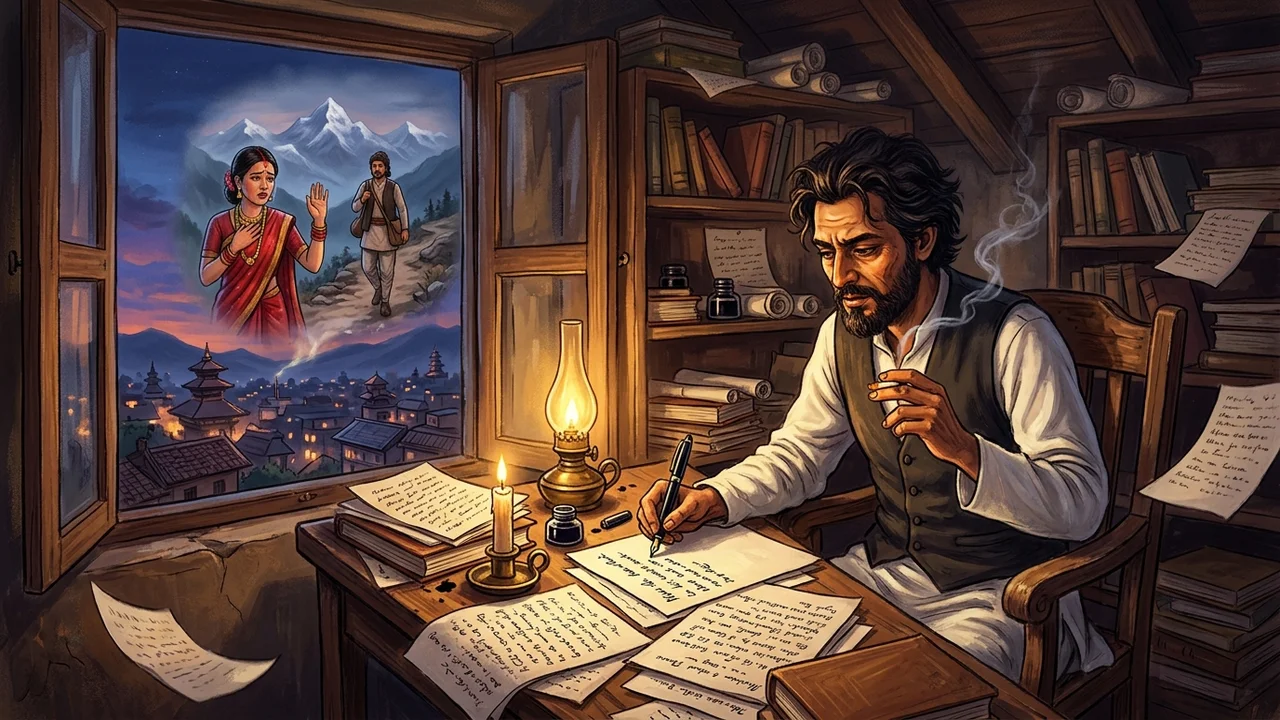
The works
Lakṣmīprasād Devkoṭa (लक्ष्मीप्रसाद देवकोटा) is the poet a Nepali (नेपाली) house calls Mahākavi (महाकवि). Mahākavi (महाकवि) means the great poet. He was born on the night of Lakṣmī Pūjā, 12 November 1909, which is 27 Kārtik 1966 in the Nepali (नेपाली) calendar. The house was in Dhobidhara, Kathmandu. His father, Til Mādhava Devkoṭa, was a Sanskrit scholar. His mother was Amar Rājya Lakṣmī. He died of cancer on 14 September 1959, at Aryaghat in Paśupati (पशुपति). He was forty-nine.
He studied at Durbar High School. At seventeen he passed the school exam from Patna. He studied arts and law at Tri-Chandra College. He sat the Patna University exams as a private student. The house needed money, so a master's degree stayed unfinished. He worked at the Nepal Bhāṣānuvād Pariṣad (नेपाल भाषानुवाद परिषद्), where books were read before they were printed. There he met the playwright Bālakṛṣṇa Sama (बालकृष्ण सम). He also taught at Tri-Chandra and at Padma Kanya.
His elder sister is Lok Priya Devi (लोकप्रियादेवी) (लोकप्रियादेवी). She was born Huta Lakshmi in Jestha of 1955 in the Nepali (नेपाली) calendar, 1898, in Kathmandu, the Kainli among Til Mādhava and Amar Rājya Lakṣmī's six sons and seven daughters. At home she was Kainli Maiya. At eight she married Loknath Joshi of Dillibazar, and he made her name by setting Priya after the Lok of his own. She wrote verse letters to him, including the letters she sent while he was in India. Lekhnath (लेखनाथ), living next door, taught her the principles of poetry. Her poem "Shantlai Jawaf" appeared in Sharada (शारदा), and a story, "Dosti," appeared in Udyog (उद्योग). She died in 1960. In 1983 her daughter Shashi Rimal (रिमाल) gathered the poems into a book. The rest of her sitting is on her page.
In 1939 he spent five months in a mental hospital in Ranchi. People say the cause was grief at home. His parents had died, and so had a daughter of two months. He later lived in exile in Varanasi. Exile means he had left Nepal. There he edited Yugvāṇī (युगवाणी), a paper of the Nepali (नेपाली) Congress. The Ranas (राणा) took his property. In 1952 King Tribhuvan put him on the Nepal Advisory Committee. From July 1957 to May 1958 he was Minister of Education and Autonomy. Autonomy means self-rule. The prime minister was K. I. Singh, and the king was Mahendra.
He died in 1959. This page does not print the long poems whole. Two couplets from Muna Madan (मुनामदन) are here, because houses say them the way they say a proverb. Two lines from Pāgal (पागल) are here. They are the opening. The sentences around the lines are this shelf's.
Muna Madan (मुनामदन)
Muna Madan (मुनामदन) is the book a house knows. It is a long poem in jhyāure (झ्याउरे), a folk-song beat. The first printing is 1936. Some people put the writing a few years earlier. This page uses 1936.
He had heard a Newar song, Ji Waya La Lachhi Maduni (जि वया ला लछि मदुनी). In that song a Newar merchant is about to leave Kathmandu for Tibet. The wife asks her mother-in-law to stop him. She has been in the house for less than a month. The Ranas (राणा) had banned Newar trade and the Newar language. Devkota (देवकोटा) changed the merchant from a Newar man to a Kṣatriya (क्षेत्री), a man of the warrior caste. Trade was rare in a Kṣatriya (क्षेत्री) house. He wrote the man that way so the poem could be printed.
Madan leaves Muna and goes to Lhasa to earn. On the road he falls ill. A friend leaves him. A Tibetan man nurses him. Madan touches that man's feet.
क्षेत्रीको छोरो यो पाउ छुन्छ घिनले छुँदैन
मानिस ठूलो दिलले हुन्छ जातले हुँदैन
Madan is a Kṣatriya's (क्षेत्री) son. He touches the feet. He says he feels no disgust. A person is great by the heart, whatever the caste.
He comes home. His mother has died of old age. Muna has died of a broken heart. Madan dies at the end. A film in 2003 tells the same story.
Houses also say this couplet about money.
हातका मैला सुनका थैला के गर्नु धनले
साग र सिस्नु खाएको वेश आनन्दी मनले
There is grime on the hands, and there are bags of gold. What will you do with wealth? It is better to eat greens and nettles with a happy mind. Some printings say बेस where this one says वेश. The word means better.
People say that on his last days he asked for one thing. If the other books are lost, keep Muna Madan (मुनामदन).
Shakuntala (शाकुन्तल)
Śākuntala (शाकुन्तल) was published in 1945, from Sajha. People say he wrote it in three months. It has 24 cantos. A canto is a chapter of a long poem. It uses many classical meters. Some counts say about 32. People call it the first mahākāvya (महाकाव्य) written in Nepali (नेपाली). A mahākāvya (महाकाव्य) is a long poem with the old rules of a classical epic. Bhanubhakta, born in Nepal, had already written a Nepali (नेपाली) Rāmāyaṇa (रामायण). Devkota (देवकोटा) is the second writer born in Nepal to begin an epic. The name "first mahākāvya (महाकाव्य)" is the one people give this book.
The poem retells Kālidāsa's play Abhijñānaśākuntalam (अभिज्ञानशाकुन्तलम्). King Duṣyanta meets Śakuntalā (शकुन्तला) in a hermitage. A curse makes him forget her. A ring brings the memory back. Devkota (देवकोटा) also put the poem into English himself. The long poem is not printed here.
Sulochana (सुलोचना)
Sulocanā (सुलोचना) was published in 1946. People say he wrote it in ten days. People call it the first social epic in Nepali (नेपाली). A social epic is a long poem about a house and about class.
Sulocanā (सुलोचना) is a woman from a high house. Anaṅganāth (अनङ्गनाथ) is a man from a middle house. They love each other. The families refuse the match because of class. The poem is on the side of a love marriage, and on the side of a widow marrying again. The long poem is not printed here.
Kunjini (कुञ्जिनी)
Kunjinī (कुञ्जिनी) is a long poem in folk meters. People say he wrote it in one day. People say it comes from an old story, about a love the two families refuse. This page does not retell the rest. The poem is not printed here.
Pagal (पागल)
Pāgal (पागल) means a mad person. It is free verse, from the five months in Ranchi in 1939. The book came out in 1953. It opens like this.
जरुर साथी म पागल !
यस्तै छ मेरो हाल ।
Of course, friend, I am mad. This is my state. He says he sees words. He hears sights (दर्शन). He tastes smells. He touches things the world says are not there. The rest of the poem is not printed here.
Bhikhari (भिखारी)
Bhikhārī (भिखारी) means a beggar. The book of poems came out in 1953. The title poem is about a beggar in hard poverty. He has little comfort, and little love from people. The poem also makes him the place where kindness begins. Readers set it beside a poem by the English poet Wordsworth, about an old beggar in Cumberland. The poem is not printed here.
The essays
People call him the father of the modern Nepali (नेपाली) essay. The book is Lakṣmī Nibandha Saṅgraha (लक्ष्मी निबन्धसङ्ग्रह). It holds 37 essays.
One essay asks, is Nepal small? (के नेपाल सानो छ?). He says the country is its people, and the people make it great. He wrote the essay against the push of British India into Nepali (नेपाली) life.
Another essay is Bhalādamī (भलादमी). The word means a gentleman. The essay looks at the man himself. Clothes are only clothes.
The title, and the three ways he wrote
Mahākavi (महाकवि) is the title a house gives him before it gives the dates, and the word means great poet. The style is not one instrument. He kept three, and a reader who learns only one of them has a postcard.
The first is jhyāure (झ्याउरे), the folk-song beat. Muna Madan (मुनामदन) is written in it, and so is Kunjinī (कुञ्जिनी). A line in that beat can be carried by a person who never sat a Sanskrit exam. That is why the thin book is the one a house owns. The second is the classical count, the many meters of a mahākāvya (महाकाव्य). Śākuntala (शाकुन्तल) is that labor, twenty-four cantos, people say about three months of writing, and an English version he made himself. The third is the broken line. Pāgal (पागल), from the months in Ranchi, starts by agreeing that he is mad, and then describes a mind that sees words and hears sights (दर्शन). Beside that line sit the essays. People call him the father of the modern Nepali (नेपाली) essay because the essay looks at a person, or at a country, and refuses to be only a poem's echo. Clothes are only clothes. A country is its people.
He was born on Lakṣmī Pūjā night, so the calendar and the name arrived together. Til Mādhava, the father, was a Sanskrit scholar, which is why the classical meters were a family language and not a costume. Amar Rājya Lakṣmī was the mother. The elder sister, Lok Priya Devi (लोकप्रियादेवी), wrote too. The wife was Man Devi Chalise. In 1939 the parents were dead, and a daughter of two months was dead, and he spent five months in a mental hospital in Ranchi. The mad poem comes out of that building, and was printed in 1953, the same year as the beggar poems. Exile in Varanasi, the paper Yugvāṇī (युगवाणी), the Ranas (राणा) taking the property: that is the political weather around the classical work. In 1957 and 1958 he was a minister, education and autonomy, under K. I. Singh and King Mahendra. The minister and the madman and the folk poet are one man. The death was cancer, 14 September 1959, Aryaghat, forty-nine years old. People say the last request was narrow and exact. If the other books are lost, keep Muna Madan (मुनामदन).
Muna and Madan, told as a road
The poem a house can retell without the book in its hand goes like this. Madan is a young man of a Kṣatriya (क्षेत्री) house. Muna is his wife. The road to Lhasa is money. He leaves. On the way he falls ill. A companion he trusted leaves him there, which is the poem's first hard fact about friendship. A Tibetan man nurses him. Madan, a Kṣatriya's (क्षेत्री) son, touches that man's feet and says there is no disgust in it. A person is great by the heart. The caste line is the one houses recite, and it is printed on this page because they recite it the way they recite a proverb. He comes home. His mother has died of age. Muna has died of the waiting. Madan dies at the end. The gold he went for is answered by the other couplet houses know: grime on the hands, bags of gold, and the better meal is greens and nettles eaten with a glad mind. Some printings say बेस where this one says वेश. The word means better.
Under that road is a Newar song, Ji Waya La Lachhi Maduni (जि वया ला लछि मदुनी). In the song the merchant is Newar, the wife has been in the house less than a month, and she asks her mother-in-law to stop the journey to Tibet. The Ranas (राणा) had banned Newar trade and the Newar language. Devkota (देवकोटा) changed the merchant to a Kṣatriya (क्षेत्री) so the poem could be printed. Trade was rare in a Kṣatriya (क्षेत्री) house, which makes Madan's leaving stranger, and the strangeness is the price of the printing. A 2003 film tells the same story. The poem remains the thin book. He also said, if the tellings are true, that this was the one to save. A mahākavi asking to be remembered by the folk beat, not by the epic that took three months and thirty-odd meters, is a judgment on his own shelf. This page obeys it. The long poems are named. Muna Madan (मुनामदन) is walked.
What the epic and the essay are for
Śākuntala (शाकुन्तल) retells Kālidāsa. King Duṣyanta, hunting, enters Kaṇva's hermitage and finds Śakuntalā (शकुन्तला), daughter of Viśvāmitra and Menakā, raised by the sage. They marry by the gandharva rite. He leaves a ring. She fails to greet Durvāsas, who curses the king to forget her until the ring returns the memory. The ring is lost in a river, swallowed in the telling by a fish. At court he does not know her. She is taken toward her mother's world. A son, Bharata (भरत), is born. A fisherman brings the ring. Memory returns. Devkota (देवकोटा) gives this story the length and the meters of a mahākāvya (महाकाव्य), in 1945, from Sajha. People call it the first mahākāvya (महाकाव्य) in Nepali (नेपाली). Bhanubhakta, born in Nepal, had already written a Nepali (नेपाली) Rāmāyaṇa (रामायण). Devkota (देवकोटा) is the second writer born in Nepal to begin an epic of that ambition. The name "first mahākāvya (महाकाव्य)" is the one people give this book, and it names the classical rules, not the mere fact of length. He also put the poem into English himself. The cantos are not printed here. The story is the gist. The meters are the style's second instrument, the one the folk beat does not need and the mahākavi would not give up.
Sulocanā (सुलोचना), 1946, people say ten days, is the social epic. Sulocanā (सुलोचना) from a high house, Anaṅganāth (अनङ्गनाथ) from a middle house, families who refuse the match for class, a poem on the side of a love marriage and of a widow marrying again. Kunjinī (कुञ्जिनी), people say one day, folk meters, an old story of a love two families refuse. This page does not invent the rest of that plot. The speed people boast of, three months, ten days, one day, is part of the legend and should stay labeled as what people say. The range is the fact. He could write the counted epic and the social quarrel and the folk tale, and then sit down to an essay.
The essay book, Lakṣmī Nibandha Saṅgraha (लक्ष्मी निबन्धसङ्ग्रह), holds thirty-seven essays. His essay Ke Nepal sano chha (के नेपाल सानो छ), which asks whether Nepal is small, answers a sneer from British India. The country is its people, and the people make it great. Bhalādami (भलादमी) looks past the coat. A gentleman is the man, and clothes are only clothes. Prometheus (प्रमिथस), the titan who took fire for human beings, is a long poem of the exile, printed after the death. Van Kusum (वनकुसुम) and Mahārāṇā Pratāp (महाराणा प्रताप) are named here as long poems. The Pṛthvīrāj poem was printed many years after he died, and the Hamlet translation shows the same hunger that put Śakuntalā (शकुन्तला) into English. A minister of education who translates Hamlet and writes a folk tragedy and a mad free verse is using all three instruments in one life. The title Mahākavi (महाकवि) is what the house says when it means that range.
Ranchi, Varanasi, the ministry
The five months in Ranchi are the part of the life people whisper, and they are also the part that produced a style. A mental hospital in 1939, in India, for a Nepali (नेपाली) poet whose parents had died and whose infant daughter had died. Grief is the cause people give. The poem he wrote there does not argue with the diagnosis. It accepts the word mad, and then it describes a perception the street calls impossible. He sees words. He hears sights (दर्शन). He tastes smells. He touches what the world says is not there. Printed in 1953 as Pāgal (पागल), with the beggar poems of the same year, it is the third instrument at full volume. The opening two lines are on this page because they are the door. The rest of the poem stays in the book. A reader who wants the blow has to take the blow from him.
Bhikhārī (भिखारी), the beggar, is the companion piece of that year. A man in hard poverty, with little comfort and little love from the people who pass, and also the place where kindness would have to begin if kindness were going to begin at all. Readers set it beside Wordsworth's old beggar in Cumberland. The likeness is a way of saying the poem is not a local scold only. It is a picture of a person the city has decided not to see, which is a picture Bhupi will later draw with a revolving chair. Devkota (देवकोटा) draws it with pity that still has a spine. The beggar is not a decoration for a festival of compassion. He is the test of whether the gentleman in the essay Bhalādami (भलादमी) is a man or a coat.
Exile is the next room. Varanasi, the paper Yugvāṇī (युगवाणी) of the Nepali (नेपाली) Congress, the Ranas (राणा) holding his property. Prometheus (प्रमिथस) belongs to that table. The Greek story is simple and public. A titan takes fire, which the gods had kept, and gives it to human beings, and is punished for the gift. A poet writing that story while his own house has been seized is not being subtle about the rhyme. The poem was printed after he died. Van Kusum (वनकुसुम), forest flowers, and Mahārāṇā Pratāp (महाराणा प्रताप), the Rajput king who would not bow, are the other long poems of that hunger for a large subject. Pṛthvīrāj Cauhān waited even longer for print. Hamlet, translated, is the play about a son who cannot act cleanly in a rotten court. He did not have to explain why that play felt like a Nepali (नेपाली) job.
Then the state, briefly, asked him to administer. July 1957 to May 1958, Minister of Education and Autonomy, under Prime Minister K. I. Singh and King Mahendra. Autonomy means self-rule, and a poet in that chair is a strange sight (दर्शन) until you remember he had already spent his life trying to make Nepali (नेपाली) able to rule itself as a literature. Ten months is not a policy era. It is a fact that keeps the legend from being only illness and genius. He could sit in a cabinet. He went back to the page. In September 1959 the cancer finished it, at Aryaghat, where Motiram (मोतीराम) had been burned sixty-three years earlier and where Ghimire (घिमिरे) would be burned sixty-one years later. The river has taken a lot of this shelf. The thin book is what he asked the living to keep.
Other books
He wrote a long poem about Prometheus (प्रमिथस), the Greek titan who took fire and gave it to people. He wrote it in exile. It was printed after his death. He also wrote long poems called Van Kusum (वनकुसुम) and Mahārāṇā Pratāp (महाराणा प्रताप). A long poem about Pṛthvīrāj Cauhān was printed many years after he died. He translated Shakespeare's Hamlet into Nepali (नेपाली). The names are enough for this page.
लक्ष्मीप्रसाद देवकोटा त्यो कवि हुन्, जसलाई नेपाली घरले महाकवि भन्छ। महाकवि भनेको महान् कवि हो। उहाँ लक्ष्मी पूजाको रात जन्मनुभयो, ई.सं. १२ नोभेम्बर १९०९, नेपाली पात्रोमा वि.सं. १९६६ कार्तिक २७। घर धोबीधारा, काठमाडौंमा थियो। बुबा तिलमाधव देवकोटा संस्कृतका विद्वान् हुनुहुन्थ्यो। आमा अमर राज्यलक्ष्मी हुनुहुन्थ्यो। उहाँ क्यान्सरले ई.सं. १४ सेप्टेम्बर १९५९ मा पशुपतिको आर्यघाटमा बित्नुभयो। उमेर उनान्पचास वर्ष थियो।
उहाँ दरबार हाई स्कूलमा पढ्नुभयो। सत्र वर्षमा पटनाको स्कूल परीक्षा पास गर्नुभयो। त्रिचन्द्र कलेजमा कला र कानून पढ्नुभयो। पटना विश्वविद्यालयको परीक्षा निजी परीक्षार्थी भएर दिनुभयो। घरलाई पैसा चाहियो, त्यसैले स्नातकोत्तर अधुरो रह्यो। उहाँ नेपाल भाषानुवाद परिषद्मा काम गर्नुभयो। त्यहाँ पुस्तक छपाइअघि पढिन्थ्यो। त्यहीँ नाटककार बालकृष्ण समलाई भेट्नुभयो। त्रिचन्द्र र पद्म कन्यामा पनि पढाउनुभयो।
उहाँकी दिदी लोकप्रियादेवी हुन्। उनी नेपाली १९५५ जेठमा, अङ्ग्रेजी वर्षको चलनमा १८९८ मा, काठमाडौंमा जन्मिइन्। उनको जन्मनाम हुतलक्ष्मी थियो। तिलमाधव र अमर राज्यलक्ष्मीका छ छोरा र सात छोरीमध्ये उनी काइँली थिइन्। घरमा उनलाई काइँलीमैयाँ भनिन्थ्यो। आठ वर्षमा डिल्लीबजारका लोकनाथ जोशीसँग उनको विवाह भयो, र पतिले आफ्नो नामको लोकपछि प्रिया जोडेर उनको नाम बनाए। उनी पतिलाई पद्यमा चिठी लेख्थिन्, पति भारतमा हुँदा पठाइएका चिठी पनि। छिमेकका लेखनाथले उनलाई कविताका सिद्धान्त पढाउनुभयो। उनको कविता "शान्तलाई जवाफ" शारदामा छापियो, र "दोस्ती" नामको कथा उद्योगमा छापियो। उनको मृत्यु ई.सं. १९६० मा भयो। ई.सं. १९८३ मा छोरी शशी रिमालले कविता जम्मा गरेर किताब बनाइन्। बाँकी बसाइ उनकै पृष्ठमा छ।
ई.सं. १९३९ मा उहाँ राँचीको मानसिक अस्पतालमा पाँच महिना बस्नुभयो। मानिस भन्छन्, कारण घरको शोक थियो। बुबाआमा बित्नुभएको थियो। दुई महिनाकी छोरी पनि बितेकी थिइन्। पछि उहाँ वाराणसीको निर्वासनमा बस्नुभयो। निर्वासन भनेको नेपालबाहिर बस्नु हो। त्यहाँ नेपाली कांग्रेसको पत्र युगवाणी सम्पादन गर्नुभयो। राणाहरूले उहाँको सम्पत्ति कब्जा गरे। ई.सं. १९५२ मा राजा त्रिभुवनले उहाँलाई नेपाल सल्लाहकार समितिमा राख्नुभयो। ई.सं. १९५७ जुलाईदेखि १९५८ मेसम्म उहाँ शिक्षा तथा स्वायत्त शासन मन्त्री हुनुहुन्थ्यो। स्वायत्त शासन भनेको आफ्नै शासन हो। त्यतिबेला प्रधानमन्त्री के. आई. सिंह थिए, र राजा महेन्द्र थिए।
उहाँ ई.सं. १९५९ मा बित्नुभयो। यो पृष्ठले लामा कविता पूरा छाप्दैन। मुनामदनका दुई श्लोक छन्, किनभने घरले ती उखानझैँ भन्छ। पागलका सुरुका दुई पङ्क्ति छन्। वरपरका वाक्य यस तहका हुन्।
मुनामदन
मुनामदन त्यो किताब हो, जुन घरले चिन्छ। यो झ्याउरे भाकाको लामो कविता हो। झ्याउरे लोकगीतको ताल हो। पहिलो छपाइ ई.सं. १९३६ हो। कतिपय मानिस लेखाइ केही वर्ष अघि राख्छन्। यो पृष्ठले १९३६ नै लिन्छ।
उहाँले नेवार गीत जि वया ला लछि मदुनी सुन्नुभएको थियो। त्यो गीतमा नेवार व्यापारी काठमाडौंबाट तिब्बत जान लागेको छ। पत्नीले सासूसँग उसलाई रोक्न बिन्ती गर्छिन्। घरमा आएको एक महिना पनि भएको छैन। राणाहरूले नेवार व्यापार र नेवार भाषामा रोक लगाएका थिए। देवकोटाले व्यापारीलाई नेवारबाट क्षेत्री बनाउनुभयो। क्षेत्री भनेको योद्धा जातको मानिस हो। क्षेत्री घरमा व्यापार विरलै हुन्थ्यो। कविता छापियोस् भनेर उहाँले व्यापारीलाई त्यसरी लेख्नुभयो।
मदन मुनालाई छोडेर ल्हासा कमाउन जान्छ। बाटोमा बिरामी पर्छ। साथीले छोड्छ। एक जना भोटेले स्याहार्छ। मदनले त्यसको पाउ छुन्छ।
क्षेत्रीको छोरो यो पाउ छुन्छ घिनले छुँदैन
मानिस ठूलो दिलले हुन्छ जातले हुँदैन
मदन क्षेत्रीको छोरो हो। ऊ पाउ छुन्छ। घिन मान्दैन भन्छ। मानिस दिलले ठूलो हुन्छ, जात जे भए पनि।
ऊ घर फर्कन्छ। आमा बुढ्यौलीले मरिसकेकी हुन्छिन्। मुना मन दुखेर मरिसकेकी हुन्छिन्। अन्त्यमा मदन मर्छ। ई.सं. २००३ को एउटा फिल्मले यही कथा भन्छ।
घरले पैसाको यो श्लोक पनि भन्छ।
हातका मैला सुनका थैला के गर्नु धनले
साग र सिस्नु खाएको वेश आनन्दी मनले
हातमा मैला छ, सुनका थैला छन्। धनले के गर्नु? आनन्दित मनले साग र सिस्नु खानु नै बेस हो। कुनै छपाइमा बेस छ। यो पृष्ठले वेश राख्छ। शब्दको अर्थ राम्रो हो।
मानिस भन्छन्, अन्तिम दिनमा उहाँले एउटा कुरा माग्नुभयो। अरू किताब हराए पनि मुनामदन राख्नू।
शाकुन्तल
शाकुन्तल ई.सं. १९४५ मा साझाबाट छापियो। मानिस भन्छन्, उहाँले तीन महिनामा लेख्नुभयो। चौबीस सर्ग छन्। सर्ग भनेको लामो कविताको अध्याय हो। धेरै शास्त्रीय छन्द छन्। कुनै गन्तीले झन्डै बत्तीस भन्छ। मानिस यसलाई नेपालीमा लेखिएको पहिलो महाकाव्य भन्छन्। महाकाव्य शास्त्रीय महाकाव्यका पुराना नियम पालेको लामो कविता हो। नेपालमा जन्मनुभएका भानुभक्तले नेपाली रामायण पहिले लेखिसक्नुभएको थियो। नेपालमा जन्मेर महाकाव्य थाल्नेमा देवकोटा दोस्रो हुनुहुन्छ। "पहिलो महाकाव्य" भन्ने नाम मानिसले यही किताबलाई दिन्छन्।
कविताले कालिदासले लेख्नुभएको नाटक अभिज्ञानशाकुन्तलम् फेरि भन्छ। राजा दुष्यन्त आश्रममा शकुन्तला भेट्नुहुन्छ। सराप लाग्छ, र राजा बिर्सनुहुन्छ। औँठीले सम्झना फर्काउँछ। देवकोटाले कविता आफैँ अङ्ग्रेजीमा पनि राख्नुभयो। लामो कविता यहाँ छापिएको छैन।
सुलोचना
सुलोचना ई.सं. १९४६ मा छापियो। मानिस भन्छन्, उहाँले दस दिनमा लेख्नुभयो। मानिस यसलाई नेपालीको पहिलो सामाजिक महाकाव्य भन्छन्। सामाजिक महाकाव्य भनेको घर र वर्गको लामो कविता हो।
सुलोचना उच्च घरकी नारी हो। अनङ्गनाथ मध्यम घरको पुरुष हो। दुवैले माया गर्छन्। परिवारले वर्गको कारण विवाह मान्दैन। कविता प्रेम विवाहको पक्षमा छ, र विधवा फेरि विवाह गर्न पाउने पक्षमा छ। लामो कविता यहाँ छापिएको छैन।
कुञ्जिनी
कुञ्जिनी लोक छन्दको लामो कविता हो। मानिस भन्छन्, उहाँले एक दिनमा लेख्नुभयो। मानिस भन्छन्, यो एउटा पुरानो कथाबाट आएको हो, जसमा दुई परिवारले त्यो माया मान्दैनन्। यो पृष्ठले बाँकी कथा भन्दैन। कविता यहाँ छापिएको छैन।
पागल
पागल भनेको बौलाहा मानिस हो। यो स्वच्छन्द छन्दको कविता हो, जुन ई.सं. १९३९ मा राँचीमा बितेका पाँच महिनाबाट जन्मियो। किताब ई.सं. १९५३ मा आयो। यसरी खुल्छ।
जरुर साथी म पागल !
यस्तै छ मेरो हाल ।
अवश्य, साथी, म पागल हुँ। मेरो हाल यस्तै छ। उहाँ भन्नुहुन्छ, आफूले शब्द देख्नुहुन्छ। दृश्य सुन्नुहुन्छ। बास्ना चाख्नुहुन्छ। संसारले छैन भनेको चिज छुनुहुन्छ। बाँकी कविता यहाँ छापिएको छैन।
भिखारी
भिखारी भनेको माग्ने मानिस हो। कविताको किताब ई.सं. १९५३ मा आयो। शीर्षक कविता कठिन गरिबीको भिखारीको हो। उसलाई सुख कम छ, र मानिसको माया कम छ। कविताले उसलाई दया सुरु हुने ठाउँ पनि बनाउँछ। पाठकले यसलाई अङ्ग्रेजी कवि वर्डस्वर्थको कवितासँग राख्छन्, कम्बरल्याण्डको बूढो भिखारीको कवितासँग। कविता यहाँ छापिएको छैन।
निबन्ध
मानिस उहाँलाई आधुनिक नेपाली निबन्धका पिता भन्छन्। किताब लक्ष्मी निबन्धसङ्ग्रह हो। ३७ निबन्ध छन्।
एउटा निबन्ध सोध्छ, के नेपाल सानो छ? उहाँ भन्नुहुन्छ, देश भनेका त्यहाँका मानिस हुन्, र तिनैले देश ठूलो बनाउँछन्। उहाँले यो निबन्ध ब्रिटिस भारतले नेपाली जीवनमा गरेको घुसपैठविरुद्ध लेख्नुभयो।
अर्को निबन्ध भलादमी हो। भलादमी भनेको भद्र मानिस हो। निबन्धले मानिस आफैँलाई हेर्छ। लुगा चाहिँ लुगा मात्र हुन्।
अरू किताब
उहाँले प्रमिथसको लामो कविता लेख्नुभयो। प्रमिथस ग्रीक कथाको त्यो पात्र हो, जसले आगो लिएर मानिसलाई दियो। उहाँले निर्वासनमा लेख्नुभयो। कविता उहाँ बितेपछि छापियो। वनकुसुम र महाराणा प्रतापका लामा कविता पनि लेख्नुभयो। पृथ्वीराज चौहानको लामो कविता उहाँ बितेको धेरै वर्षपछि छापियो। उहाँले शेक्सपियरको ह्यामलेट नेपालीमा अनुवाद गर्नुभयो। यो पृष्ठका लागि नाम नै पर्याप्त छन्।
उपाधि, र तीन तरिका
महाकवि घरले मितिभन्दा पहिले दिने उपाधि हो, र शब्दको अर्थ महान् कवि हो। शैली एउटै साधन होइन। उहाँले तीन राख्नुभयो। एउटा मात्र चिन्नेले पोस्टकार्ड पाउँछ।
पहिलो झ्याउरे हो, लोकगीतको ताल। मुनामदन त्यही तालमा छ, कुञ्जिनी पनि। त्यो तालको पङ्क्ति संस्कृत परीक्षा नबसेको मानिसले बोक्न सक्छ। त्यसैले पातलो किताब घरले राख्छ। दोस्रो शास्त्रीय गन्ती हो, महाकाव्यका धेरै छन्द। शाकुन्तल त्यो मिहिनेत हो, चौबीस सर्ग, मानिस भन्छन् तीन महिनाको लेखाइ, र उहाँ आफैँले बनाउनुभएको अङ्ग्रेजी रूप। तेस्रो भाँचिएको पङ्क्ति हो। पागल, राँचीका महिनाबाट, उहाँ पागल हुनुहुन्छ भनेर मञ्जुर गरेर सुरु हुन्छ, अनि शब्द देख्ने र दृश्य सुन्ने मन वर्णन गर्छ। त्यो पङ्क्तिको छेउमा निबन्ध छन्। उहाँलाई आधुनिक नेपाली निबन्धका पिता भनिन्छ, किनभने निबन्धले मानिसलाई वा देशलाई हेर्छ, र कविताको प्रतिध्वनि मात्र हुन मान्दैन। लुगा लुगा मात्र हुन्। देश भनेका त्यहाँका मानिस हुन्।
उहाँ लक्ष्मी पूजाको रात जन्मनुभयो, त्यसैले पात्रो र नाम सँगै आए। बुबा तिलमाधव संस्कृतका विद्वान् हुनुहुन्थ्यो, त्यसैले शास्त्रीय छन्द घरको भाषा थियो, पोसाक होइन। आमा अमर राज्यलक्ष्मी हुनुहुन्थ्यो। दिदी लोकप्रियादेवीले पनि लेख्नुहुन्थ्यो। पत्नी मनदेवी चालिसे हुनुहुन्थ्यो। ई.सं. १९३९ मा बुबाआमा बित्नुभएको थियो, दुई महिनाकी छोरी बितेकी थिइन्, र उहाँ राँचीको मानसिक अस्पतालमा पाँच महिना बस्नुभयो। पागल कविता त्यो भवनबाट आउँछ, र ई.सं. १९५३ मा छापियो, भिखारी कविताकै वर्ष। वाराणसीको निर्वासन, युगवाणी, राणाले लगेको सम्पत्ति, यी नै शास्त्रीय कामवरिपरिको राजनीतिक मौसम हुन्। ई.सं. १९५७ र १९५८ मा उहाँ मन्त्री हुनुहुन्थ्यो, शिक्षा र स्वायत्त शासन, के. आई. सिंह र राजा महेन्द्रको पालामा। मन्त्री, पागल, र लोककवि एउटै मानिस हुन्। मृत्यु क्यान्सरले भयो, ई.सं. १४ सेप्टेम्बर १९५९, आर्यघाट, उनान्पचास वर्ष। मानिस भन्छन्, अन्तिम बिन्ती साँघुरो र ठीक थियो। अरू किताब हराए पनि मुनामदन राख्नू।
मुना र मदन, बाटोका रूपमा
किताब हातमा नभई घरले भन्न सक्ने कविता यस्तो छ। मदन क्षेत्री घरको जवान मानिस हो। मुना उसकी पत्नी हो। ल्हासाको बाटो पैसा हो। ऊ जान्छ। बाटोमा बिरामी पर्छ। विश्वास गरेको साथीले त्यहीँ छोड्छ, जुन मित्रताबारे कविताको पहिलो कठोर तथ्य हो। एक जना भोटेले स्याहार्छ। क्षेत्रीको छोरो मदनले त्यसको पाउ छुन्छ, र घिन छैन भन्छ। मानिस दिलले ठूलो हुन्छ। जातको पङ्क्ति घरले सुनाउने हो, र उखानझैँ सुनाउने भएकाले यस पृष्ठमा छापिएको छ। ऊ घर फर्किन्छ। आमा उमेरले मरिसकेकी हुन्छिन्। मुना पर्खाइले मरिसकेकी हुन्छिन्। अन्त्यमा मदन मर्छ। उसले कमाउन गएको सुनको जवाफ घरले चिनेको अर्को श्लोकले दिन्छ। हातमा मैला, सुनका थैला, र राम्रो भोजन आनन्दित मनले खाएको साग र सिस्नु हो। कुनै छपाइमा बेस छ। यो पृष्ठले वेश राख्छ। अर्थ राम्रो हो।
त्यो बाटोमुनि नेवार गीत जि वया ला लछि मदुनी छ। गीतमा व्यापारी नेवार हो, पत्नी घरमा एक महिना नपुगी आएकी छिन्, र सासूलाई तिब्बतको यात्रा रोक्न बिन्ती गर्छिन्। राणाहरूले नेवार व्यापार र नेवार भाषामा रोक लगाएका थिए। कविता छापियोस् भनेर देवकोटाले व्यापारीलाई क्षेत्री बनाउनुभयो। क्षेत्री घरमा व्यापार विरलै हुन्थ्यो, त्यसैले मदनको यात्रा झन् अनौठो हुन्छ, र त्यो अनौठोपन छपाइको मोल हो। ई.सं. २००३ को फिल्मले यही कथा भन्छ। कविता पातलो किताब नै रहन्छ। भनाइ साँचो भए, उहाँले बचाउनुपर्ने किताब यही हो भनेर पनि भन्नुभएको थियो। महाकविले तीन महिना र तीस जति छन्द लागेको महाकाव्यले होइन, लोक तालले सम्झियोस् भनेर चाहनु उहाँको आफ्नै तहमाथिको फैसला हो। यो पृष्ठले त्यो मान्छ। लामा कविताका नाम लिइएका छन्। मुनामदनको बाटो हिँडिएको छ।
महाकाव्य र निबन्ध केका लागि
शाकुन्तलले कालिदासको कथा फेरि भन्छ। राजा दुष्यन्त शिकारमा कण्वको आश्रम पस्छन् र शकुन्तला भेट्छन्, विश्वामित्र र मेनकाकी छोरी, ऋषिले हुर्काएकी। उनीहरू गन्धर्व विवाह गर्छन्। उहाँ औँठी छोड्नुहुन्छ। उनी दुर्वासलाई अभिवादन गर्न चुक्छिन्, जसले राजालाई बिर्सने श्राप दिन्छन्, औँठीले स्मृति नफर्काउन्जेल। औँठी नदीमा हराउँछ, भनाइमा माछाले निल्छ। दरबारमा उहाँले चिन्नुहुन्न। उनी आमाको लोकतिर लगिन्छिन्। भरत नाम गरेको छोरा जन्मिन्छ। माझीले औँठी ल्याउँछ। स्मृति फर्किन्छ। देवकोटाले यो कथालाई महाकाव्यको लम्बाइ र छन्द दिनुहुन्छ, ई.सं. १९४५ मा, साझाबाट। मानिस यसलाई नेपालीको पहिलो महाकाव्य भन्छन्। नेपालमा जन्मनुभएका भानुभक्तले नेपाली रामायण पहिले लेखिसक्नुभएको थियो। यो महत्त्वाकाङ्क्षाको महाकाव्य थाल्नेमा नेपालमा जन्मेका दोस्रो लेखक देवकोटा हुनुहुन्छ। "पहिलो महाकाव्य" भन्ने नाम मानिसले यही किताबलाई दिन्छन्, र त्यो नामले लम्बाइ होइन, शास्त्रीय नियम जनाउँछ। उहाँले कविता अङ्ग्रेजीमा पनि राख्नुभयो। सर्ग यहाँ छापिएका छैनन्। कथा सार हो। छन्द शैलीको दोस्रो साधन हुन्, जुन लोक तालले चाहँदैन, तर महाकविले छोड्दैनन्।
सुलोचना, ई.सं. १९४६, मानिस भन्छन् दस दिनमा लेखिएको, सामाजिक महाकाव्य हो। यसमा उच्च घरकी सुलोचना र मध्यम घरका अनङ्गनाथ छन्, वर्गका कारण विवाह नमान्ने परिवार छ, र कविता प्रेम विवाह र विधवाको पुनः विवाहको पक्षमा उभिन्छ। कुञ्जिनी, मानिस भन्छन् एक दिनमा लेखिएको, लोक छन्दमा दुई परिवारले नमान्ने प्रेमको पुरानो कथा हो। यो पृष्ठले त्यो कथाको बाँकी भाग आफैँ रच्दैन। मानिसले घमण्ड गर्ने गति, तीन महिना, दस दिन, एक दिन, किंवदन्तीको हिस्सा हो, र त्यो "मानिस भन्छन्" भनेरै लेखिनुपर्छ। फैलाव तथ्य हो। उहाँले छन्द गनिएको महाकाव्य, सामाजिक झगडा, र लोककथा लेख्न सक्नुहुन्थ्यो, अनि निबन्ध लेख्न बस्नुहुन्थ्यो।
निबन्धको किताब लक्ष्मी निबन्धसङ्ग्रहमा सैंतीस निबन्ध छन्। के नेपाल सानो छ? ले ब्रिटिस भारतको गिल्लाको जवाफ दिन्छ। देश भनेका मानिस हुन्, र मानिसले देश ठूलो बनाउँछन्। भलादमीले कोटभन्दा पर हेर्छ। भद्र मानिस मानिस आफैँ हो, लुगा लुगा मात्र हुन्। प्रमिथस, मानिसका लागि आगो लिने टाइटन, निर्वासनको लामो कविता हो, मृत्युपछि छापिएको। वनकुसुम र महाराणा प्रताप लामा कविताका रूपमा यहाँ नाम लिइएका छन्। पृथ्वीराजको कविता उहाँ बितेको धेरै वर्षपछि छापियो, र ह्यामलेटको अनुवादले शाकुन्तल अङ्ग्रेजीमा राख्ने त्यही भोक देखाउँछ। ह्यामलेट अनुवाद गर्ने, लोक त्रासदी लेख्ने, र पागल स्वच्छन्द पद्य लेख्ने शिक्षा मन्त्रीले एउटै जीवनमा तीनै साधन चलाउनुहुन्छ। महाकवि त्यो फैलाव भन्न घरले दिने नाम हो।
राँची, वाराणसी, मन्त्रालय
राँचीका पाँच महिना जीवनको त्यो हिस्सा हुन्, जसबारे मानिसले कानेखुसी गर्छन्, र एउटा शैली जन्माउने हिस्सा पनि। बुबाआमा र दूधे छोरी बितेका नेपाली कविले ई.सं. १९३९ मा भारतको मानसिक अस्पतालमा बस्नुपर्यो। कारण शोक हो भन्छन्। त्यहाँ लेखिएको कविताले निदानसँग झगडा गर्दैन। पागल शब्द मान्छ, अनि सडकले असम्भव भन्ने चेतना वर्णन गर्छ। उहाँले शब्द देख्नुहुन्छ। दृश्य सुन्नुहुन्छ। गन्ध चाख्नुहुन्छ। संसारले छैन भनेको छुनुहुन्छ। ई.सं. १९५३ मा पागल नामले छापियो, त्यही वर्षका भिखारी कवितासँग। तेस्रो साधन पूरा आवाजमा हो। सुरुका दुई पङ्क्ति यस पृष्ठमा छन्, किनभने ती ढोका हुन्। बाँकी कविता किताबमै रहन्छ। चोट चाहनेले चोट उहाँबाट लिनुपर्छ।
भिखारी त्यही वर्षको साथी रचना हो। यो कठिन गरिबीको मानिस हो, जसलाई थोरै सुख र बाटो हिँड्नेबाट थोरै माया मिल्छ, र दया सुरु हुने नै हो भने सुरु हुनुपर्ने ठाउँ पनि ऊ नै हो। पाठकले यसलाई वर्डस्वर्थको कम्बरल्याण्डका बूढा भिखारीको छेउमा राख्छन्। तुलनाले कविता स्थानीय हप्की मात्र होइन भन्छ। सहरले नदेख्ने निधो गरेको मानिसको चित्र हो, जुन चित्र भूपीले पछि घुम्ने मेचले कोर्नेछन्। देवकोटाले मेरूदण्ड भएको दयाले कोर्नुहुन्छ। भिखारी करुणाको चाडको सजावट होइन। भलादमी निबन्धको भद्र मानिस मानिस हो कि कोट हो भन्ने परीक्षा हो।
निर्वासन अर्को कोठा हो, जहाँ वाराणसी छ, नेपाली कांग्रेसको युगवाणी छ, र उहाँको सम्पत्ति समातेका राणा छन्। प्रमिथस त्यो टेबलको हो। ग्रीक कथा सरल र सार्वजनिक छ। एउटा टाइटनले देवताहरूले लुकाएको आगो लिन्छ, मानिसलाई दिन्छ, र दानका लागि सजाय पाउँछ। आफ्नो घर खोसिएको बेला त्यो कथा लेख्ने कविले समानता लुकाउनुहुन्न। कविता उहाँ बितेपछि छापियो। वनकुसुम, र नझुक्ने राजपूत राजा महाराणा प्रताप, त्यो भोकका अरू लामा कविता हुन्। पृथ्वीराज चौहानले छापाका लागि अझ पर्खनुपर्यो। अनुवाद गरिएको ह्यामलेट कुहिएको दरबारमा सफासँग काम गर्न नसक्ने छोराको नाटक हो। त्यो नाटक नेपाली कामजस्तो किन लाग्यो भनेर उहाँले व्याख्या गर्नु पर्दैनथ्यो।
अनि राज्यले केही समयका लागि उहाँलाई प्रशासन चलाउन बोलायो। ई.सं. जुलाई १९५७ देखि मे १९५८ सम्म उहाँ शिक्षा तथा स्वायत्त शासन मन्त्री हुनुहुन्थ्यो, प्रधानमन्त्री के. आई. सिंह र राजा महेन्द्रको पालामा। स्वायत्त शासन भनेको आफ्नै शासन हो, र त्यो मेचमा कवि बसेको देख्दा अनौठो लाग्छ, जबसम्म सम्झना हुँदैन कि उहाँले नेपालीलाई साहित्यका रूपमा आफैँ चल्न सक्ने बनाउन जीवन खर्च गर्नुभएको थियो। दस महिना नीति युग होइन। त्यो किंवदन्तीलाई रोग र प्रतिभा मात्र हुनबाट जोगाउने तथ्य हो। उहाँ मन्त्रिमण्डलमा बस्न सक्नुहुन्थ्यो। पृष्ठमा फर्कनुभयो। ई.सं. सेप्टेम्बर १९५९ मा क्यान्सरले टुङ्ग्यायो, आर्यघाटमा, जहाँ त्रेसट्ठी वर्षअघि मोतीरामको दाहसंस्कार भएको थियो र एकसट्ठी वर्षपछि घिमिरेको हुने थियो। नदीले यो तहको धेरै लगेको छ। पातलो किताब उहाँले जीवितलाई राख्न भन्नुभएको हो। मुनामदन, पातलो किताबमा, घरले उहाँलाई भेट्छ। यसअघिको पृष्ठ उहाँकी दिदी लोकप्रियादेवीको हो। उहाँ लक्ष्मी पूजाको रात जन्मनुभयो, जुन रात लक्ष्मी पूजाको कथामा भनिएको छ। उहाँको मृत्यु आर्यघाटमा, पशुपतिमा भयो। यसपछिको पृष्ठ सिद्धिचरण श्रेष्ठको हो। पारिजात र भूपि शेरचन पछि आउँछन्।
Where it sits
A house meets him in Muna Madan (मुनामदन), the thin book. The page before this one is his elder sister, Lok Priya Devi (लोकप्रियादेवी). He was born on Lakṣmī Pūjā night, the night told on the Lakṣmī Pūjā page. He died at Aryaghat, at Paśupati (पशुपति). The next page is Siddhicharan Shrestha (सिद्धिचरण श्रेष्ठ). Parijat (पारिजात) and Bhupi Sherchan (भूपि शेरचन) come later.