Nepali Readings / Dharanidhar Koirala
Dharanidhar Koirala (धरणीधर कोइराला)धरणीधर कोइराला
The name they used
| Literary Identity | Pioneer of Socio-Educational Awakening & Reformist Verse |
|---|---|
| Lifespan & Origins | 1892–1970 CE (1949–2027 BS) · Born in Dumja, Sindhuli, Nepal · Active in Darjeeling & Kathmandu |
| Historic Association | The SuDhaPa Triumvirate of Darjeeling (Surya Bikram Gyawali, Dharanidhar Koirala, and Parasmani Pradhan) |
| Landmark Masterpiece | Naivedya (1920, "The Offering" — iconic poetry collection sounding an urgent call for intellectual resurgence, moral dignity, and social reform) |
| Educational Pioneering | Co-founded the Gorkha Samiti (1918) and Nepali Sahitya Sammelan (1924) in Darjeeling; prepared standardized textbooks that established Nepali as an academic discipline |
| Core Themes | Denunciation of fatalism and social vices; championing of female education, labor dignity, national pride, and ethical rebirth |
| Historic Impact | Transformed poetry into a potent instrument of civic empowerment, establishing Darjeeling as a premier beacon of modern Nepali literary culture. |
Among the visionary figures who roused the Nepali-speaking diaspora in the early twentieth century, Pandit Dharanidhar Sharma Koirala (Dharaṇīdhara Koirālā / धरणीधर कोइराला) occupies a sacred place as the poetic conscience of the nation. At a time when autocratic rule inside Nepal suppressed civic discourse, Dharanidhar forged poetry into a trumpet of moral resurgence, rallying a scattered and impoverished people toward self-respect, education, and collective dignity.
Born in 1892 CE (1949 BS) in Dumja, Sindhuli, Dharanidhar pursued Sanskrit and English studies in Banaras and Calcutta before making Darjeeling his adopted home. There, in close alliance with historian Surya Bikram Gyawali and linguist Parasmani Pradhan—the immortal intellectual triumvirate known as SuDhaPa (SuDhaPā / सुधपा)—he spearheaded an epochal cultural renaissance. Together, they founded the Nepali Sahitya Sammelan in 1924, established schools, standardized grammar, and compiled textbooks that secured the academic recognition of the Nepali language at Calcutta University.
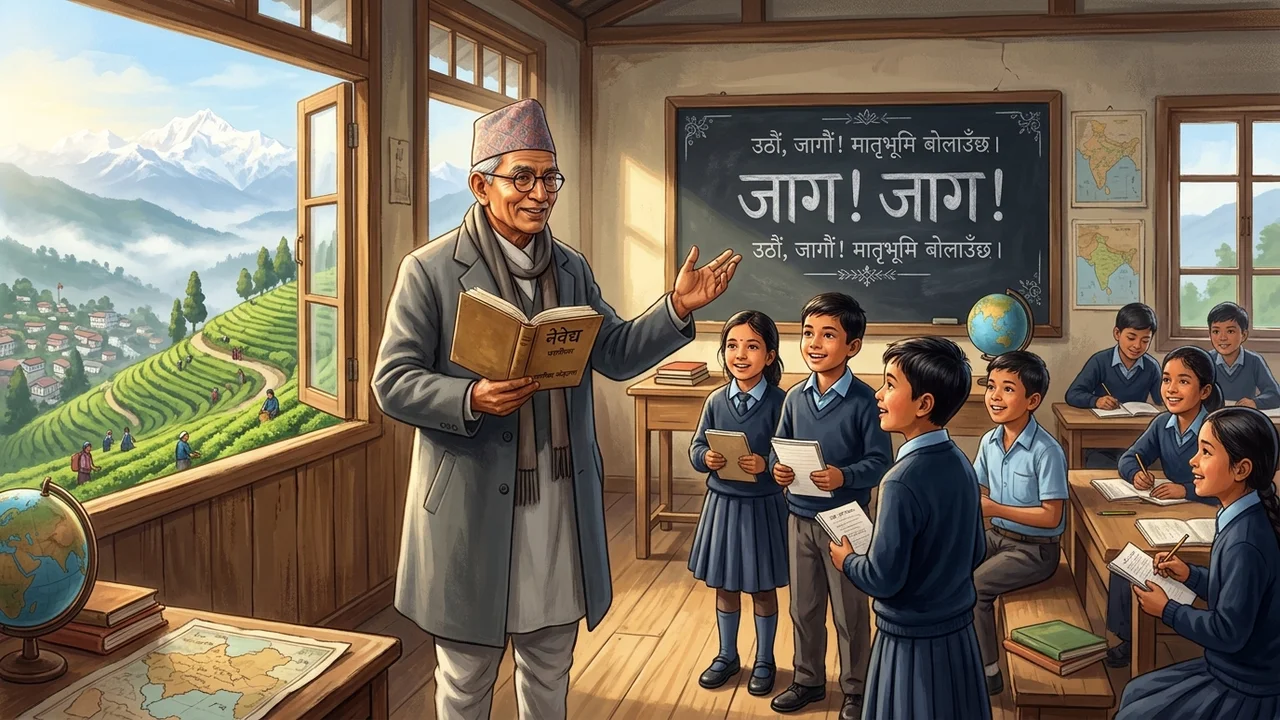
In 1920, Dharanidhar published his seminal masterpiece Naivedya (Naivedya / नैवेद्य, "The Sacred Offering"). Moving far beyond the escapist romanticism of courtly verse, Naivedya delivered an electric wake-up call to a slumbering populace ("Jāga, Jāga, aba Jāga re..."). His verses attacked fatalistic apathy, alcohol abuse, social stratification, and the neglect of women's education, summoning his countrymen to throw off ignorance and build a just, enlightened society.
SuDhaPa (सुधापा), and the dictionary
In 1918 the accounts place him outside Nepal with the men who would be abbreviated into SuDhaPa (सुधापा). In 1924 he, Suryabikram Gyawali, Parasmani Pradhan, Hari (हरि) Prasad Pradhan, and others founded the Nepali (नेपाली) Sahitya Sammelan in Darjeeling. Histories of the language treat that founding as a major event, because a literature that cannot meet inside its own capital will meet on the other side of the Mechi and call the meeting national anyway. Suryabikram became the historian of the Gorkhas. Parasmani became the grammarian and the schoolbook man, the person who made Nepali (नेपाली) a subject a child could be examined in. Dharanidhar became the poet of the three, the one whose book you could love rather than only study. SuDhaPa (सुधापा) is a trinity of a different kind from Lekhnath (लेखनाथ), Sama (सम), and Devkota (देवकोटा). Theirs was inside the valley's canon. SuDhaPa (सुधापा) was the canon's foreign service.
He advised Ralph Lilley Turner on the Comparative and Etymological Dictionary of the Nepali (नेपाली) Language, the 1931 book that is still the scholar's Nepali (नेपाली) dictionary. A poet sitting with an English linguist, telling him what a word does in a mouth from Sindhuli or Darjeeling, is as much a part of the style as any lyric. The patriotic poem says the language is great. The dictionary session proves he was willing to sit for years while someone else wrote the greatness down in etymologies. Turner needed a pandit who would not romanticize the gloss. He found one.
Naivedya (नैवेद्य), and the books around it
The book to start with is Naivedya (नैवेद्य), 1920. A naivedya is the food a worshipper sets before a god, offered and not yet eaten. The title tells you the poems are offerings, not ornaments. Around it the lists place Jaga Jaga (जाग जाग), Wake Up, Wake Up, which is the whole style in two words; Asha (आशा), hope; Spandana (स्पन्दन) or Spandhan (स्पन्धन), a throb, a heartbeat, a collection dated by one account to 2009 in the Nepali (नेपाली) calendar; Nepali (नेपाली) Manjari (मञ्जरी), a blossom-cluster of Nepali (नेपाली); Lokko Raj (लोकको राज), the people's realm. He translated the Bhagvad Gītā. He wrote for the papers, and he edited, with others, a quarterly called Jyoti (ज्योति). Jagannath Sharma Tripathi, himself titled Bidwatkesari, later wrote the book that tries to hold the whole poet, classical and modern at once. The criticism exists because the poems do not explain themselves as a single trick. There is devotion, there is the school, there is the country, there is the human being he thought education could improve.
What a sitting can know without the lines is the pressure of Jaga Jaga (जाग जाग). A poet in Darjeeling, watching a Nepal he cannot administer, writes a poem whose title is an order to rise. Siddhicharan, younger, will go to jail for a plainer political heat and come out the Yugakavi (युगकवि). Rimal (रिमाल) will put the rising into a mother's mouth and lose his mind when the rising curdles. Dharanidhar stays the teacher. His rising is a curriculum. You learn the language, you learn the country is not nothing, you learn a man can be useful in a classroom even when the election has defeated him. The chariot came late and it came. In 2031 of the Nepali (नेपाली) calendar the literary conference put him in a procession, the honor Kathmandu had given Lekhnath (लेखनाथ) in 1955. Tribhuvan University gave him an honorary doctorate of letters. In 2022 of the Nepali (नेपाली) calendar the Academy gave him the Tribhuvan Pragya Puraskar and a life membership. In 1994 the government printed his stamp. He had already died, on 9 February 1980, in the Pashupati precinct, eighty-seven years after Dumja.
He is also a Koirala (कोइराला), which a reader of BP (बीपी) should not flatten. The political family and the pandit of Darjeeling share a name and a reformer's temper. They do not share a genre. BP (बीपी) hid inside the minds of women in novels written in jail. Dharanidhar stood in front of a class and in front of a page and said the public thing. One is a psychological novelist who became prime minister. The other is a poet who lost an Indian election and went back to being an education officer. Both believed a Nepali (नेपाली) public could be made. They made it with opposite instruments.
What to carry out of the room
Carry Panditji (पण्डितजी), not Aashukavi (आशुकवि). Carry SuDhaPa (सुधापा) as three men and a hill town. Carry Naivedya (नैवेद्य) as an offering and Jaga Jaga (जाग जाग) as an order. Carry the afternoon with Turner, because a language is not only its poems. Carry the lost election and the Pharping headmastership as the same life. He died in 1980. The lines stay in the books. The wake-up is public.
उहाँलाई भनिने नाम
धरणीधर कोइराला, जसलाई धरणीधर शर्मा कोइराला पनि भनिन्छ, दार्जिलिङले पण्डितजी भन्ने कवि हुन्। उहाँसँग आशुकवि उपाधि छैन। त्यो उपाधि शम्भुप्रसाद ढुङ्गेलको हो, चन्द्र शमशेरले दिएको। धरणीधरको सम्मान अर्कै खालको हो। उहाँ सुधापाका एक तिहाइ हुनुहुन्छ, नेपालबाहिर नेपाली साहित्य बनाउने तीन जनामध्ये एक। ती तीन जना सूर्यविक्रम ज्ञवाली, धरणीधर कोइराला र पारसमणि प्रधान हुन्। धा अक्षर उहाँको हो। उहाँको मृत्यु ९ फेब्रुअरी १९८० मा पशुपतिमा भयो। कविता अझै प्रतिलिपिअधिकारभित्र छन्। यो पृष्ठले जीवन र किताब भन्छ। पङ्क्ति छाप्दैन।
शैली आह्वानको हो, जसको पछाडि शिक्षकको धैर्य छ। जाग भन्ने आह्वान छ। देश सिकाउन सकिने भाव हो। भाषा एउटा कोश र एउटा जीवन लगाउन लायक छ। उहाँको कविता लेखनाथको रूपकीय मीठोपन होइन, देवकोटाको बाढी पनि होइन। उहाँको कविता ब्रिटिस भारतका पहाडको भाडाको कोठाबाट लेखिएको देशभक्त कविता हो, नेपालमा जागिर नपाएर त्यहाँ पुगेको मानिसले लेखेको। कविताहरूले सामाजिक सुधार माग्छन्, देशवासीप्रति माया देखाउँछन्, र सार्वजनिक नेपालीमुनि उच्च संस्कृत राख्छन्। दार्जिलिङमा उहाँलाई भेट्नेले शिक्षक सम्झन्छन्। उहाँलाई पढ्नेले आह्वान सम्झन्छन्।
दुम्जा, बनारस, जागिर नदिने बाटो
उहाँको जन्म नेपाली पात्रोमा वि.सं. १९४९ माघ २४, अङ्ग्रेजी मितिको चलनमा ४ फेब्रुअरी १८९३, दुम्जामा भयो। त्यो ठाउँ त्यति बेलाको पूर्वी जिल्ला व्यवस्थामा गनिन्थ्यो र अहिले सिन्धुली भनिन्छ। बुबा अवन्तिनाथ कोइराला हुनुहुन्थ्यो। आमा पुण्यमातादेवी हुनुहुन्थ्यो। नेपाली वृत्तान्तले जुन बाल्यकालको धेरै चर्चा गर्छन्, त्यो हजुरबुबा पूर्णानन्दको काख हो। उहाँले बनारसबाट इन्टरमिडिएटको पढाइ सक्नुभयो। त्यो सहरमा उहाँले भारतीयहरू आफ्नै भाषाका लागि उभिएको देख्नुभयो, र त्यो दृश्यले उहाँलाई नेपाल र नेपालीतिर फर्कायो। बनारसबाट गोर्खाली साप्ताहिक निस्कन्थ्यो। उहाँले त्यहाँ काम गर्नुभयो। त्यसमा देशभक्त कविता छापिए। राणाले पत्रिकामा रोक लगाए। अरू कविता खरसाङको मासिक चन्द्रिकामा छापिए। मानिसको निर्वासनभन्दा पहिले कविताको निर्वासन सुरु भयो।
योग्य भएर फर्किँदा नेपालमा जागिर थिएन। वि.सं. १९७६ मा साथी पारसमणि प्रधानले उहाँलाई दार्जिलिङको सरकारी स्कूलमा नेपाली शिक्षकका रूपमा भित्र्याइदिनुभयो। पढाउँदै कलकत्ताबाट स्नातक र ढाकाबाट शिक्षण प्रमाणपत्र लिनुभयो। गम्भीर संस्कृत विद्वान् हुनुहुन्थ्यो, त्यसैले घरले पण्डितजी भन्छ, र साँच्चै त्यही अर्थमा भन्छ। प्रधानाध्यापक हुनुभयो। स्कूलबाट ई.सं. १९४९ मा अवकाश लिनुभयो। त्यही वर्ष स्वतन्त्र भारतको पहिलो विधानसभा निर्वाचनमा भारतीय राष्ट्रिय कांग्रेसबाट उभिनुभयो, र हार्नुभयो। डिसेम्बर १९४९ देखि डिसेम्बर १९५४ सम्म दार्जिलिङ जिल्लाको सामाजिक शिक्षा अधिकारी हुनुहुन्थ्यो। अनि वि.सं. २०१२ मा घर फर्कनुभयो। फर्पिङको त्रिभुवन आवासीय स्कूलको प्रधानाध्यापक हुनुहुन्थ्यो। अरूका बालबालिकालाई उहाँ आफैँले सम्मानित बनाउन खोजेको भाषा पढ्न सिकाउँदै बितेको जीवन नै कवितामुनिको कथा हो।
सुधापा, र कोश
ई.सं. १९१८ मा उहाँ नेपालबाहिर, पछि सुधापा भनेर छोटो नाम पाउने मानिसहरूसँग हुनुहुन्थ्यो भनिन्छ। ई.सं. १९२४ मा उहाँ, सूर्यविक्रम ज्ञवाली, पारसमणि प्रधान, हरिप्रसाद प्रधान, र अरूले दार्जिलिङमा नेपाली साहित्य सम्मेलन स्थापना गर्नुभयो। भाषाका इतिहासहरूले त्यो स्थापनालाई ठूलो घटना मान्छन्, किनभने आफ्नै राजधानीभित्र भेला हुन नसक्ने साहित्य मेचीपारि भेला हुन्छ, र त्यो भेलालाई जसरी भए पनि राष्ट्रिय नै भन्छ। सूर्यविक्रम गोर्खाहरूका इतिहासकार बन्नुभयो। पारसमणि व्याकरणकार र पाठ्यपुस्तकका मानिस बन्नुभयो, जसले नेपालीलाई बालबालिकाले परीक्षा दिन सक्ने विषय बनाउनुभयो। धरणीधर तीन जनामध्ये कवि बन्नुभयो, जसको किताब पढ्ने मात्र होइन, माया पनि गर्न सकिन्थ्यो। सुधापा लेखनाथ, सम र देवकोटाभन्दा अर्कै खालको त्रिमूर्ति हो। ती तीन जना उपत्यकाको स्थापित साहित्यिक परम्पराभित्र थिए। सुधापा त्यो परम्पराको विदेश सेवा थियो।
उहाँले राल्फ लिली टर्नरलाई नेपाली भाषाको तुलनात्मक र व्युत्पत्ति कोशमा सल्लाह दिनुभयो। ई.सं. १९३१ को त्यो किताब अझै विद्वान्हरूको नेपाली कोश हो। अङ्ग्रेज भाषाविद्सँग बसेर सिन्धुली वा दार्जिलिङको मुखमा एउटा शब्दले के गर्छ भनिदिने कवि शैलीको त्यत्तिकै हिस्सा हुन्, जति कुनै गीत। देशभक्त कविताले भाषा ठूलो छ भन्छ। कोश बनाउने बैठकले चाहिँ उहाँ अरूले भाषाको महिमा व्युत्पत्तिमा लेखुन्जेल वर्षौं बस्न तयार हुनुहुन्थ्यो भन्ने प्रमाणित गर्छ। टर्नरलाई अर्थलाई रोमान्टिक नबनाउने पण्डित चाहिन्थ्यो। उनले एक जना भेटे।
नैवेद्य, र वरिपरिका किताब
सुरु गर्ने किताब नैवेद्य हो, ई.सं. १९२०। नैवेद्य भक्तले देवतासामु राख्ने भोजन हो, चढाइएको र अझै नखाएको। शीर्षकले कविता भेटी हुन्, गहना होइनन् भन्छ। यसवरिपरि सूचीहरूले जाग जाग राख्छन्, जुन दुई शब्दमा पूरै शैली हो; आशा; स्पन्दन वा स्पन्धन, अर्थात् मुटुको ढुकढुक, जसलाई एउटा भनाइले वि.सं. २००९ को सङ्ग्रह भन्छ; नेपाली मञ्जरी, नेपालीको फूलगुच्छा; लोकको राज, जनताको राज्य। उहाँले श्रीमद्भगवद्गीता अनुवाद गर्नुभयो। पत्रिकामा लेख्नुभयो, र अरूसँग ज्योति नामको चौमासिक सम्पादन गर्नुभयो। पछि विद्याकेशरी उपाधि पाएका जगन्नाथ शर्मा त्रिपाठीले कविलाई शास्त्रीय र आधुनिक दुवै रूपमा समेट्ने किताब लेख्नुभयो। समालोचना यसैले छ कि कविताहरूले आफूलाई एउटै युक्तिका रूपमा बुझाउँदैनन्। भक्ति छ, स्कूल छ, देश छ, शिक्षाले सुधार्न सक्छ भन्ने उहाँले ठानेको मानिस छ।
पङ्क्ति नपढी यो बैठकले जान्न सक्ने कुरा जाग जागको दबाब हो। आफूले चलाउन नसक्ने नेपाललाई हेर्दै दार्जिलिङका कविले शीर्षक नै उठ भन्ने आदेश भएको कविता लेख्नुहुन्छ। कान्छा सिद्धिचरण सपाट राजनीतिक तापका लागि जेल जानुहुन्छ र युगकवि भएर निस्किनुहुन्छ। रिमालले जागरणलाई आमाको मुखमा राख्नुहुन्छ र जागरण बिग्रिँदा होश गुमाउनुहुन्छ। धरणीधर शिक्षक नै रहनुहुन्छ। उहाँको जागरण पाठ्यक्रम हो। यहाँ मानिसले भाषा सिक्छ, देश तुच्छ होइन भन्ने सिक्छ, र चुनावले हराए पनि मानिस कक्षाकोठामा उपयोगी हुन सक्छ भन्ने सिक्छ। रथ ढिलो आयो, तर आयो। वि.सं. २०३१ मा साहित्य सम्मेलनले उहाँलाई जुलुसमा राख्यो, जुन काठमाडौंले ई.सं. १९५५ मा लेखनाथलाई दिएकै सम्मान थियो। त्रिभुवन विश्वविद्यालयले उहाँलाई मानार्थ साहित्य महाविद्यावारिधि दियो। वि.सं. २०२२ मा प्रज्ञाले उहाँलाई त्रिभुवन प्रज्ञा पुरस्कार र आजीवन सदस्यता दियो। ई.सं. १९९४ मा सरकारले उहाँको टिकट छाप्यो। उहाँ त्यसअघि नै, दुम्जाको जन्मको सत्तासी वर्षपछि, ९ फेब्रुअरी १९८० मा पशुपति क्षेत्रमा बितिसक्नुभएको थियो।
उहाँ कोइराला पनि हुनुहुन्छ, यो कुरालाई बीपी पढ्ने पाठकले सतही बनाउनु हुँदैन। राजनीतिक परिवार र दार्जिलिङका पण्डित एउटै थर र सुधारकको स्वभाव साझा राख्छन्, तर विधा साझा राख्दैनन्। बीपी जेलमा लेखिएका उपन्यासमा नारीका मनभित्र लुक्नुहुन्थ्यो। धरणीधर कक्षा र पृष्ठको अगाडि उभिएर सार्वजनिक कुरा भन्नुहुन्थ्यो। एक जना प्रधानमन्त्री बनेका मनोवैज्ञानिक उपन्यासकार हुन्। अर्का भारतीय चुनाव हारेर फेरि शिक्षा अधिकारी भएका कवि हुन्। दुवैले नेपाली जनसमुदाय बनाउन सकिन्छ भन्ने विश्वास गर्नुभयो। उहाँहरूले त्यो उल्टा साधनले बनाउनुभयो।
कोठाबाट के लैजाने
पण्डितजीलाई सँगै लैजानुहोस्, आशुकविलाई होइन। सुधापालाई तीन पुरुष र पहाडी सहरका रूपमा लैजानुहोस्। नैवेद्यलाई भेटी र जाग जागलाई आदेशका रूपमा लैजानुहोस्। टर्नरसँगको दिउँसोलाई लैजानुहोस्, किनभने भाषा आफ्ना कविता मात्र होइन। हारेको चुनाव र फर्पिङको प्रधानाध्यापकतालाई एउटै जीवनका रूपमा लैजानुहोस्। उहाँ ई.सं. १९८० मा बित्नुभयो। पङ्क्ति किताबमै रहन्छन्। जागरण सार्वजनिक हो। यो पृष्ठभन्दा अघिको पृष्ठ शम्भुप्रसाद ढुङ्गेलको हो, जसले यो पृष्ठले नबोकेको उपाधि बोक्नुहुन्छ। यसपछिको पृष्ठ लेखनाथ पौड्यालको हो। उहाँ पशुपतिमा बित्नुभयो। उही थरका उपन्यासकार बीपी कोइराला हुन्।
Where it sits
The page before this one is Shambhu Prasad Dhungel (शम्भुप्रसाद ढुङ्गेल), who holds the title this page does not. The page after it is Lekhnath Paudyal (लेखनाथ पौड्याल). He died at Paśupati (पशुपति). The novelist of the same clan is BP Koirala (विश्वेश्वरप्रसाद कोइराला).