Nepali Readings / Bhupi Sherchan
Bhupi Sherchan (भूपि शेरचन)भूपि शेरचन
The name on the book
| Literary Identity | Supreme Modernist Satirist, Social Iconoclast, and Master of Free Verse |
|---|---|
| Lifespan & Origins | 1935–1989 CE (1992–2046 BS) · Born in Tukuche, Mustang, Nepal (Thakali heritage) |
| Literary Movement | High Modernism, Existential Satire, and Vernacular Free Verse (Pariṣkṛta Gadya-Kavitā) |
| Epochal Masterpiece | Ghumne Mechmathi Andho Manche (1969, "Blind Man on a Revolving Chair" — awarded the Sajha Puraskar; the definitive modern poetry collection in modern Nepali literature) |
| Major Poetic Works | Naya Jhyaure (early progressive folk lyrics), Nirjhar, and numerous immortal free-verse satires including "Galbandi", "Hami", "Mid-Day Walk", and "A Cold Hearth" |
| Defining Voice | Lethal satirical wit targeting feudal martial vanity, bureaucratic corruption, political lethargy, and the human tragedy of mercenary military recruitment abroad. |
In the history of twentieth-century South Asian poetry, few writers have punctured national illusions with the surgical wit, linguistic precision, and poignant pathos of Bhupi Sherchan (Bhūpi Śeracana / भूपि शेरचन). Emerging from the high, arid trans-Himalayan salt-trading corridor of Mustang, Bhupi dismantled the grandiose, ornate rhetoric of feudal patriotism, replacing it with an incisive conversational free verse that laid bare the paralysis, hypocrisy, and existential absurdity of contemporary Nepali society.
Born Bhupendraman Sherchan in 1935 CE (1992 BS) in Tukuche, Mustang, into a wealthy Thakali merchant family holding royal customs monopolies, Bhupi was educated in Banaras, where he was drawn into the underground communist movement and wrote progressive folk songs under the pen name Sarbahara ("The Proletarian"). Yet as ideological dogmatism proved as stifling as feudal autocracy, Bhupi abandoned party orthodoxy to forge an intensely personal, modernist poetic idiom that mirrored the disillusionments of post-1960 Panchayat Nepal.
In 1969, he published his monumental collection Ghumne Mechmathi Andho Manche ("Blind Man on a Revolving Chair"). Awarded the Sajha Puraskar, the book revolutionized Nepali poetry overnight. In unforgettable masterworks such as the title poem—depicting an authoritarian ruler spinning aimlessly in a mechanical swivel chair while imagining he commands the cosmos—and Hami ("Us"—satirizing a docile populace proud of its bravery while sipping tea in bureaucratic torpor), Bhupi spoke with the fearless, tragic honesty of a society's awakened conscience.
Tukuche, a dead mother, and Banaras
He was the fifth son of Hit Man Sherchan (शेरचन) and Padma Kumari Sherchan (शेरचन). The father was one of the Nepali (नेपाली) merchants of the Rana (राणा) years who traded toward India and Tibet. The house had money. It also had a rule of discipline, work, and a plain life. The children were expected to obey and not to live softly. His mother died when he was five. Astrologers had said at his birth that the stars were bad and that he would harm his parents. People in the lanes called him aama tokuwa (आमा तोक्वा), a jab that means the child on whose account the mother died. A five-year-old can take a taunt as a verdict. He did. The grief, the guilt, and the anger at his own family stayed. Readers who want a psychological key to the later irony can find one here, and they should hold it lightly. A childhood wound explains a temper. It does not write the poems.
He was a quick child. By eight he could recite the Mahabharata and the Ramayana from memory, the kind of memory a merchant house respected and a future satirist would later spend. He was also charming, funny, and able to hold a crowd. The charm and the bite are the same gift. He went to school in India, first at Ananda Nagar in Gorakhpur, then to high school and college at Banaras Hindu University. In Banaras the two political rooms that mattered to Nepali (नेपाली) students were Congress and the communists. He went to the communists. His elder brother was with Congress. The argument was not academic. It split the house they shared, and Bhupi moved out.
He began to sign himself Sarbahara (सर्वहारा), proletarian, the word for a person who has nothing but labor to sell. The first printed work is a play, Pariwartan (परिवर्तन), Change, in 1951, under his birth name, when he was sixteen. It takes its heat from the movement against the Ranas (राणा). Then, in the early 1950s, Janayug Prakashan in Banaras brought out Naya Jhyaure (नयाँ झ्याउरे), New Jhyaure, under the Sarbahara (सर्वहारा) name. Jhyaure is a folk-song beat. The book puts communist feeling into that beat. People who only know the 1969 free verse are often surprised that he began in a meter a village could sing. He did not despise the old tune. He used it while he still believed a party line could carry a people.
He took part in the protests against the Ranas (राणा) and was jailed for it. He finished a B.A. in Banaras. Around 1955 and 1956 he was district secretary of the Communist Party of Nepal. In 1958 a second collection, Nirjhar (निर्झर), Waterfall, came out in Kathmandu from Narendra Yantralaya, under the name Bhupendra Man Sherchan (भूपेन्द्रमान शेरचन). Those poems still keep the old meters, the chhanda (छन्द). After Nirjhar (निर्झर) he takes the name on the famous book. Bhupi is the short name, the one a friend would use. The change of name is also a change of allegiance, away from a pen-name that means a class and toward a voice that will suspect every class, including the one that trained him.
He married twice. The first marriage was to Om Kumari Tulachan, and they had six children, five daughters and a son. In 1969, the year of the famous book, he married Kanti Rana (राणा), and they had a daughter and a son. He did not become the merchant his father's road offered. He went into the literary life of Kathmandu, which in those decades meant magazines, a thin income, and the Panchayat looking over the shoulder of anyone who wrote in a plain angry Nepali (नेपाली). From 1979 to 1989 he was a member of the Royal Nepal Academy for two terms. He died on 14 May 1989 of complications from a long lung illness.
The salt road, the counted line, the banned party
Tukuche is a town in the Kali Gandaki valley. For generations the Thakali merchants of that valley carried salt down from Tibet and grain back up. In the Rana (राणा) years they also held much of the customs work on that road. A boy in Hit Man Sherchan's (शेरचन) house grew up on a road that brought news. The house kept accounts. When the local schools were not enough, the sons went to India, and Banaras was one of the places they went. The Mahabharata he could recite at eight belonged to that kind of house. A trader's family still treated the old poems as the education that traveled. The anger he carried out of the house belonged to it too. There was money. There was a dead mother. There was a lane that had already decided whose fault the death was.
The play Pariwartan (परिवर्तन) comes in 1951, the year the Rana (राणा) family lost the state. King Tribhuvan came back to Kathmandu. Parties that had been banned sat in the open. A sixteen-year-old play about change was written into that season. The jhyaure (झ्याउरे) book put a hope into a tune a crowd already knew. For a few years he did the work the hope asked for. He had been to jail for the protests. He finished the B.A. in Banaras. He served as a district secretary of the communist party. In 1958 Nirjhar (निर्झर) came out in Kathmandu, still in chhanda (छन्द), still under the long name his parents gave him.
Chhanda (छन्द) means a counted line. The line has a set number of beats, and it ends where the count ends. A Nepali (नेपाली) ear learned that count from Sanskrit and from poets such as Lekhnath (लेखनाथ), who made the old foot sound like Nepali (नेपाली). Devkota (देवकोटा) could fill those counts, and he could also drop into jhyaure (झ्याउरे) when he wrote Muna Madan (मुनामदन). Bhupi's early books keep the count. A reader who stops at Nirjhar (निर्झर) has met a poet who can do the old job. The feeling is arranged so the line finishes on time. The 1969 book refuses that job. He had already shown, in print, that he could keep the count. Then he stopped asking it for permission. The change is a decision by a man who had already shown he could keep the count.
In December 1960 King Mahendra removed BP Koirala (विश्वेश्वरप्रसाद कोइराला)'s government. The parties were banned. The Panchayat was a stack of councils with the king above them and no legal party under them. Bhupi had been a party man. The new order had no legal place for the party. Nine years into that order, Sajha printed the blind man on the chair. The poems stay with pictures. He writes a man who cannot see the person in front of him. He writes a "we" that thinks a roar is a height. He writes a soldier whose war has been turned into a pension and a fishing rod. Those pictures belong to the Panchayat even when a poem never says the word. A chair can outlive the council that first sat in it. The poems are built so a later reader can sit down in a different decade and still recognize the furniture.
Some readers of the Banaras books wanted him to stay Sarbahara (सर्वहारा). A pen name that means a person with nothing but labor to sell comes with a promise. The poems will take the party's side, and the enemy will be named. The 1969 book breaks that promise on purpose. The "we" includes the poet. The noise includes the meeting as well as the ministry. The satire bites the room it came from. He had written the party's side, in jhyaure (झ्याउरे), when he still thought a party line could carry a people. After the party was banned, and after public life filled with chairs, the habit of not looking became the thing he wrote against. The habit stays after the government changes. It is why the book is still hard on its friends.
What the 1969 book did to the line
The poems in Ghumne Mechmathi Andho Manche (घुम्ने मेचमाथि अन्धो मान्छे) had already appeared in the magazines of the day, Ruprekha (रूपरेखा) and Madhupark (मधुपर्क) among them. Sajha gathered them and named the book after one poem. The prize came the same year, the first time that prize was given. The formal news is small beside the change in the line. Nepali (नेपाली) poetry of weight had a road through classical meters, the road of Lekhnath (लेखनाथ) and of Devkota's (देवकोटा) epics, a road a trained ear could walk and a tired ear could respect without quite hearing. Bhupi wrote the sentence a person actually says, broke it where the breath breaks, and let the irony do the work a rhyme used to do.
Free verse here is not decoration. It is a politics of address. If the line does not need a Sanskrit foot, then the reader does not need a pundit. The poems talk about injustice, poverty, the habit of looking down on people, and the hypocrisy of public life. They are still readable for that reason. A later decade's complaints are not identical to 1969, and the poems do not require them to be. A blind man in a turning chair, a square full of hunger, a country that mistakes noise for news: those situations did not retire when the Panchayat did. He is often called the poet who brought free verse home in Nepali (नेपाली) and made it the popular form, not a coterie's experiment. The popularity is part of the art. A satire that only other satirists hear has failed the job he set.
There is a Himalayan kind of nationalism in him, and it is not the poster kind. He can love the country and call its bravery a kind of foolishness. He can write an ode to men the Ranas (राणा) hanged and, in the next mood, show an old soldier whose glory has shrunk to a pension and a fishing rod. The love is not canceled by the joke. The joke is how the love keeps from lying. That double motion is the gist of the whole collection. Anything softer becomes a tribute evening. Anything only bitter becomes a slogan. He stays in the middle, which is why the poems are still quoted in rooms that agree on nothing else, and why this page, respecting the copyright, has to describe the quote instead of joining it.
The blind man on the revolving chair
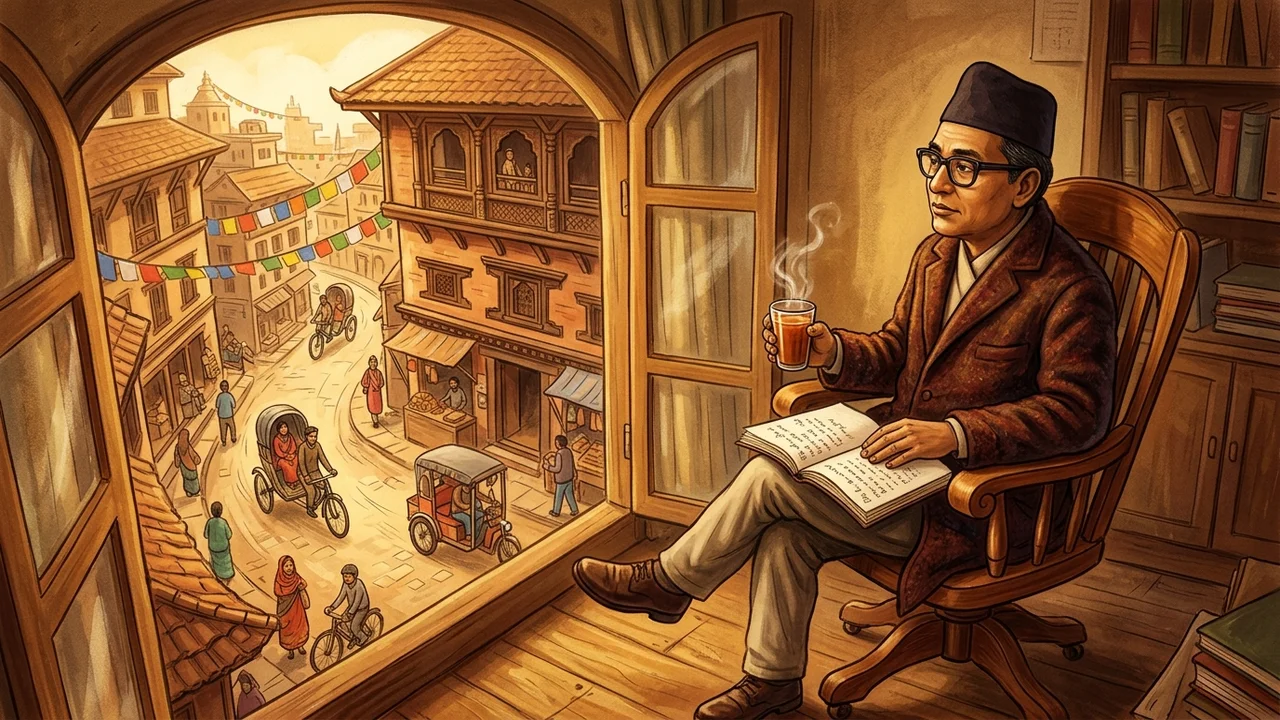
The title poem puts a blind man on a chair that turns. He sits. The chair rotates. He does not see who has come to stand in front of him. The picture is simple enough to remember after one hearing, which is the test he liked. People read the chair as an office. A minister's chair, a stage, a seat that comes with a title and a habit of receiving people. The blindness is not a medical case study. It is what happens to sight (दर्शन) when the job is to be seen, and to turn, and never to look carefully at the person the turn has just presented.
The Panchayat is the history under the poem. After 1960 the king ruled without parties, and public life filled with men who held chairs and performed attention. The poem does not need to name a cabinet. A chair that revolves is already a cabinet. The man is not a monster in the poem's first glance. He is a man in a seat, and the seat does the moral damage by keeping him blind while it makes him look busy. That is harsher than a poem that calls a villain a villain. A villain can be voted out or jailed. A chair that turns is a system. Anyone who sits down inherits the blindness.
The collection takes its name from this poem because the other poems are variations of the same inability to see. A country that cannot see itself. A square that cannot see a person. A soldier who cannot see that the war is over. A poet who can see all of that and still live in the city that runs the chair. The title is not a riddle. It is the thesis, and the thesis is visual, so it survives translation into the plain prose of a page like this. What does not survive, and should not be faked, is the exact sequence of his sentences. The picture is the public property of readers. The wording is his until the law says otherwise.
Hami (हामी)
Hami (हामी), We, is the poem in which he looks at Nepalis (नेपाली) as a group and refuses the compliment they like. The argument, as readers and a standard short account give it, is that we are brave, and foolish because we are brave. Courage without a mind is not a virtue he is willing to frame and hang. The poem lets "we" rise, run, and roar, and then takes the height away. The rising can be something done to us, the way weather lifts water, rather than something we decided. The roar can be thinner than thunder. Inside, the height is hollow. We are worn down while we admire the outline.
When a person of ordinary human size arrives among us, the poem's "we" is frightened by its own shortness. It attacks with small weapons, the little bites of envy and rumor, until it is tired, and then it gives in. The scene is a crowd that cannot bear one real stature, and that ends by washing the feet of what it tried to pull down. Readers hear the whole modern habit of public life in that arc. We celebrate a height. We discover it was borrowed. We punish the person who shows us the difference. We call the punishment patriotism or criticism or a joke, depending on the week.
This is the poem people mean when they say he loved the country without flattering it. A nationalist poem that only praises is a speech. Hami (हामी) praises nothing except the honesty of the accusation, and it includes the poet in the "we." He does not stand on a rock above the drops of water. He is in the weather. That inclusion is why the poem does not become a lecture from a clean man. It is also why it stings across decades. Every generation finds a new borrowed height and a new way to roar.
The clock tower and the old soldier
Ghantaghar (घण्टाघर) stands by Rani Pokhari, the pond and the clock tower that a Kathmandu person can walk to. The poem's man is an old soldier on a pension. His army jerseys have gone the way old clothes go. Some tore. Some were eaten by mice. Some were divided among sons and friends. What he has kept of that life is small, and he keeps it carefully. He sits. He fishes. He remembers victories that are no longer a job.
The poem is not a sneer at veterans, and it is not a recruitment poster. It is a picture of usefulness after the use is over. A man who was dressed by an institution is now a body with time, and the clock beside him measures that time without consulting him. Bhupi's nationalism has room for this man. The bravery Hami (हामी) calls foolish is, in this poem, a biography with a pension at the end. The reader is allowed to feel tenderness and to notice the waste in the same minute. That double feeling is his specialty. A simpler poet would choose. He describes the jerseys until the choice feels cheap.
In memory of the martyrs
Shahidharuko Samjhanama (शहीदहरूको सम्झनामा) is the ode to the four men the Ranas (राणा) hanged in 1941, 1997 in the Nepali (नेपाली) calendar. The four are Shukraraj Shastri, Dharma Bhakta Mathema, Dasharath Chand, and Ganga (गङ्गा) Lal Shrestha (श्रेष्ठ). They were killed for the politics of getting out from under the Rana (राणा) state. The poem remembers them laughing toward the death rather than giving up the self-respect the state wanted. It was first printed in the magazine Rachana (रचना) in 2019 of the Nepali (नेपाली) calendar, about 1962, and later taken into the 1969 book. Unlike most of that book, it is in jhyaure (झ्याउरे), the folk beat of his communist youth. The poem runs to eighteen lines, which is a song's length. The old meter comes back when the subject is the dead, as if free verse were for the living city's irony and a tune were for men who should be sung.
The argument is a duty. A morning does not arrive for free. Someone falls so that a darker rule can break, the way a darkness breaks when lights go out of a sky and a sun comes. A generation that forgets the work those four paid for will be shamed by the dead, and by the history that keeps their names. The poem does not offer the martyr as a decoration for a festival. It offers the martyr as a creditor. We breathe a freer air on a debt. Forgetting the debt is not a neutral quiet. It is a kind of theft from the people who cannot invoice us. He wrote other pieces in this neighborhood of feeling, among them Mainbattiko Shikha (मैनबत्तीको शिखा), The Candle's Flame, which readers set beside the martyrs and beside a young life. The candle poem stays with one flame. It does not narrate a hanging. It lets a small light stand for a life that has burned and for a life just becoming adult. This page will not pretend to a closer summary than that. The flame is the gist. The lines are the poem.
A square, a noisy country, a letter abroad
Mero Chok (मेरो चोक), My Square, walks a square in a narrow lane. The poem inventories what such a square holds. It holds sickness without a count, hunger without an end, and grief without a shore. The list is a city's honesty, and then the poem turns onto an absence. What a square full of people can still lack is a human being in the full sense, a person the inventory cannot find among the bodies. The power of the poem is the bookkeeping. He does not sigh about the human condition. He counts, the way a shopkeeper counts, and the missing item is the one that makes the stock a failure. Readers in Kathmandu hear their own intersection. Readers elsewhere hear any intersection where the crowd is real and the person is hard to locate.
Yo Hallaihalla ko Desh Ho (यो हल्लैहल्लाको देश हो) says the quiet part as a title. This is a country of noise. Rumor, shouting, a politics that treats volume as if it were an event. The poem is a satire on the public ear. If everything is a commotion, then a real alarm cannot be heard, and a fake alarm can govern the week. He had a good ear for that, because his own poems were loud in the only way that matters. They were memorable. He knew the difference between a line people repeat and a noise people drown in. The country in this poem has lost that difference.
Ho Chi Minh lai Chithi (हो-चि-मिन्हलाई चिठी) is a letter, in verse, to Ho Chi Minh. A poet in a small kingdom writes to a leader whose name meant, in those years, a war of independence fought in the open. The distance is the device. Nepal's unfinished freedom, its caution, its habit of lowering the voice, can be looked at more clearly when the addressee is far away and has already chosen a harder road. The poem is not a foreign-policy essay. It is a use of someone else's fame as a mirror. What the mirror shows is local. This page does not invent the comparisons stanza by stanza. The gesture is the gist. He would rather talk to a distant revolutionary than flatter a nearby chair.
Other poems in the same book keep the same workshop. Mero Desh (मेरो देश), My Country, holds affection and indictment in one hand. A poem that wears his own name, Bhupi Sherchan (भूपि शेरचन), puts the poet on the page and does not spare him. Mera Sathiharu (मेरा साथीहरू), My Friends, looks at the generation that shared the magazines, the arguments, and the disappointments. A reader does not need every title to have the gist. The book is one temperament applied to many rooms. The square, the tower, the chair, the letter, and the friends are ordinary nouns. That ordinariness is the modern thing. Devkota's (देवकोटा) road went through epics and a madman's cosmic claim. Bhupi's road goes through furniture and a lane. Both roads are Nepali (नेपाली) poetry. They do not cancel each other. A shelf that has both is telling the truth about the century.
After the prize
The Sajha prize and the book made him the poet of a generation. They did not make him a factory. In the years after, the flow of new poems thinned. He was appointed to the Royal Nepal Academy in 1979 and stayed through two terms, until the year he died. The appointment sits awkwardly beside the blind man in the chair, and the awkwardness should be stated without a cheap triumph. Institutions invite the satirist in, and the satirist sometimes goes. Going does not erase the 1969 book. It adds a human fact. He was not a statue of refusal. He was a man with children, a second marriage, a lung that failed, and a seat in a royal body during the same Panchayat his poems had taught people how to see.
Poems that never entered the 1969 book were later gathered by Shiva Regmi as Bhupi Sherchanka Kavita (भूपि शेरचनका कविता), published in 2008, long after his death. They are part of the record. They are not a second revolution. The revolution was the decision, sometime after Nirjhar (निर्झर), to stop asking the old meter for permission, and to speak as if the reader were in the room. Once that decision is in the language, other poets can use it without becoming him. That is the real influence. He left a permission, and he did not leave a school with a manifesto.
A Nepali (नेपाली) student often meets him before meeting the novelists. For years the schoolbook has carried a few of these poems, so the chair, the "we," and the four hanged men are public memory. On the day the country stands up for Shukraraj Shastri, Dharma Bhakta Mathema, Dasharath Chand, and Ganga (गङ्गा) Lal Shrestha (श्रेष्ठ), his jhyaure (झ्याउरे) is one of the pieces a program will say aloud. That is a strange success for a poet who distrusted noise. The poem becomes part of the ceremony, and the ceremony is the kind of public hour his other poems look at sideways. The reader who has the book can hear both. The ode is sincere. The chair poem is still in the same volume, watching the platform.
Michael Hutt's English book, The Life of Bhupi Sherchan (भूपि शेरचन): Poetry and Politics in Post-Rana Nepal, is the biography a reader of English can hold, with translations and with the life told from friends, wives, and children as well as from print. Those translations are another writer's English. They are not a reason for this page to lift lines. They are a reason to say the life has been seriously told elsewhere, and that the telling confirms the shape used here. The shape runs from Mustang and the trade, through Banaras and the party, through jail, and into the turn toward a short name and a free line. It includes one book that a country memorized, an academy chair, and a death in 1989, a year before the Panchayat itself fell. He did not see the parties come back. The poems had already described the chair those parties would inherit if they sat down without looking.
What to carry out of the room
Read the 1969 book, not a garland of his most forwarded lines. Start with the title poem until the chair is a picture you can see. Then Hami (हामी), so the bravery you were taught at school has to answer him. Then the martyrs, so you remember he could praise without lying, and the clock tower, so you remember he could pity without recruiting. Then the square and the noisy country, which are the Kathmandu method. The letter to Ho Chi Minh is the moment he looks out, in order to look back. The early play and Naya Jhyaure (नयाँ झ्याउरे) are the communist youth. Nirjhar (निर्झर) is the last time the old meter held him. After that, the sentence is the line.
If you read him next to Parijat (पारिजात), notice the division of labor in the same decades. She builds a novel in which a person cannot sleep. He builds a poem in which a public man cannot see. If you read him next to Laxmi Prasad Devkota (लक्ष्मीप्रसाद देवकोटा), notice the change of instrument. The epic and the essay wanted a large music. Bhupi wanted a spoken Nepali (नेपाली) that could draw blood without raising its voice into a chant. The blind man turns. The reader is the one who is supposed to see.
चर्चित किताबमा रहेको नाम भूपि शेरचन हो। आमाबुबाले राखेको नाम भूपेन्द्रमान शेरचन हो। उहाँ ई.सं. २५ डिसेम्बर १९३५ मा जन्मनुभयो, नेपाली पात्रोमा १० पुस १९९२, मुस्ताङको टुकुचेमा, र ई.सं. १४ मे १९८९ मा काठमाडौंमा बित्नुभयो, १ जेठ २०४६। उमेर त्रिपन्न वर्ष थियो। पारिवारिक भनाइ र नेपाली पात्रो त्यो जन्ममा मिल्छन्। कतिपय अङ्ग्रेजी सूचीले जन्म दुई वर्षपछि राखेका छन्। यो पृष्ठले अघिल्लो मिति लिन्छ, जसले पहिलो नाटक छापिँदा उहाँलाई सोह्र वर्षको बनाउँछ।
उहाँ ई.सं. १९८९ मा बित्नुभयो। नेपालमा लेखकका किताब मृत्युको वर्षपछि पचास वर्षसम्म संरक्षित रहन्छन्। कविता उतार्न पाइँदैन, र कविता त्यस्तो छोटो चिज हो, जसको सारांश लेख्ने मानिसलाई एउटा पङ्क्ति चोर्न मन लाग्छ, किनभने पङ्क्ति नै पूरै चोट हो। यो पृष्ठले पङ्क्ति लिँदैन। कविता के गर्दै छन् भन्ने कुरा आफ्नै वाक्यमा भन्छ। चोट चाहनेले उहाँको किताब खोल्नुपर्छ। बाँडफाँड ठीक हो। सार यहाँ छ। सुर उहाँको रहन्छ।
किताब एउटै हो। घुम्ने मेचमाथि अन्धो मान्छे ई.सं. १९६९ मा साझाबाट आयो, र पहिलो साझा पुरस्कार पायो। साधारण नेपालीमा लेखिएको स्वच्छन्द छन्द हो। चिया पसलको मानिसले सुन्न सक्ने, र संस्कृत पढेको मानिसले कोलाहल मात्र भनेर हटाउन नसक्ने खालको कविता यसले बनायो। त्यो किताबअघि उहाँले नाटक र अरू नाममा दुई पातला सङ्ग्रह लेख्नुभएको थियो। त्यसपछि कम लेख्नुभयो, नेपाल राजकीय प्रज्ञा-प्रतिष्ठानमा दुई कार्यकाल बस्नुभयो, र लामो फोक्सोको रोगले बित्नुभयो। शीर्षकको मेच अझै त्यो चित्र हो, जुन मानिसले उहाँको नाम लिँदा सम्झन्छन्।
टुकुचे, मरेकी आमा, र बनारस
उहाँ हितमान शेरचन र पद्म कुमारी शेरचनका पाँचौँ छोरा हुनुहुन्थ्यो। बुबा राणा वर्षका ती नेपाली व्यापारीमध्ये हुनुहुन्थ्यो, जो भारत र तिब्बततिर व्यापार गर्थे। घरमा पैसा थियो। अनुशासन, काम, र सादा जीवनको नियम पनि थियो। सन्तानले आज्ञा मान्नुपर्थ्यो, सुखसयलमा बस्न पाइँदैनथ्यो। उहाँ पाँच वर्षको हुँदा आमा बित्नुभयो। जन्मिँदा ज्योतिषीले ग्रह नराम्रो छ, र उहाँले आमाबुबालाई हानि गर्नुहुनेछ भनेका थिए। गल्लीका मानिसले आमा तोक्वा भनेर चिढाउँथे, जसको अर्थ आमाको मृत्युको कारण ठानिएको बालक हो। पाँच वर्षको बालकले चिढ्याइलाई फैसला ठान्न सक्छ। उहाँले ठान्नुभयो। शोक, अपराधबोध, र आफ्नै परिवारप्रतिको रिस रह्यो। पछिल्लो व्यङ्ग्यको मनोवैज्ञानिक साँचो खोज्ने पाठकले यहाँ एउटा साँचो भेट्न सक्छन्, र त्यसलाई हलुका ढङ्गले लिनुपर्छ। बाल्यकालको घाउले स्वभाव बुझाउँछ। कविता लेख्दैन।
उहाँ तीक्ष्ण बुद्धिको बालक हुनुहुन्थ्यो। आठ वर्षमा महाभारत र रामायण कण्ठस्थ सुनाउन सक्नुहुन्थ्यो, व्यापारी घरले सम्मान गर्ने खालको स्मरण, जुन भावी व्यङ्ग्यकारले पछि खर्च गर्ने थिए। आकर्षक, हँसिलो, र भीड सम्हाल्न सक्ने पनि हुनुहुन्थ्यो। आकर्षण र टोकाइ एउटै वरदान हुन्। भारतमा पढ्नुभयो, पहिले गोरखपुरको आनन्द नगरमा, अनि बनारस हिन्दू विश्वविद्यालयको स्कूल र कलेजमा। बनारसमा नेपाली विद्यार्थीका लागि महत्त्वका दुई राजनीतिक थलो कांग्रेस र कम्युनिस्ट थिए। उहाँ कम्युनिस्टतिर जानुभयो। दाजु कांग्रेसमा हुनुहुन्थ्यो। त्यो बहस किताबी थिएन। सँगै बसेको घर फुट्यो, र भूपि बाहिर सर्नुभयो।
उहाँले आफूलाई सर्वहारा लेख्न थाल्नुभयो, श्रम बेचेर बाँच्ने मानिसको शब्द। पहिलो छापिएको कृति नाटक परिवर्तन हो, ई.सं. १९५१, जन्मनाममा, सोह्र वर्षको उमेरमा। यसको ताप राणाविरोधी आन्दोलनबाट आउँछ। अनि ई.सं. १९५० को दशकको सुरुमा बनारसको जनयुग प्रकाशनले नयाँ झ्याउरे निकाल्यो, सर्वहारा नाममा। झ्याउरे लोकगीतको ताल हो। किताबले कम्युनिस्ट भाव त्यो तालमा राख्छ। ई.सं. १९६९ को स्वच्छन्द छन्द मात्र चिन्ने मानिस यो थाहा पाउँदा छक्क पर्छन् कि उहाँले गाउँले गाउन सक्ने छन्दबाट सुरु गर्नुभएको थियो। पुरानो धुनलाई घृणा गर्नुहुन्नथ्यो। दलको धाराले जनता बोक्न सक्छ भन्ने विश्वास रहुन्जेल त्यो धुन चलाउनुभयो।
राणाविरोधी प्रदर्शनमा लाग्नुभयो र थुनिनुभयो। बनारसमा बी.ए. सक्नुभयो। करिब ई.सं. १९५५ र १९५६ मा नेपाल कम्युनिस्ट पार्टीको जिल्ला सचिव हुनुहुन्थ्यो। ई.सं. १९५८ मा दोस्रो सङ्ग्रह निर्झर काठमाडौंको नरेन्द्र यन्त्रालयबाट आयो, भूपेन्द्रमान शेरचन नाममा। ती कविता अझै पुरानो छन्दमा छन्। निर्झरपछि उहाँले चर्चित किताबको नाम लिनुहुन्छ। भूपि छोटो नाम हो, साथीले बोलाउने। नामको परिवर्तन निष्ठाको परिवर्तन पनि हो, वर्ग जनाउने कलमनामबाट टाढा, र सिकाउने वर्गसहित हरेक वर्गलाई शङ्का गर्ने स्वरतिर।
उहाँले दुई पटक विवाह गर्नुभयो। पहिलो विवाह ओम कुमारी तुलाचनसँग भयो, र छ सन्तान भए, पाँच छोरी र एक छोरा। ई.सं. १९६९ मा, चर्चित किताबकै वर्ष, कान्ति राणासँग विवाह गर्नुभयो, र एक छोरी र एक छोरा भए। बुबाको बाटोले दिएको व्यापारी बन्नुभएन। काठमाडौंको साहित्यिक जीवनमा जानुभयो, जसको अर्थ ती दशकमा पत्रिका, पातलो आम्दानी, र सादा, रिसले भरिएको नेपालीमा लेख्ने मानिसको काँधमाथिबाट हेर्ने पंचायत थियो। ई.सं. १९७९ देखि १९८९ सम्म दुई कार्यकाल नेपाल राजकीय प्रज्ञा-प्रतिष्ठानको सदस्य हुनुहुन्थ्यो। ई.सं. १४ मे १९८९ मा लामो फोक्सोको रोगको जटिलताले बित्नुभयो।
नुनको बाटो, गन्तीको पङ्क्ति, प्रतिबन्धित दल
टुकुचे कालीगण्डकी उपत्यकाको बस्ती हो। पुस्तौँपुस्ता त्यो उपत्यकाका थकाली व्यापारीले तिब्बतबाट नुन झार्थे र अन्न उकाल्थे। राणा वर्षमा त्यो बाटोको भन्सारको धेरै काम पनि उनीहरूकै हातमा थियो। हितमान शेरचनको घरको बालक खबर ल्याउने बाटोमा हुर्किनुभएको थियो। घरले हिसाब राख्थ्यो। स्थानीय स्कूल पुगेन भने छोरा भारत जान्थे, र बनारस ती ठाउँमध्ये एक थियो। आठ वर्षमा सुनाउन सक्नुभएको महाभारत त्यस्तै घरको हो। व्यापारी परिवारले पुरानो कवितालाई यात्रामा हिँड्ने शिक्षा ठान्थ्यो। घरबाट लैजानुभएको रिस पनि त्यही घरको हो। पैसा थियो। मरेकी आमा थिइन्। मृत्यु कसको दोष हो भनेर गल्लीले पहिले नै ठहर गरिसकेको थियो।
नाटक परिवर्तन ई.सं. १९५१ मा आउँछ, राणा परिवारले राज्य गुमाएको वर्ष। राजा त्रिभुवन काठमाडौं फर्किनुभयो। प्रतिबन्धित दल खुला ठाउँमा बसे। सोह्र वर्षको उमेरमा परिवर्तनबारे लेखिएको नाटक त्यही मौसममा आयो। झ्याउरे किताबले भीडले चिनेकै धुनमा एउटा आशा राख्यो। केही वर्ष उहाँले आशाले मागेको काम गर्नुभयो। प्रदर्शनका लागि जेल जानुभएको थियो। बनारसमा बी.ए. सक्नुभयो। कम्युनिस्ट पार्टीको जिल्ला सचिव हुनुभयो। ई.सं. १९५८ मा निर्झर काठमाडौंमा आयो, अझै छन्दमा, अझै आमाबुबाले राखेको लामो नाममा।
छन्दको अर्थ गनिने पङ्क्ति हो। पङ्क्तिमा तोकिएको ताल हुन्छ, र गन्ती सकिने ठाउँमा पङ्क्ति सकिन्छ। नेपाली कानले त्यो गन्ती संस्कृतबाट र लेखनाथजस्ता कविबाट सिक्यो, जसले पुरानो खुट्टालाई नेपालीजस्तो सुनाउनुभयो। देवकोटाले ती गन्ती भर्न सक्नुहुन्थ्यो, र मुनामदन लेख्दा झ्याउरेमा झर्न पनि सक्नुहुन्थ्यो। भूपीका सुरुका किताबले गन्ती राख्छन्। निर्झरमा रोकिने पाठकले पुरानो काम गर्न सक्ने कवि भेटेको हुन्छ। भावलाई यसरी मिलाइन्छ कि पङ्क्ति समयमै सकियोस्। ई.सं. १९६९ को किताबले त्यो काम अस्वीकार गर्छ। उहाँले छापिएका किताबमै देखाइसक्नुभएको थियो कि उहाँ गन्ती राख्न सक्नुहुन्छ। अनि अनुमति माग्न छाड्नुभयो। परिवर्तन त्यो मानिसको निर्णय हो, जसले गन्ती राख्न सक्नुहुन्छ भनेर पहिले नै देखाउनुभएको थियो।
ई.सं. डिसेम्बर १९६० मा राजा महेन्द्रले बीपी कोइरालाको सरकार हटाउनुभयो। दल प्रतिबन्धित भए। पंचायत तहतहका परिषद् थिए, माथि राजा, मुनि कानूनी दल थिएन। भूपि दलका मानिस हुनुहुन्थ्यो। नयाँ व्यवस्थाले दललाई कानूनी ठाउँ दिँदैनथ्यो। त्यो व्यवस्थाको नौ वर्षमा साझाले मेचको अन्धो मानिस छाप्यो। कविता चित्रमै बस्छन्। आफ्नै अगाडि उभिएको मानिसलाई नदेख्ने मानिस लेख्नुहुन्छ। गर्जनलाई उचाइ ठान्ने "हामी" लेख्नुहुन्छ। युद्ध पेन्सन र माछा मार्ने बल्छीमा बदलिएको सिपाही लेख्नुहुन्छ। कविताले शब्द नबोले पनि ती चित्र पंचायतका हुन्। मेचले पहिले बसेको परिषद्भन्दा लामो बाँच्न सक्छ। कविता यसरी बनेका छन् कि पछिको पाठक अर्को दशकमा बस्दा पनि फर्निचर चिन्न सकोस्।
बनारसका किताबका कति पाठक उहाँ सर्वहारा नै रहियोस् भन्ने चाहन्थे। श्रम बेचेर बाँच्ने मानिस जनाउने कलमनामसँग एउटा वाचा आउँछ। कविता दलको पक्ष लिन्छन्, र शत्रुको नाम लिइन्छ। ई.सं. १९६९ को किताबले त्यो वाचा जानीजानी तोड्छ। "हामी" भित्र कवि हुनुहुन्छ। हल्लाभित्र मन्त्रालय छ, बैठक पनि छ। व्यङ्ग्य आफू आएको कोठालाई टोक्छ। दलको धाराले जनता बोक्न सक्छ भन्ने विश्वास रहुन्जेल उहाँले दलको पक्ष झ्याउरेमा लेख्नुभएको थियो। दल प्रतिबन्धित भएपछि, र सार्वजनिक जीवन मेचले भरिएपछि, उहाँले नहेर्ने बानीविरुद्ध लेख्नुभयो। सरकार बदलिँदा पनि त्यो बानी रहन्छ। किताब अझै साथीहरूप्रति कठोर हुनुको कारण यही हो।
ई.सं. १९६९ को किताबले पङ्क्तिलाई के गर्यो
घुम्ने मेचमाथि अन्धो मान्छेका कविता पत्रिकामा आइसकेका थिए, रूपरेखा र मधुपर्क लगायत। साझाले जम्मा पारेर एउटा कविताको नाम किताबलाई दियो। पुरस्कार त्यही वर्ष आयो, त्यो पुरस्कार पहिलो पटक दिइँदा। औपचारिक खबर पङ्क्तिको परिवर्तनको छेउमा सानो छ। वजन भएको नेपाली कविताको बाटो शास्त्रीय छन्दहुँदै जान्थ्यो, लेखनाथ र देवकोटाका महाकाव्यको बाटो, तालिम पाएको कानले हिँड्न सक्ने, र थाकेको कानले नसुनी पनि सम्मान गर्न सक्ने। भूपिले मानिसले साँच्चै भन्ने वाक्य लेख्नुभयो, सास टुट्ने ठाउँमा तोड्नुभयो, र व्यङ्ग्यलाई पहिले अनुप्रासले गर्ने काम गर्न दिनुभयो।
यहाँ स्वच्छन्द छन्द सजावट होइन। सम्बोधनको राजनीति हो। पङ्क्तिलाई संस्कृत खुट्टा नचाहिने भए पाठकलाई पण्डित चाहिँदैन। कविता अन्याय, गरिबी, मानिसलाई हेप्ने बानी, र सार्वजनिक जीवनको ढोंगको कुरा गर्छन्। त्यसैले अझै पढिन्छन्। पछिल्लो दशकको गुनासो ई.सं. १९६९ को गुनासोसँग उस्तै हुनुपर्दैन, र कविताले त्यो माग्दैनन्। घुम्ने मेचको अन्धो मानिस, भोकले भरिएको चोक, हल्लालाई समाचार ठान्ने देश। ती अवस्था पंचायत गएपछि पनि सेवानिवृत्त भएनन्। उहाँलाई अक्सर त्यो कवि भनिन्छ, जसले स्वच्छन्द छन्द नेपालीमा घर ल्याएर लोकप्रिय रूप बनाउनुभयो, कुनै गुटको प्रयोगका रूपमा होइन। लोकप्रियता कलाको हिस्सा हो। अरू व्यङ्ग्यकारले मात्र सुन्ने व्यङ्ग्यले उहाँले तोकेको कामलाई असफल बनाएको हुन्छ।
उहाँमा हिमाली खालको राष्ट्रियता छ, र पोस्टर खालको होइन। देशलाई माया गर्न सक्नुहुन्छ, र त्यसको बहादुरीलाई एक प्रकारको मूर्खता भन्न सक्नुहुन्छ। राणाले झुण्ड्याएका मानिसको स्तुति लेख्न सक्नुहुन्छ, र अर्को मूडमा पेन्सन र माछा मार्ने बल्छीसम्म खुम्चिएको गौरवको बूढो सिपाही देखाउन सक्नुहुन्छ। ठट्टाले माया काट्दैन। ठट्टा नै मायालाई झुट बोल्न नदिने तरिका हो। त्यो दोहोरो चाल नै सङ्ग्रहको सार हो। नरम भयो भने श्रद्धाञ्जलिको साँझ हुन्छ। तीतो मात्र भयो भने नारा हुन्छ। उहाँ बीचमा बस्नुहुन्छ, त्यसैले अरू केहीमा नमिल्ने कोठामा पनि कविता उद्धृत हुन्छन्, र प्रतिलिपि अधिकार मान्ने यो पृष्ठले उद्धरण जोड्नुको सट्टा उद्धरणको वर्णन गर्नुपर्छ।
घुम्ने मेचमाथि अन्धो मान्छे
शीर्षक कविताले अन्धो मानिसलाई घुम्ने मेचमा राख्छ। ऊ बस्छ। मेच घुम्छ। आफ्नो अगाडि उभिन आएको मानिसलाई ऊ देख्दैन। चित्र एक पटक सुन्दै सम्झन सजिलो छ, जुन उहाँलाई मन पर्ने कसी हो। पाठकले मेचलाई कार्यालयका रूपमा बुझ्छन्। त्यो मन्त्रीको मेच हो, मञ्च हो, पद र मानिसलाई स्वागत गर्ने बानीसँगै आउने सिट हो। अन्धोपन रोगको केस होइन। देखिनु काम हुँदा, घुम्नु काम हुँदा, र घुमाइले भर्खर अघि ल्याएको मानिसलाई कहिल्यै राम्ररी नहेर्दा दृष्टिलाई के हुन्छ भन्ने हो।
कवितामुनि इतिहास पंचायत हो। ई.सं. १९६० पछि राजाले दल बिना शासन गर्नुभयो, र सार्वजनिक जीवन मेच समातेर ध्यानको अभिनय गर्ने मानिसले भरियो। कविताले मन्त्रिमण्डलको नाम लिनुपर्दैन। घुम्ने मेच पहिले नै मन्त्रिमण्डल हो। पहिलो हेराइमा मानिस राक्षस होइन। सिटमा बसेको मानिस हो, र सिटले उसलाई व्यस्त देखाउँदै अन्धो राखेर नैतिक हानि गर्छ। खलनायकलाई खलनायक भन्ने कविताभन्दा यो कठोर छ। खलनायकलाई मतले हटाउन वा थुन्न सकिन्छ। घुम्ने मेच व्यवस्था हो। जो बस्छ, अन्धोपन पाउँछ।
सङ्ग्रहले यसै कविताको नाम लिन्छ, किनभने अरू कविता त्यही नदेख्ने असक्षमताका भेद हुन्: आफैँलाई नदेख्ने देश, मानिस नदेख्ने चोक, युद्ध सकिएको नदेख्ने सिपाही, र त्यो सबै देख्न सक्दा पनि मेच चलाउने सहरमै बस्ने कवि। शीर्षक पहेली होइन। थीसिस हो, र थीसिस दृश्य हो, त्यसैले यस्तो पृष्ठको सादा गद्यमा अनुवाद हुँदा बाँच्छ। नबाँच्ने, र नक्कल गर्न नहुने, उहाँका वाक्यको ठीक क्रम हो। चित्र पाठकको सार्वजनिक सम्पत्ति हो। शब्द कानूनले नभनेसम्म उहाँको हो।
हामी
हामी त्यो कविता हो, जसमा उहाँ नेपालीलाई समूहका रूपमा हेर्नुहुन्छ र उनीहरूलाई मन पर्ने प्रशंसा अस्वीकार गर्नुहुन्छ। पाठक र मानक छोटो भनाइले दिने तर्क यस्तो छ। हामी बहादुर छौं, र बहादुर भएकैले मूर्ख छौं। मन नभएको साहस उहाँले फ्रेममा झुण्ड्याउने गुण होइन। कविताले "हामी"लाई उठ्न, दगुर्न, र गर्जन दिन्छ, अनि उचाइ खोस्छ। उठाइ हामीले गरेको निर्णय नभएर मौसमले पानी उठाएझैँ हामीमाथि गरिएको काम हुन सक्छ। गर्जन बादलको गडगडाहटभन्दा पातलो हुन सक्छ। भित्र उचाइ खोक्रो छ। रूपको तारिफ गर्दा हामी खिइँदै छौं।
साधारण मानिसको उचाइ भएको व्यक्ति हामीबीच आउँदा कविताको "हामी" आफ्नै पुड्कोपनदेखि डराउँछ। ईर्ष्या र हल्लाका साना हतियारले आक्रमण गर्छ, थाकेसम्म, अनि हार मान्छ। दृश्य एउटा भीड हो, जसले एउटा साँचो कद धान्न सक्दैन, र तान्न खोजेको कुराको पाउ धुन पुग्छ। पाठकले सार्वजनिक जीवनको आधुनिक बानी त्यो क्रममा सुन्छन्। हामी उचाइको उत्सव मनाउँछौं। सापटीको रहेछ भनेर पत्ता लगाउँछौं। फरक देखाउने मानिसलाई सजाय दिन्छौं। हप्ताअनुसार सजायलाई देशभक्ति, आलोचना, वा ठट्टा भन्छौं।
उहाँले देशलाई चाप्लुसी नगरी माया गर्नुभयो भन्दा मानिसले यही कविता सम्झन्छन्। प्रशंसा मात्र गर्ने राष्ट्रिय कविता भाषण हो। "हामी" कविताले अभियोगको इमानदारीबाहेक केही प्रशंसा गर्दैन, र कविलाई पनि "हामी" भित्रै राख्छ। उहाँ पानीका थोपाभन्दा माथिको चट्टानमा उभिनुहुन्न। मौसमभित्र हुनुहुन्छ। त्यो समावेशले कविता सफा मानिसको भाषण हुन दिँदैन। दशक नाघेर घोच्ने कारण पनि यही हो। हरेक पुस्ताले नयाँ सापटीको उचाइ र गर्जने नयाँ तरिका भेट्छ।
घण्टाघर र बूढो सिपाही
घण्टाघर रानीपोखरीको छेउमा छ, पोखरी र घडीको धरहरा, जुन काठमाडौंको मानिसले हिँडेर पुग्न सक्छ। कविताको मानिस पेन्सनको बूढो सिपाही हो। उसका फौजी जर्सी पुराना लुगा जाने बाटो गएका छन्। कुनै फाटे। कुनै मुसाले खाए। कुनै छोरा र साथीमा बाँडिए। त्यो जीवनबाट राखेको चिज सानो छ, र ऊ जतनले राख्छ। बस्छ। माछा मार्छ। अब जागिर नरहेका विजय सम्झन्छ।
कविता पूर्वसैनिकको गिल्ला होइन, र भर्तीको पोस्टर होइन। उपयोग सकिएपछिको उपयोगिताको चित्र हो। संस्थाले लुगा लगाइदिएको मानिस अब समय भएको शरीर हो, र छेउको घडीले उसलाई नसोधी त्यो समय नाप्छ। भूपीको राष्ट्रियतामा यो मानिस अटाउँछ। "हामी" कविताले मूर्खता भनेको बहादुरी यो कवितामा अन्त्यमा पेन्सन भएको जीवनी हो। पाठकलाई ममता महसुस गर्न दिइन्छ, र त्यही मिनेटमा खेर गएको कुरा देख्न दिइन्छ। त्यो दोहोरो भाव उहाँको विशेष सीप हो। सरल कविले एउटा भाव छान्थे। उहाँले छनोट सस्तो नलागेसम्म जर्सी वर्णन गर्नुहुन्छ।
शहीदहरूको सम्झनामा
शहीदहरूको सम्झनामा ई.सं. १९४१ मा, नेपाली पात्रोमा १९९७ मा, राणाले झुण्ड्याएका चार मानिसको स्तुति हो। ती चार जना शुक्रराज शास्त्री, धर्मभक्त माथेमा, दशरथ चन्द, र गङ्गालाल श्रेष्ठ हुन्। उहाँहरू राणा राज्यमुनिबाट निस्कने राजनीतिका लागि मारिनुभयो। कविताले उहाँहरूलाई राज्यले चाहेको स्वाभिमान नदिई मृत्युतिर हाँस्दै गएको सम्झन्छ। पहिले रचना पत्रिकामा नेपाली पात्रोको २०१९ मा छापियो, करिब ई.सं. १९६२, र पछि ई.सं. १९६९ को किताबमा आयो। त्यो किताबका धेरै कविताभन्दा फरक, यो झ्याउरेमा छ, कम्युनिस्ट युवावस्थाको लोक ताल। कविता अठार पङ्क्तिको छ, गीतजत्तिकै लामो। मृतक विषय हुँदा पुरानो छन्द फर्किन्छ, मानौं स्वच्छन्द छन्द जीवित सहरको व्यङ्ग्यका लागि हो, र धुन गाउनुपर्ने मानिसका लागि।
तर्क कर्तव्यको हो। बिहान सित्तैमा आउँदैन। अँध्यारो नियम भाँचिन कोही झर्नुपर्छ, आकाशका बत्ती निभेपछि घाम आउँदा अँध्यारो भाँचिन्छ जस्तै। ती चारले तिरेको काम बिर्सने पुस्तालाई मृतकले र उहाँहरूको नाम राख्ने इतिहासले लाज दिन्छ। कविताले शहीदलाई चाडको सजावट बनाउँदैन। साहु बनाउँछ। हामी ऋणमाथि अलि स्वतन्त्र सास फेर्छौं। ऋण बिर्सनु तटस्थ मौन होइन। बिल पठाउन नसक्ने मानिसबाट चोरीको एक प्रकार हो। यही भावको छेउमा उहाँले लेखेका अरू रचना पनि छन्, तीमध्ये मैनबत्तीको शिखा, जसलाई पाठकले शहीद र एउटा जवान जीवनको छेउमा राख्छन्। मैनबत्तीको कविता एउटा ज्वालामा बस्छ। झुण्ड्याइको कथा भन्दैन। सानो बत्तीलाई जलेको जीवन र भर्खर वयस्क हुँदै गरेको जीवनको ठाउँमा उभिन दिन्छ। यो पृष्ठ त्योभन्दा नजिकको सार दिन खोज्दैन। ज्वाला सार हो। पङ्क्ति कविता हुन्।
चोक, हल्लाको देश, परदेशको चिठी
मेरो चोक कविताले साँघुरो गल्लीको चोकमा हिँड्छ। कविताले त्यस्तो चोकमा के हुन्छ भनेर सूची बनाउँछ। त्यहाँ गन्न नसकिने रोग, अन्त्य नभएको भोक, र किनार नभएको शोक छ। सूची सहरको इमान हो, अनि कविता अनुपस्थितिमा मोडिन्छ। मानिसले भरिएको चोकमा अझै नहुन सक्ने चिज पूरा अर्थको मानिस हो, जसलाई सूचीले शरीरहरूबीच भेट्न सक्दैन। कविताको शक्ति हिसाबकिताब हो। उहाँ मानव अवस्थाबारे सुस्केरा हाल्नुहुन्न। पसलेले गनेझैँ गन्नुहुन्छ, र हराएको सामानले नै स्टक असफल बनाउँछ। काठमाडौंका पाठकले आफ्नै चौबाटो सुन्छन्। अन्तका पाठकले भीड साँचो भएको र मानिस भेट्न गाह्रो भएको जुनसुकै चौबाटो सुन्छन्।
"यो हल्लैहल्लाको देश हो" कविताले चुपचाप राखिने कुरा शीर्षकमै खुलेर भन्छ। यो हल्लाको देश हो। यहाँ अफवाह छ, चिच्याहट छ, र आवाजलाई नै घटनाझैँ लिने राजनीति छ। कविता सार्वजनिक कानको व्यङ्ग्य हो। सबै हुलदङ्गा भए साँचो सङ्केत सुनिँदैन, र झुटो सङ्केतले हप्ता चलाउन सक्छ। उहाँको कान त्यसमा राम्रो थियो, किनभने उहाँका आफ्नै कविता मतलबको अर्थमा चर्का थिए, अर्थात् सम्झन लायक थिए। दोहोर्याइने पङ्क्ति र मानिस डुब्ने हल्लाको फरक उहाँ जान्नुहुन्थ्यो। यो कविताको देशले त्यो फरक गुमाएको छ।
"हो-चि-मिन्हलाई चिठी" हो चि मिन्हलाई लेखिएको पद्यको चिठी हो। सानो राज्यको कविले ती वर्षमा खुला रूपमा लडिएको स्वतन्त्रताको युद्धको नाम बनेका नेतालाई लेख्नुहुन्छ। दूरी नै साधन हो। नेपालको अधुरो स्वतन्त्रता, सावधानी, स्वर होचो पार्ने बानी, चिठी पाउने व्यक्ति टाढा र पहिले नै कठिन बाटो रोजिसकेका हुँदा अझ स्पष्ट देखिन्छ। कविता परराष्ट्र निबन्ध होइन। अरूको ख्यातिलाई ऐना बनाउने काम हो। ऐनाले देखाउने कुरा स्थानीय हो। यो पृष्ठले श्लोकैपिच्छेको तुलना रच्दैन। इसारा सार हो। उहाँ नजिकको मेचलाई चाप्लुसी गर्नुभन्दा टाढाको क्रान्तिकारीसँग बोल्नुहुन्थ्यो।
त्यही किताबका अरू कविताले पनि त्यही कार्यशाला चलाउँछन्। मेरो देश कविताले माया र अभियोग एउटै हातमा राख्छ। उहाँकै नाम भएको भूपि शेरचन कविताले कविलाई पृष्ठमै उभ्याउँछ, र उहाँलाई बख्सँदैन। मेरा साथीहरू कविताले पत्रिका, झगडा, र निराशा बाँडेको पुस्तालाई हेर्छ। सारका लागि हरेक शीर्षक चाहिँदैन। किताब धेरै कोठामा लगाइएको एउटै स्वभाव हो। चोक, धरहरा, मेच, चिठी, साथी साधारण नाम हुन्। आधुनिक कुरा यही हो। देवकोटाको बाटो महाकाव्य र पागलको ब्रह्माण्डीय दाबीबाट गयो। भूपीको बाटो फर्निचर र गल्लीबाट जान्छ। दुवै बाटो नेपाली कविता हुन्। एकअर्कालाई काट्दैनन्। दुवै भएको तहले शताब्दीको सत्य भन्छ।
पुरस्कारपछि
साझा पुरस्कार र किताबले उहाँलाई एउटा पुस्ताको कवि बनायो। कारखाना बनाएन। त्यसपछिका वर्षमा नयाँ कविताको बहाव पातलियो। ई.सं. १९७९ मा नेपाल राजकीय प्रज्ञा-प्रतिष्ठानमा नियुक्त हुनुभयो र बित्नुभएको वर्षसम्म दुई कार्यकाल बस्नुभयो। नियुक्ति मेचको अन्धो मानिसको छेउमा अप्ठ्यारो बस्छ, र अप्ठ्यारो सस्तो विजय बिना भन्नुपर्छ। संस्थाले व्यङ्ग्यकारलाई भित्र बोलाउँछ, र व्यङ्ग्यकार कहिलेकाहीँ जान्छ। गएकोले ई.सं. १९६९ को किताब मेटिँदैन। मानवीय तथ्य थपिन्छ। उहाँ अस्वीकारको मूर्ति हुनुहुन्नथ्यो। सन्तान भएको, दोस्रो विवाह भएको, फोक्सो बिग्रेको, र कविताले हेर्न सिकाएको त्यही पंचायतमा राजकीय निकायको सिट भएको मानिस हुनुहुन्थ्यो।
ई.सं. १९६९ को किताबमा नपरेका कविता शिव रेग्मीले भूपि शेरचनका कविता नाममा जम्मा पार्नुभयो, ई.सं. २००८ मा, उहाँ बितेको धेरै पछि। ती अभिलेखका हिस्सा हुन्। दोस्रो क्रान्ति होइनन्। क्रान्ति निर्झरपछि पुरानो छन्दसँग अनुमति माग्न छोडेर पाठक कोठामा भएझैँ बोल्ने निर्णय थियो। त्यो निर्णय भाषामा परेपछि अरू कवि उहाँ नबनी चलाउन सक्छन्। असली प्रभाव यही हो। उहाँले छाडेको घोषणापत्र भएको स्कूल होइन, अनुमति हो।
नेपाली विद्यार्थीले अक्सर उपन्यासकारभन्दा अघि उहाँलाई भेट्छ। वर्षौं स्कूलको किताबले यी कवितामध्ये केही बोकेको छ, त्यसैले मेच, "हामी", र झुण्ड्याइएका चार मानिस सार्वजनिक स्मृति हुन्। शुक्रराज शास्त्री, धर्मभक्त माथेमा, दशरथ चन्द, र गङ्गालाल श्रेष्ठका सम्झनामा देश उभिने दिनमा कार्यक्रमले सुनाउने रचनामध्ये उहाँको झ्याउरे एक हुन्छ। हल्लामाथि शङ्का गर्ने कविका लागि यो अनौठो सफलता हो। कविता समारोहको हिस्सा बन्छ, र समारोह त्यस्तो सार्वजनिक घडी हो, जसलाई उहाँका अरू कविताले छेउबाट हेर्छन्। किताब भएको पाठकले दुवै सुन्न सक्छ। स्तुति सच्ची छ। मेचको कविता त्यही किताबमा छ, मञ्च हेरिरहेको।
माइकल हटको अङ्ग्रेजी किताब द लाइफ अफ भूपि शेरचन, पोस्ट-राना नेपालमा कविता र राजनीति, अङ्ग्रेजी पाठकले समात्न सक्ने जीवनी हो, अनुवादसहित, र छापाका साथै साथी, पत्नी, र सन्तानबाट भनिएको जीवनसहित। ती अनुवाद अर्का लेखकको अङ्ग्रेजी हुन्। यो पृष्ठले पङ्क्ति उठाउने कारण होइनन्। जीवन अन्यत्र गम्भीर रूपमा भनिएको छ, र त्यो भनाइले यहाँ प्रयोग गरिएको आकार पुष्टि गर्छ भन्ने कारण हुन्। त्यो आकार मुस्ताङ र व्यापारबाट सुरु हुन्छ, बनारस र दल, जेल हुँदै छोटो नाम र स्वच्छन्द पङ्क्तितिरको मोडसम्म पुग्छ। त्यसमा देशले कण्ठ गरेको एउटा किताब, प्रज्ञाको मेच, र पंचायत ढल्नुभन्दा एक वर्षअघि ई.सं. १९८९ को मृत्यु पर्छन्। दल फर्केको उहाँले देख्नुभएन। नहेरी बसे भने ती दलले पाउने मेच कविताले पहिले नै वर्णन गरिसकेका थिए।
कोठाबाट के लैजाने
ई.सं. १९६९ को किताब पढ्नुहोस्, उहाँका सबैभन्दा धेरै पठाइएका पङ्क्तिको माला होइन। शीर्षक कविताबाट सुरु गर्नुहोस्, मेच तपाईंले देख्न सक्ने चित्र नबनेसम्म। अनि "हामी" पढ्नुहोस्, ताकि स्कूलमा सिकाइएको बहादुरीले उहाँलाई जवाफ दिनुपरोस्। अनि शहीदको कविता पढ्नुहोस्, ताकि उहाँ झुट बिना प्रशंसा गर्न सक्नुहुन्थ्यो भन्ने सम्झना रहोस्, र घण्टाघर पढ्नुहोस्, ताकि भर्ती बिना दया गर्न सक्नुहुन्थ्यो भन्ने सम्झना रहोस्। अनि चोक र हल्लाको देश पढ्नुहोस्, जुन काठमाडौंको विधि हो। हो चि मिन्हलाई चिठी बाहिर हेर्ने क्षण हो, फर्केर हेर्नका लागि। सुरुको नाटक र नयाँ झ्याउरे कम्युनिस्ट युवावस्था हुन्। निर्झर पुरानो छन्दले उहाँलाई समातेको अन्तिम पटक हो। त्यसपछि वाक्य नै पङ्क्ति हो।
पारिजातको छेउमा पढ्दा ती नै दशकको कामको बाँडफाँड देख्नुहोस्। पारिजातले निदाउन नसक्ने मानिसको उपन्यास बनाउनुहुन्छ। भूपिले देख्न नसक्ने सार्वजनिक मानिसको कविता बनाउनुहुन्छ। देवकोटाको छेउमा पढ्दा साधनको परिवर्तन देख्नुहोस्। महाकाव्य र निबन्धले ठूलो सुर चाहन्थे। भूपीले रगत निकाल्न सक्ने, मन्त्रमा स्वर नचढाई, बोलिने नेपाली चाहनुहुन्थ्यो। अन्धो मानिस घुम्छ। देख्नुपर्ने पाठक हो।
Where it sits
The page before this one is Parijat (पारिजात). Laxmi Prasad Devkota (लक्ष्मीप्रसाद देवकोटा) is the epic and essay road of the same century. BP Koirala (विश्वेश्वरप्रसाद कोइराला) is the mind inside the house, written in the jail the Panchayat built. Bhupi is the voice on the street outside that house. Bhanubhakta, the counted line, and Yogmaya (योगमाया) are already behind him. The next page is King Mahendra (महेन्द्र).